Multi-Unit Franchise Growth: A Franchisor Playbook
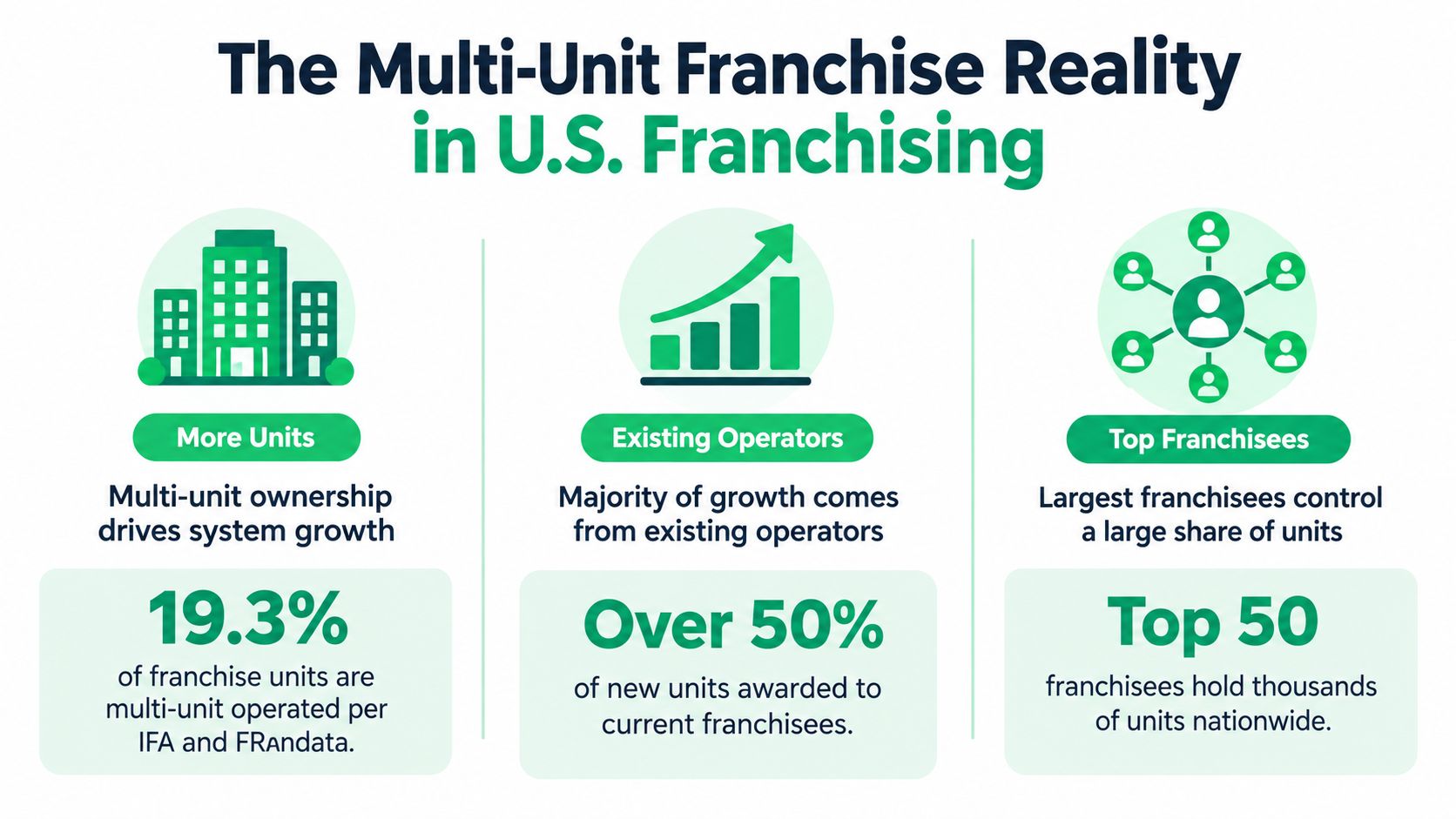
19.3% of U.S. franchisees control 58.8% of all franchised locations, making multi-unit operators the primary engine of network expansion rather than an optional growth segment. For franchisors with 50 or more locations, the central development question is no longer how to sell another unit, but how to identify operators who can add locations without weakening unit economics or increasing system concentration risk.
Table of Contents
- The Multi-Unit Franchise Reality in U.S. Franchising
- Area Development Versus Multi-Unit Ownership Models
- Performance Benchmarks for Multi-Unit Scaling
- Navigating FDD Items for Multi-Unit Compliance
- Concentration Risk and Strategic Expansion
- Cross-Concept Capability and Franchisee Selection
The Multi-Unit Franchise Reality in U.S. Franchising
The disparity between operator count and location count changes how franchise development teams should allocate attention. The International Franchise Association and FRANdata benchmark reports that, as of 2025, approximately 19.3% of franchisees operated multiple units, while those operators controlled 58.8% of all franchised locations in the United States. Fewer than one in five franchisees therefore accounted for nearly three in five locations.
That concentration makes multi-unit franchise recruitment a measurable growth constraint. A brand can generate interest from many first-time prospects, but its territory plan depends disproportionately on a smaller group with the capital, management structure, and development discipline to open several locations. The broader market reinforces the point. The IFA's 2025 outlook estimated 830,876 franchise establishments, nearly 8.8 million direct jobs, and $896.9 billion in U.S. economic output for 2024, with franchise activity representing almost 3% of gross domestic product. The same outlook projected more than 20,000 additional establishments in 2025, reaching approximately 851,000 locations, with projected output of $936.4 billion. Those projections are explicitly identified as projections in the IFA franchisor survey.
Scale differs by vertical
Multi-unit ownership isn't evenly distributed across franchise categories. FRANdata found that multi-unit franchisees controlled approximately 82% of quick-service restaurant units, 72% of sit-down restaurant units, 71.5% of beauty-related units, 53.8% of automotive units, and 51.6% of real-estate franchise units in its analysis of more than 43,000 multi-unit operators and more than 223,213 franchised units. The FRANdata ownership analysis also reported an average of about five locations per multi-unit franchisee, up from approximately 4.8 in 2011.
The implication for QSR, home services, real estate brokerages, fitness and wellness, automotive services, health and beauty, retail, education, and senior care brands is practical. A development team should segment its pipeline by demonstrated development capacity, not only by net worth or stated interest. A candidate with one successful location and no management bench may be less valuable for territory expansion than an operator with a smaller portfolio but repeatable hiring, training, and opening systems.
The growth mechanism is concentrated
Multi-unit ownership can also cross brand boundaries. About 9% of more than 43,000 multi-unit franchisees, roughly 3,900 operators, ran units across multiple franchise brands, according to FRANdata. This creates a pool of experienced counterparties, but it also raises a diligence question: does the operator possess transferable operating capability, or only access to capital?
Development rule: Treat multi-unit ownership as evidence of potential capacity, not proof of capacity for a new concept.
Area Development Versus Multi-Unit Ownership Models
Area development and independent multi-unit ownership can look similar from the outside. Both can produce several locations under one operator. The legal structure, enforcement tools, and planning risk are different.
An Area Development Agreement, or ADA, commits the franchisee to a defined number of openings within a specific territory and time period. In practice, that means the franchisor is not just awarding growth potential. It is contracting for a schedule. The agreement usually sets opening deadlines, default triggers, and the conditions under which undeveloped rights can be reduced or lost. Each store may still sit under its own unit franchise agreement, but the development obligation is centralized.
Independent multi-unit ownership works differently. The operator adds units one decision at a time through new awards, resales, conversions, or expansion into another brand. That structure gives the franchisee more room to slow down, accelerate, or redirect capital when financing tightens, labor is thin, or site selection shifts. It also gives the franchisor less visibility into the exact pace of market buildout.
The multi unit franchise definition is useful here because it separates an ownership outcome from a contractual mechanism. A multi-unit operator may own several stores with no ADA in place. An area developer, by contrast, has accepted a binding growth obligation whether or not every future unit is already identified.
| Model | Commitment | Flexibility | Best For |
|---|---|---|---|
| Area Development Agreement | Contractual unit count, geography, and opening schedule | Lower, because rights and deadlines are pre-defined | Brands seeking predictable territory development |
| Independent multi-unit ownership | Additional units acquired through separate decisions | Higher, because timing and portfolio choices remain open | Experienced operators testing capacity or category fit |
What the Flynn Group example actually shows
The 2026 Multi-Brand 50 ranking identified Flynn Group as the largest U.S. multi-unit, multi-brand franchise operator, with 2,828 total units across Pizza Hut, Applebee's, Taco Bell, Panera Bread, Planet Fitness, and Residence Inn, as noted earlier in the article's trend discussion. The practical point is not size alone. It is structure. Large operators often grow beyond a single brand or a single development agreement and start allocating capital across a portfolio of concepts, territories, and operating teams.
For franchisors, the contract choice should follow the growth problem being solved. Use an ADA when the brand needs a committed timetable for a mapped territory and has the field support, real estate process, and enforcement discipline to hold the developer to it. Use independent expansion when the brand wants to award additional units only after performance is proven at the store and district level.
That distinction becomes clearer when candidate screening is standardized against the Franchise Fast Track ownership model breakdown. The useful question is not whether an operator wants multiple units. It is whether the brand needs contractual certainty or staged discretion.
Performance Benchmarks for Multi-Unit Scaling
Unit count is a lagging indicator. A franchisor evaluating a multi-unit franchise candidate needs to know whether the operator's infrastructure is expanding alongside the portfolio, or whether each new location is drawing attention and capital away from the existing base.
Geography offers one of the clearest operating signals. A Cornell study of every new restaurant opened in Texas from 1980 through 1995 by seven major fast-food chains found that an existing franchisee was significantly more likely to receive a new unit when the unit was geographically close to the franchisee's current locations. In Texas in 1995, 49% of franchisees in the sample were multi-unit operators, according to the Cornell study.
The reason is operational density. Nearby units can share district management, recruiting, training, procurement, maintenance, and oversight. The operator also spends less time moving managers and information between sites. A territory map should therefore show current units, proposed sites, management coverage, labor-market overlap, and travel radius before a development award is approved.
The right scorecard goes beyond openings
A useful review combines portfolio metrics with unit-level measures:
| Evaluation area | What the franchisor should test | Why it matters |
|---|---|---|
| Geographic density | Distance between current and proposed units, management coverage, and market overlap | Shows whether shared infrastructure is realistic |
| Opening cadence | Whether previous openings followed the operator's stated schedule | Separates development intent from execution |
| Unit economics | Sales and profit performance at the unit level, where properly disclosed | Prevents portfolio growth from hiding weak locations |
| Management depth | Installed district leadership and replacement coverage | Tests whether the owner can manage managers |
| Capital resilience | Cash reserves, debt service, ramp-up losses, and slower-opening scenarios | Measures capacity under stress |
| Brand compliance | Operating consistency across locations | Identifies system-wide exposure from one weak site |
A peer-reviewed study using franchisor and franchisee data found positive short-term franchisor consequences from multi-unit franchising, but also reported a significant decline in sales and profits per unit once an operator owned more than three units, as described in the Journal of Business Research study. The finding doesn't establish a universal limit. It establishes a non-linear curve that requires concept-specific testing.
Practical rule: A development award should be tied to installed management capacity and unit-level performance, not capital availability alone.
For QSR and automotive services, that may mean validating labor systems and procurement discipline. For home services, senior care, and real estate brokerages, it may mean testing recruiting, local market coverage, and manager development. The same system value growth objective can require very different operating evidence by vertical.
Navigating FDD Items for Multi-Unit Compliance
The FDD gives a development executive a disciplined framework for separating documented economics from sales enthusiasm. Multi-unit commitments affect several sections, but Items 7, 19, 20, and 21 answer different questions and shouldn't be treated as interchangeable.
Item 7 establishes the investment boundary
Item 7 reports the estimated initial investment, including expenditure categories and ranges required to open and operate the franchise during the stated start-up period. For a multi-unit or area-development relationship, executives should examine whether the disclosed presentation clearly distinguishes the first unit from subsequent units, development fees, site costs, working capital, and the timing of required spending.
The FTC Franchise Rule requires franchisors to provide an FDD containing 23 specified categories of information. The FTC Franchise Rule also establishes the role of Item 19. A franchisor isn't required to provide sales or earnings data, but any financial performance representation it elects to make must appear in Item 19 and have a reasonable factual basis.
Item 19 controls performance representations
Sales teams, brokers, and other representatives can't make financial performance claims outside the controlled disclosure framework. That boundary matters when a multi-unit candidate asks whether a portfolio will produce a particular return, when an area-development schedule is presented as a rapid wealth-building plan, or when a successful operator's results are used to imply expected performance for another category.
A sound process routes approved representations through Item 19 and documents what the development team can say. Executives can then compare the candidate's assumptions with the FDD rather than allowing informal projections to become an undisclosed promise.
Items 20 and 21 test the network and the franchisor
Item 20 reports outlet counts, ownership changes, transfers, and franchisee turnover. It can help analysts identify operators with multiple units, map their locations, and distinguish new development from transfers, acquisitions, conversions, or replacement of failed locations.
Item 21 provides the franchisor's three most recent audited annual financial statements. It doesn't establish individual franchisee profitability, but it provides context about the franchisor's financial condition and its ability to support a growing network.
The data-driven FDD analysis approach is most useful when these sections are read together. Item 7 frames investment, Item 19 controls financial performance claims, Item 20 shows network activity, and Item 21 tests the franchisor's financial condition.
Concentration Risk and Strategic Expansion
Multi-unit penetration can signal efficient growth, but it can also reveal dependence on too few counterparties. The same data that supports a development strategy should therefore be used to measure concentration risk by operator, brand, geography, debt exposure, and development obligation.
The FRANdata economic outlook identifies the practical tension: 19.3% of franchisees control 58.8% of franchised locations, while 57% of franchised units are operated by multi-unit owners. A brand that awards territories rapidly to a small group may improve opening velocity, yet become exposed to an operator's refinancing needs, succession plan, labor problems, or decision to slow development.
Four forms of concentration deserve separate tests
Territory concentration arises when one operator controls a large share of a market or development pipeline. A missed schedule can leave valuable territory underused while preventing the franchisor from placing another operator there.
Credit concentration develops when several openings depend on one balance sheet, lender relationship, or refinancing event. Financing resources such as the get funding for franchise expansion guide can inform planning, but each candidate still requires brand-specific financial diligence.
Succession concentration appears when operating knowledge rests with one owner or a small leadership group. The risk affects QSR, home services, fitness and wellness, senior care, and other categories where manager continuity directly affects service delivery.
Cross-brand concentration can spread stress between concepts. About 9% of more than 43,000 multi-unit franchisees, roughly 3,900 operators, operated across multiple brands, according to the FRANdata ownership analysis cited earlier. A downturn, leadership gap, or financing problem in one portfolio can therefore influence decisions across several franchisors.
Balance speed with resilience
A strong territory plan can award priority to proven operators without making the system dependent on them. Development teams should segment candidates by unit count, geography, brands, debt capacity, succession depth, and actual opening performance. The approval process should also test cannibalization and local demand before granting adjacent rights.
Franchisors can use market sizing for franchise territories to connect operator capacity with territory availability. The objective isn't to minimize multi-unit ownership. It is to prevent a high unit count from concealing a fragile ownership structure.
Cross-Concept Capability and Franchisee Selection
83% of QSR locations in one large multi-unit sample were operated by multi-unit owners, according to 2026 Multi-Brand 50 coverage. That scale makes experienced operators attractive candidates for new deals. It does not mean performance transfers cleanly across concepts.
The central screening question is operational portability. A candidate may have capital, lender relationships, and a record of opening units on schedule, yet still lack the systems needed for a concept with different compliance, staffing, service, or customer-acquisition demands. As the Flynn Group example in section 2 demonstrates, scale in one portfolio can prove execution capacity without proving category fit in another.
That distinction matters most when two concepts look similar at the portfolio level but work differently at the unit level. An automotive-services operator entering QSR may understand local marketing and multi-site supervision, while still facing a new food-safety regime, procurement cadence, and daypart model. A fitness operator considering senior care may know membership sales and retention, but senior care requires different hiring controls, documentation habits, and service-delivery oversight. A brokerage group entering home services may bring local market knowledge while lacking dispatch discipline, technician development, and recurring-service controls.
Development teams should therefore test transfer at the process level, not the resume level. The most useful review points are concrete:
- Labor management: whether staffing runs through repeatable recruiting, training, scheduling, and retention processes rather than owner intervention
- Real-estate judgment: whether the team can assess trade areas, occupancy costs, access, visibility, and competitive density for the new concept
- Manager development: whether district or regional leaders already carry meaningful operating responsibility
- Technology use: whether the operator can implement required reporting, scheduling, CRM, and compliance systems without disruption
- Supply-chain fit: whether the team has handled the vendor structure, inventory rhythm, service standards, and purchasing constraints the concept requires
- Opening discipline: whether prior launches show controlled ramp-up, stable staffing, and a clear path to steady-state operations
Selection gets sharper when franchisors look at how a candidate allocates attention and capital across the existing portfolio. Cross-brand ownership can create internal competition for leadership time, site approvals, and post-opening support. The issue is rarely simple overexpansion. It is sequencing. An operator opening in one brand while refinancing another or replacing managers in a third may bring less practical bandwidth than unit totals suggest.
Assessment should reflect that operating reality. Tools such as pre-employment assessment tools for franchises can help evaluate leadership fit and role requirements, but they are only one input. Franchisors still need FDD review, operating references, financial analysis, and validation tied to the target category. The Franchise Fast Track multi-unit leadership discussion is useful here because it separates founder presence from repeatable management infrastructure.
The practical conclusion is narrow and important. Multi-unit experience improves the odds that a candidate understands reporting lines, capital planning, and portfolio oversight. Franchisee selection still turns on evidence that those capabilities will hold in a different concept, under different operating conditions.
Ready to see results like these for your franchise?
Stop wasting money on leads that never close. Start getting hundreds of replies from high-net-worth professionals daily.