Make $75–$200 CPL Work: LinkedIn Ads That Close Franchise Leads
LinkedIn works for franchise recruitment, but it is not cheap, and it punishes vague targeting. If you run one campaign, make it a Lead Gen Form promoting a webinar or a private territory briefing aimed at directors and above. Expect cost-per-lead within a moderate range depending on targeting precision, and route every response into your CRM within hours, not days.
TL;DR:
- Target senior executives and operators with specific, high-intent offers such as webinars or private briefings, not generic ads.
- Use a combination of LinkedIn campaigns, search, and Meta ads to cover different audience segments and discovery paths effectively.
- Keep audience filters between 50,000 and 300,000 to ensure enough delivery volume without diluting lead quality.
- Expect a median cost per lead around $110, with higher costs when targeting seniority and industry-specific filters.
- Speed in response and qualification is critical; route leads into your CRM within hours and focus on qualified prospects to maximize ROI.
Table of Contents
- What LinkedIn Ads Franchise Leads Campaigns Should Actually Run
- Which LinkedIn Targeting Actually Reaches Capital-Ready Buyers
- What Offers and Forms Convert Executives Into Calls
- LinkedIn CPL Benchmarks: What You Should Expect to Pay
- Handling Leads in the First 72 Hours
- KPIs That Actually Matter for a Long Sales Cycle
- Running a Pilot Before You Commit Real Budget
- What Franchise Fast Track Has Learned Running This Playbook
- Let Franchise Fast Track Run This System for You
- Sources
What LinkedIn Ads Franchise Leads Campaigns Should Actually Run
A single ad format will not carry a franchise recruitment funnel. Sponsored Content builds credibility over weeks with case studies and unit-economics proof points. Lead Gen Forms capture the prospects who are ready to raise a hand right now. Message Ads and Conversation Ads work best once someone has already engaged, when a personal note from a development director lands differently than another form fill.
Sequence matters as much as format. A short video or a Thought Leader-style post should run ahead of any conversion push, especially for a franchise investment that a prospect will spend weeks or months evaluating. Jumping straight to a "book a call" ad in front of a cold audience wastes budget on people who have never heard of your brand.
LinkedIn also should not carry the whole load. It is the right channel for reaching executives, operators, and multi-unit candidates, but Search picks up people actively typing "franchise opportunities near me," and Meta reaches a broader, more casual discovery audience. Treat LinkedIn as the professional-targeting layer of a bigger system, not the whole system.
A working mix looks like this:
- Sponsored Content: builds trust with case studies and franchisee success stories over 2 to 4 weeks before any hard ask.
- Lead Gen Forms: capture warm interest fast, pre-filled with LinkedIn profile data to cut friction.
- Message/Conversation Ads: reserved for retargeting engaged prospects with a personal, founder-level tone.
- Search and Meta: fill the gaps LinkedIn does not cover, from active searchers to broader brand discovery.
Which LinkedIn Targeting Actually Reaches Capital-Ready Buyers
The targeting stack that works combines four layers: seniority, job function, industry, and company size. Seniority filters set to director, VP, and C-level exclude the tire-kickers who lack authority or capital to make a six-figure investment decision. Job function filters for operations, sales leadership, and general management catch people who already run something, which correlates strongly with franchise readiness.

Company size and revenue filters act as a financial proxy since LinkedIn does not let you target by personal net worth. A director at a $50 million company reads very differently than a director at a five-person startup, even with an identical title. Layering in business-owner indicators, where LinkedIn's data supports it, adds another signal that someone already thinks like an operator.
If you have a list of known operators or industry contacts, matched audiences and uploaded account lists outperform pure demographic targeting, because you are advertising to people already proven to fit the profile. Lookalike audiences built from that seed list extend reach without diluting quality nearly as much as broad interest targeting does.
- Seniority: director, VP, C-level, or owner.
- Function: operations, general management, sales leadership.
- Firmographic: mid-size to large company revenue bands as a capital proxy.
- Seed lists: matched audiences from known operators, expanded through lookalikes.
Watch your audience size. Stack too many filters and LinkedIn's delivery engine will starve the campaign before it gathers enough data to optimize. A workable range for most franchise campaigns lands somewhere between 50,000 and 300,000 members. Narrower than that, and you will spend weeks waiting for impressions.
Pro Tip: Build one broad "recruiting" audience and one narrow "high-intent operator" audience side by side. Run identical creative in both and let the cost-per-qualified-lead data, not the raw click-through rate, tell you which one is actually worth scaling.
What Offers and Forms Convert Executives Into Calls
Generic "request more information" ads do not move senior professionals. What works are offers with real content behind them: an operator webinar, a private territory briefing, an ROI snapshot for a specific market, or a founder Q&A session limited to a small group. Executive prospects respond to invitation-only experiences and specific market economics, not vague pitches.
Creative should carry that same specificity. A short testimonial video from an existing franchisee outperforms polished corporate footage. A carousel walking through unit economics, build-out costs, and margin ranges gives serious prospects something to evaluate before they ever talk to your team. Personalized Message Ads referencing someone's industry or title tend to get read, where a blast ad gets ignored.
Lead Gen Forms should ask just enough to qualify without scaring off a busy executive. Pre-filled fields (name, title, company) come free from LinkedIn's profile data. Add:
- Current role and company size.
- Available capital range or investment budget.
- Timeline to invest (immediate, 3 to 6 months, exploring).
Every extra field trims your response rate a little, so weigh each one against how much it actually improves lead quality.
LinkedIn CPL Benchmarks: What You Should Expect to Pay
Median LinkedIn cost per lead sits around $110 for lead gen form campaigns, with franchise-specific campaigns typically running $75 to $200 depending on how tightly you target. Average CPC is typically in the mid-single digits. Seniority filters, industry precision, and creative quality all push those numbers up or down.
| Factor | Effect on CPL |
|---|---|
| Broad seniority (manager and below) | Lower CPL, weaker lead quality |
| Director/VP/C-level targeting | Higher CPL, stronger fit |
| Generic "get info" offer | Lower CPL, lower intent |
| Webinar or briefing offer | Moderate CPL, higher intent |
| Narrow matched audience | Higher CPL, best quality |
The right way to judge a $150 CPL is to work backward from what a signed franchise unit is worth. If your historical lead-to-close rate and franchise fee support a cost-per-signed-unit target well above your media spend, a higher CPL is a good trade.
Handling Leads in the First 72 Hours
Speed decides whether a good lead becomes a signed franchisee or a cold contact. Use a Lead Gen Form when the offer is a webinar or briefing and speed matters most. Switch to a landing page when you need a longer application, an NDA, or more disclosure before someone commits time to a call.
- Capture the lead with pre-filled fields plus your three qualification questions: capital range, current role, investment timeline.
- Route it into your CRM automatically, tagged by campaign and audience segment so you can track source performance later.
- Assign it to a development rep within the hour, following a strict 72-hour first-contact service level.
- Import offline conversions (calls booked, applications completed, deals closed) back into LinkedIn so the platform's optimization actually learns from real outcomes, not just form fills.
Pro Tip: A tool built for prospecting automation, like the options covered in LeadPilot's rundown of B2B sales tools, can shave hours off manual CRM routing so your 72-hour window doesn't slip because someone forgot to check a spreadsheet.
KPIs That Actually Matter for a Long Sales Cycle
Franchise development runs more like recruiting than retail marketing, and it should be measured on qualification capacity and cost per signed unit, not raw lead count. Track these:
- Primary: cost per lead, number of qualified leads, discovery calls booked, lead-to-close rate.
- Secondary: engagement rate, time-to-first-contact, form completion rate.
- Attribution: extend your reporting window to 60 to 90 days minimum, since franchise decisions rarely close fast, and import CRM-sourced conversions so LinkedIn's data reflects real closes.
Calculate cost per signed unit monthly by dividing total media spend by units actually awarded, then use that number, not CPL alone, to set next quarter's budget. Review the funnel weekly during the first month of any campaign so a quality problem shows up before you have spent through the whole budget.
Running a Pilot Before You Commit Real Budget
Start small and specific. Test 2 to 3 audience and creative combinations at once, on a limited budget, and judge them on lead quality, not just volume or cost-per-click.
- Launch pilots with distinct audiences (broad seniority vs. narrow matched list) and distinct offers (webinar vs. territory briefing).
- Optimize based on what the data shows: trim form fields if completion is low, swap creative if click-through is fine but conversion lags, adjust bid strategy if delivery stalls.
- Scale by doubling budget only on combinations that hold CPL and lead quality steady across two full reporting cycles.
- Kill anything that misses your quality threshold twice in a row, regardless of how cheap the leads look.
Pro Tip: Cap each pilot audience-creative combination at a fixed test budget before launch, so a single underperforming combo can't quietly eat the money meant for the other two.
What Franchise Fast Track Has Learned Running This Playbook
Franchise Fast Track built its outreach approach around the same principle this guide leans on: qualification beats volume. That number holds up because the offer, the qualification questions, and the fast handoff to a live conversation all get treated as one connected system, not three separate steps.
— Cody
Let Franchise Fast Track Run This System for You
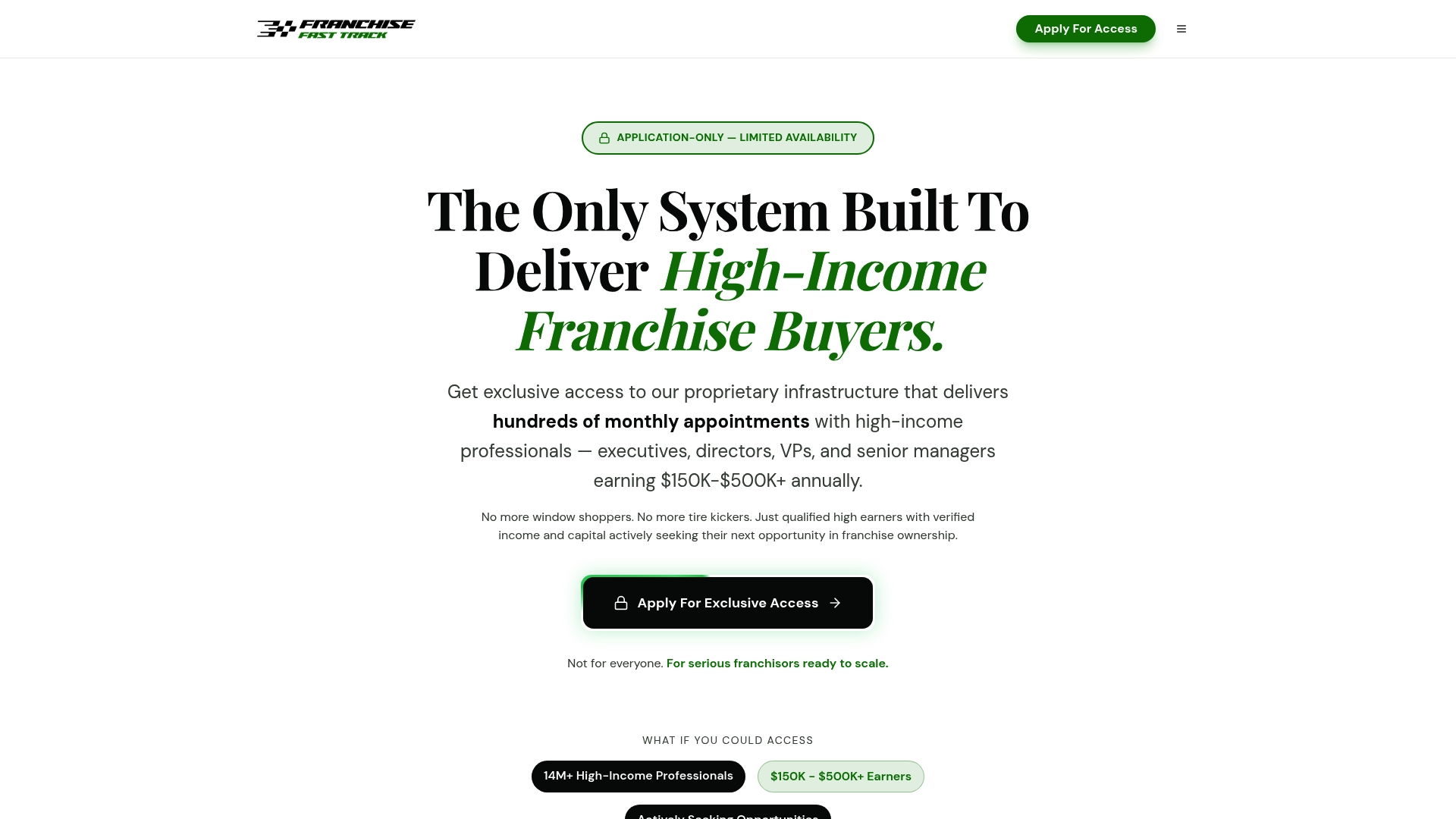
Building and tuning a LinkedIn campaign like this takes months of testing most franchise development teams don't have time for. Franchise Fast Track already runs this exact system, delivering appointments with verified professionals in the $150,000 to $500,000 income range, complete with capital and intent verification before a lead ever reaches your calendar.
That frees your development team to focus on closing, not chasing. If you are still refining your own funnel, start with a smaller pilot and measure quality before committing full budget; if you would rather skip the testing phase entirely, visit the franchise lead generation page to see how the appointment-setting process works and get a program built around your specific territory goals.
Sources
- Franchise LinkedIn Ads Stats 2026 | Web Tonic™
- Franchise marketing plan (Arc4)
- Franchise Lead Generation Playbook 2026 | Getlead
Recommended
Ready to see results like these for your franchise?
Stop wasting money on leads that never close. Start getting hundreds of replies from high-net-worth professionals daily.