Franchise Sales Process: 7 Stages from Lead to Signed Deal
Franchisors closed approximately 1.2% of leads in a Franchise Sales Index study of 487 brands, while delaying first contact by one day could reduce conversion likelihood by up to 3.5 times. The franchise sales process should therefore combine rapid candidate response with documented gates, rather than treat every inquiry as a prospect who needs more persuasion.
For established U.S. brands, the development team's task isn't merely to produce signed agreements. It is to advance candidates whose capital, operating capabilities, territory expectations, and diligence support an informed commitment. The distinction matters most when a candidate looks financially attractive but lacks the management capacity the concept requires.
Table of Contents
- Why the Franchise Sales Process Is a Regulated Funnel, Not a Marketing Campaign
- Lead Sourcing and Channel Economics for Established Brands
- Qualification Criteria That Actually Predict Success
- Operational-Fit Qualification Beyond Income and Net Worth
- FDD Delivery and the 14-Day FTC Disclosure Window
- Discovery Days, Validation Calls, and Territory Offers
- Stage-Gate Metrics, Closing Discipline, and the Next Move
Why the Franchise Sales Process Is a Regulated Funnel, Not a Marketing Campaign
The historical 1.2% close-rate benchmark across 487 brands, together with the potential 3.5-times conversion penalty from a one-day contact delay, comes from the Franchise Sales Index analysis published by the International Franchise Association. It is an industry benchmark, not a universal forecast for every brand or channel.
The managerial implication is more useful than the headline percentage. A development team can lose commercially suitable candidates through slow response, yet create legal exposure by accelerating the wrong activities. Speed-to-lead and speed-to-contract aren't interchangeable.
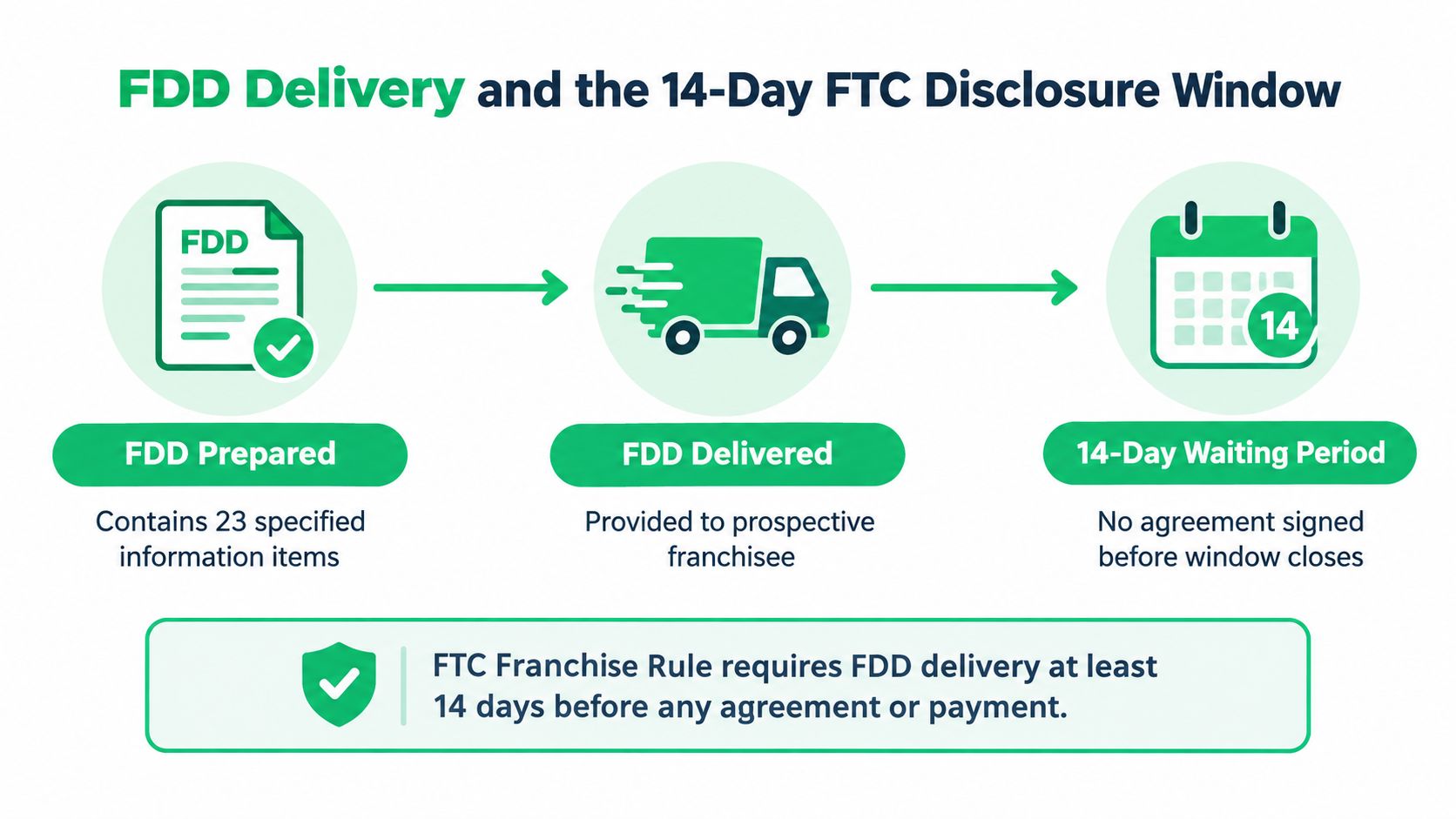
The FTC's Franchise Rule establishes a disclosure system containing 23 specified items, with the FDD furnished at least 14 calendar days before a binding agreement or payment to the franchisor or an affiliate, as specified in the federal franchise disclosure requirements. Teams should organize commercial activity around that checkpoint, not attempt to override it with sales urgency.
FTC Controls Belong Inside the Pipeline
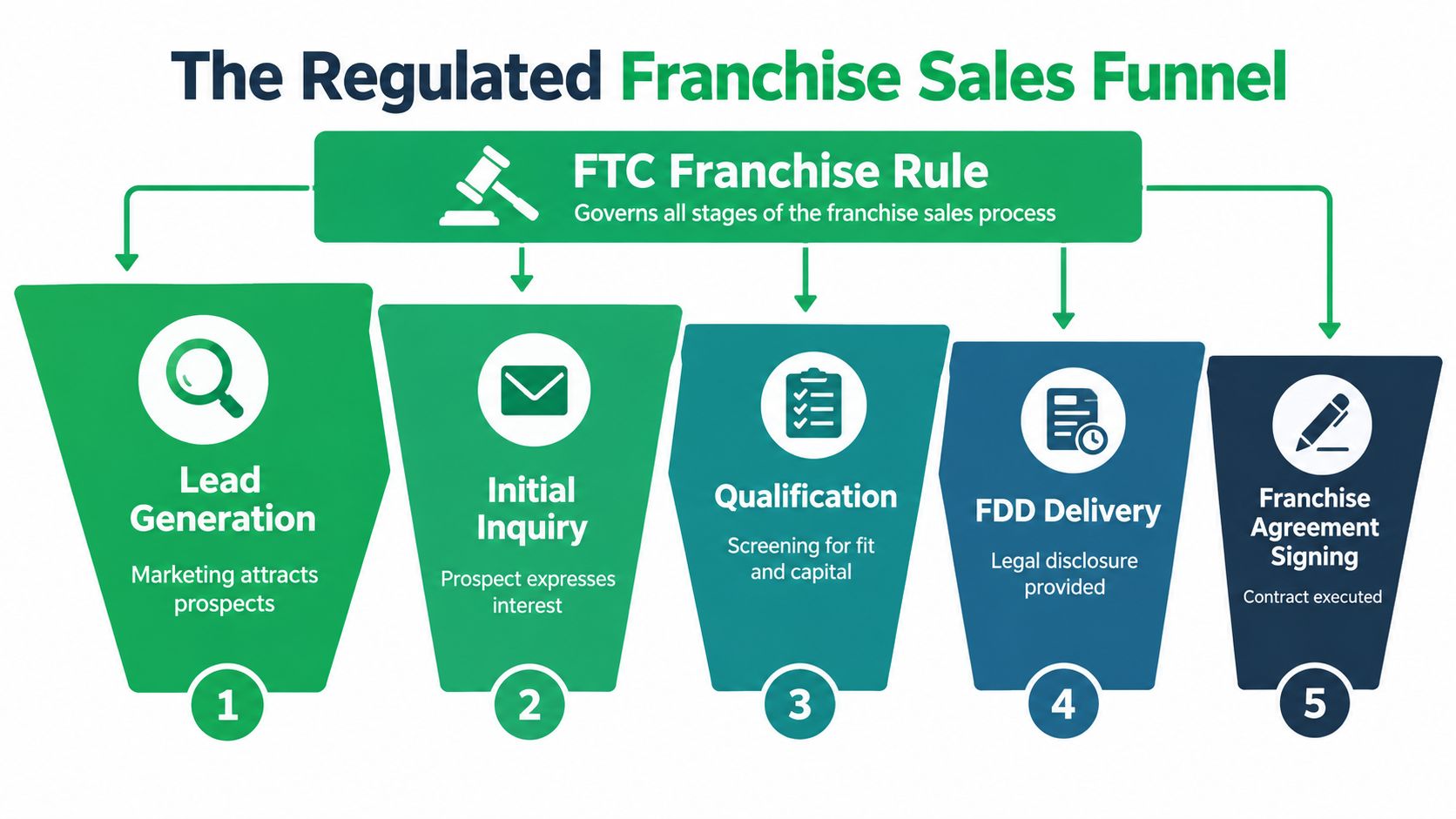
A practical gated sequence separates sourcing, initial response, qualification, disclosure, validation, territory and financing approval, and agreement execution. These are management stages, not a claim that federal law prescribes every discovery conversation in a single universal order.
Each transition needs an accountable owner and a documented condition. Marketing can identify an interested executive; qualification must establish whether that executive fits the concept. Leadership can approve a candidate commercially; legal review must still establish whether execution is permissible.
Practical rule: Respond quickly to interest, but advance only when the evidence required for the next gate is complete.
The distinction is consequential at industry scale. The IFA's 2025 industry description reported approximately 830,876 U.S. franchise establishments, nearly 8.8 million direct jobs, and $896.9 billion in economic output, providing context for system-growth decisions across established brands in its U.S. franchising economic outlook.
Documentation Is a Sales Management Responsibility
Development executives should assign responsibility for approved materials, candidate status, disclosure records, and escalation of unsupported claims. Matil's resource on compliance risk reduction strategies offers a broader process-management reference; franchise-specific decisions still require the applicable disclosure rules and legal review.
The regulated structure can be visualized as a series of checkpoints rather than an uninterrupted closing campaign.
Lead Sourcing and Channel Economics for Established Brands
Cost per qualified conversation is the appropriate comparison between franchise portals, Meta and Google advertising, broker referrals, and targeted outbound. Cost per inquiry answers a narrower question: how cheaply did the team obtain a response?
A defensible comparison requires a shared qualification definition. If a portal inquiry counts as qualified upon submission, while an outbound prospect must pass capital, geography, and operating-fit screening, the resulting dashboard compares different products. Development leaders should apply the same acceptance criteria regardless of acquisition channel.
No defensible channel-cost figures are available for this comparison. The table therefore identifies what teams should measure and verify, rather than assigning unsupported prices or declaring a universal winner.
Channel Comparison for Franchise Lead Sourcing
| Channel | Cost per Qualified Conversation | Predictability | Candidate Quality |
|---|---|---|---|
| Franchise portals | Include placement costs and screening labor | Assess accepted candidates by source and territory | Confirm capital and concept fit beyond expressed interest |
| Meta and Google paid ads | Include media, creative, management, and qualification costs | Evaluate held conversations, not clicks or form submissions | Verify readiness independently of campaign targeting |
| Traditional broker referrals | Include referral economics and internal evaluation time | Examine dependence on individual broker relationships | Reconcile broker screening with brand-specific requirements |
| Targeted outbound to verified candidates | Include data, outreach, specialist screening, and handoff costs | Assess reachable candidate coverage and sales-calendar capacity | Require documented verification before acceptance |
Outbound to verified candidates offers a testable alternative to buying inquiry volume: identify the intended operator profile before initiating contact. It shouldn't be described as cheaper until the brand measures fully loaded cost per held, accepted conversation against the alternatives.
For campaign planning, Mailadept's Cold Email That Gets Replies is a relevant messaging resource. Reply generation, however, remains a communication objective rather than proof of franchise suitability.
Capacity Determines Whether Sourcing Becomes Pipeline
A sourcing program needs an active development team, a defined franchisee profile, and calendar capacity for qualified discovery. Otherwise, screening improvements can merely move the bottleneck from marketing to sales.
The operational handoff should identify the candidate's verified investment capacity, intended territory, management background, ownership model, and unresolved questions. A calendar invitation without that context is an appointment, not a qualified sales asset.
Established brands can use the franchise lead generation resource to assess sourcing alongside qualification and handoff. For QSR, automotive services, or education concepts, the decisive channel question isn't which source creates the most replies. It is which source supplies candidates the team can responsibly advance.
Qualification Criteria That Actually Predict Success
Item 7, initial investment, should anchor financial screening. A prospect's reported earnings don't establish available liquidity, and available liquidity doesn't automatically establish sufficient funding for the proposed ownership model.
The qualification record should distinguish verified liquid capital, net worth, proposed financing, and resources reserved for operations. Development teams should compare those inputs with the current disclosed investment range rather than infer readiness from job title or enthusiasm. The FTC's Franchise Rule resources establish the disclosure framework supporting investment, outlet, and financial review.
Capital and Geography Require Different Evidence
Financial qualification addresses whether the candidate can fund the proposed commitment. Geographic qualification addresses whether the proposed commitment makes sense in an available market. Neither should substitute for the other.
Item 20, outlets and franchisee turnover, provides system context for reviewing the candidate's proposed geography. Teams should compare the requested market with existing outlets, development commitments, and territory restrictions, while recognizing that outlet statistics alone aren't a complete market-feasibility analysis.
The operating-model discussion should establish whether the candidate intends to manage directly, appoint an operator, or pursue multi-unit development. A senior executive's corporate experience may be relevant, but the sales team still needs to understand who will run the business and what responsibilities that person can assume.
Qualification Records Should Support Decisions
A useful candidate record combines evidence with an explicit decision. It shouldn't rely on a salesperson's impression that the prospect is promising.
- Investment evidence: Record verified funding inputs and unresolved financing dependencies.
- Market alignment: Identify the requested geography and the status of territory review.
- Operating responsibility: Name the intended operator and document relevant management experience.
- Commitment: Establish timing, decision participants, and availability for diligence.
The franchise sales qualification guide provides a supplementary framework for organizing that screening. Teams using franchise directories, FDD records, and operator datasets should treat those tools as research inputs, not automatic approval mechanisms.
Structured disqualification codes should distinguish insufficient capital, unavailable territory, ownership-model mismatch, timing, and incomplete evidence. That taxonomy makes campaign feedback actionable: marketing can adjust targeting, sales managers can review inconsistent decisions, and analysts can separate unsuitable candidates from suitable candidates who are not yet ready.
Operational-Fit Qualification Beyond Income and Net Worth
37% of franchisor executives identified labor availability, quality, and cost as their top business challenge, while 56% said labor constraints were limiting growth, according to the IFA's 2025 franchisor survey. Those findings challenge a qualification process that treats financial capacity as the dominant approval criterion.
For labor-intensive concepts such as quick-service restaurants, senior care, fitness and wellness, and home services, development teams should test whether the candidate can recruit, retain, and manage the workforce the operating model requires. Capital readiness is necessary for funding; it isn't evidence of staffing competence.
The analytical conclusion is that qualification should assess execution capacity in the proposed territory, not merely the candidate's financial profile. A well-capitalized operator without a credible staffing plan may still face a difficult opening and sustained operating pressure.
Labor Questions Should Test Actions, Not Confidence
A candidate who expresses confidence about hiring hasn't demonstrated hiring capability. The interview should examine prior responsibility for hourly teams, recruiting methods, scheduling, manager development, and responses to turnover.
Local wage assumptions should receive the same scrutiny as other operating inputs. Development teams should ask how the candidate will establish compensation expectations, where recruits will come from, and who will cover management responsibilities if the initial hiring plan fails.

A personal operating bench matters particularly when the proposed franchisee expects to remain employed elsewhere. The team should distinguish an identified, available operator from an intention to recruit one after signing.
Financial capacity answers whether a candidate can fund the commitment. Operational fit addresses whether the candidate has a credible plan to execute it.
The Scorecard Should Change Advancement Decisions
The operational-fit scorecard should record management evidence, recruiting readiness, local wage assumptions, operator availability, and capital reserved for payroll during ramp-up. A passing result should require a credible explanation of who does the work, not acknowledgment that staffing is important.
Item 20 can prompt questions about closures, transfers, and departures. Development teams shouldn't claim those events prove labor problems; they should use the patterns to identify issues requiring investigation through validation.
For real estate brokerages, health and beauty, retail, and education concepts, the same principle applies with category-specific staffing questions. Before discovery approval, the candidate's target market should receive a labor-readiness review alongside financial and background screening. The survey supports treating labor as a material development concern, not an after-signing operational detail.
FDD Delivery and the 14-Day FTC Disclosure Window
FDD delivery is a legal checkpoint, not a collateral download. The disclosure requirements established earlier should translate into a controlled record that allows development leadership and counsel to establish what the candidate received and when.
The FTC explains the disclosure document's role and the restrictions on seller communications in its deep dive into the Franchise Disclosure Document. Commercial approval doesn't eliminate the waiting requirement, and candidate enthusiasm doesn't justify accepting a payment prematurely.
The CRM Should Preserve the Disclosure Record
A practical control system should record delivery date, document version, receipt acknowledgment, and the proposed execution date. The team should reconcile the delivered version against the current FDD on file and escalate discrepancies before contracting.
Receipt tracking shouldn't be confused with proof that the prospect understands the document. Delivery records establish a compliance event; diligence records establish what questions remain unresolved.
Item 21, financial statements, belongs in the diligence workflow alongside the investment and system disclosures. Development executives should ensure financial questions reach the appropriate reviewers rather than allow the salesperson to improvise answers outside approved materials.
The 23-item FDD essentials explained resource can support internal training. It shouldn't replace counsel's review of the actual disclosure document and proposed transaction.
Item 19 Limits the Economic Narrative
Item 19, financial performance representations, governs sales, income, and earnings information. Such representations must appear in the disclosure, have a reasonable factual basis, and have written substantiation available, as explained in the FTC's franchise disclosure guidance on earnings claims.
That requirement applies to the economic story communicated by the sales organization, not merely the formal presentation. Outbound emails, broker scripts, discovery decks, and follow-up messages should undergo review against the current approved methodology.
Claim control: A salesperson shouldn't turn an operational discussion into an unsupported forecast of revenue, profit, or payback.
Operational conversations can address staffing, training, territory structure, and disclosed investment requirements. When a conversation shifts into expected financial results, the team needs an approved representation with the appropriate context.
Development managers should maintain an approved-claims library and a process for escalating questions that fall outside it. The purpose isn't to make discovery less useful. It is to keep the evidence presented during discovery consistent with the evidence disclosed.
Discovery Days, Validation Calls, and Territory Offers
A discovery day should resolve questions, not merely increase enthusiasm. The leadership team should evaluate whether the candidate understands the operating model, while the candidate gathers evidence about support, obligations, and implementation.
The sequence should include structured conversations with franchisor management, validation with current and former franchisees identified through the disclosure, and review of the proposed territory. The disclosed financial methodology should govern any unit-economics discussion; unsupported projections don't become acceptable because they occur in a leadership meeting.
Validation Should Produce Comparable Evidence
Development teams should prepare discussion topics rather than coach franchisees to deliver endorsements. Relevant topics include staffing responsibilities, training experience, operating involvement, and the practical demands of the concept.
The record should distinguish which conversations occurred, what questions arose, and which issues remain open. A booked validation call isn't equivalent to a completed call, just as an invitation to discovery isn't evidence that the candidate attended.
| Validation Component | Evidence to Capture | Advancement Question |
|---|---|---|
| Leadership discovery | Documented understanding of responsibilities and support | Does the proposed ownership model remain credible? |
| Franchisee conversations | Completed discussions and unresolved issues | Has the candidate tested operational assumptions? |
| Territory review | Availability, boundaries, and development commitments | Is the proposed market consistent with the offer? |
| Financing review | Funding status and outstanding conditions | Can the candidate support the proposed commitment? |
Territory review should examine availability, demographic assumptions, and potential overlap with existing development. The territory mapping for franchise leaders resource offers a practical starting point for organizing that analysis.
A Strong Discovery Conversion Rate Isn't Proof of Causation
Late-stage candidates have already passed earlier filters. A high discovery-to-sale benchmark therefore shouldn't be interpreted as evidence that attendance itself causes a sale, or that relaxing admission criteria will reproduce the same result.
The more useful question is whether discovery confirms the evidence collected upstream. A candidate who withdraws after identifying an operating mismatch may represent a sound qualification outcome, not a failed presentation.
Development leadership should require territory and funding approval before award consideration. Teams should also track post-discovery withdrawals separately from sourcing failures, because the reasons can expose weaknesses in expectations, qualification, or validation.
A written discovery summary should capture the proposed operating arrangement, unresolved diligence questions, territory assumptions, and next actions. Acknowledgment by both parties can establish shared understanding without substituting for legal documentation or financial review. That summary becomes the factual baseline for the award conversation rather than a sales narrative reconstructed from memory.
Stage-Gate Metrics, Closing Discipline, and the Next Move
An industry survey reported 2% total-lead-to-sale, 12% qualified-lead-to-sale, 32% application-to-sale, and 75% discovery-day-to-sale conversion, together with an average 24-week journey from initial lead to signed agreement, in its franchise development benchmark discussion. These are indicative benchmarks, not universal targets, because stage definitions vary.
Those ratios use different denominators. They aren't sequential transition rates that management should multiply together, and they don't establish that a particular sourcing channel outperforms another.
Stage Definitions Must Precede Performance Targets
A development dashboard should separately measure adjacent-stage movement, conversion to signed agreement, and progression from award to opening. Sales directors should segment those results by source, concept, geography, investment level, and salesperson.
The survey's illustrative comparison contrasts 1,000 leads producing 20 sales at 2% with 250 qualified leads producing 30 sales at 12%. The latter produces more agreements from fewer candidates, but the comparison isn't a controlled channel experiment.
Management test: A stronger pipeline produces better-supported decisions, not simply more activity records.
Weekly reviews should examine stage aging, outstanding evidence, next actions, and disqualification reasons. Managers should deduplicate candidate records across channels and distinguish held meetings from booked meetings before evaluating salesperson productivity.
Automation Should Enforce Gates, Not Invent Readiness
Prometheus Agency's AI-driven sales funnel improvements provides a broader automation reference. Within franchise development, automation should support reminders, record completeness, routing, and exception handling rather than approve candidates based on engagement alone.
The Franchise Fast Track pipeline strategies resource can supplement that operating design. Disclosure timing, territory decisions, and financial-claim approval still require accountable human review.
Cash-flow forecasting should distinguish expected agreements from openings and recognize the documented sales-cycle duration. Early campaign closes alone aren't a sufficient basis for judging a sourcing program.
The resulting franchise sales process is a controlled allocation of development attention. Teams respond promptly, qualify against operating realities, preserve disclosure evidence, and award only when commercial and compliance conditions align. That approach makes signed agreements an outcome of disciplined decisions rather than the sole measure of success.
Franchise Fast Track offers franchise development support and franchise-industry intelligence for established U.S. brands evaluating candidate sourcing, qualification, and pipeline controls. Development executives can visit Franchise Fast Track and explore its FDD database to inform investment, outlet, and disclosure reviews before revising their stage-gate process.
Ready to see results like these for your franchise?
Stop wasting money on leads that never close. Start getting hundreds of replies from high-net-worth professionals daily.