34% Lead to Close: Executive Targeting Criteria for Franchisors
The right prospect earns $150K to $500K+ a year, holds a director-level or executive title, shows a recent transition signal like a job change or acquisition, has liquid capital in the $75K to $250K+ range, and is willing to complete a short application before touching the FDD. Franchise Fast Track applies exactly this filter set to source appointments, and franchisors using this approach report a 34% lead-to-close rate. What follows is the full checklist, how to build a list against it, and how to book the meeting.
TL;DR:
- Proper prospect filtering relies on financial capacity, seniority, readiness signals, territory, and behavioral intent, not just job titles.
- Building an up-to-date prospect list requires sourcing from signal-rich pools, capturing key fields, and setting automated alerts for role changes.
- The most effective outreach channels are personalized LinkedIn messages and territory-specific follow-ups, not mass emails or portal blasts.
- Rapid verification through a short application and quick contact within hours significantly boosts the likelihood of closing deals.
- Franchise Fast Track streamlines prospect sourcing and verification, delivering verified, territory-matched appointments directly to franchisors, resulting in a higher lead-to-close rate.
Table of Contents
- What are the core executive targeting criteria for franchisors?
- How do you build and prioritize an executive prospect list?
- Which outreach channels actually get executives to respond?
- What does the qualification and validation workflow look like?
- What most franchisors get wrong about targeting executives
- How Franchise Fast Track applies these criteria at scale
- Sources
What are the core executive targeting criteria for franchisors?
Franchisors chasing volume instead of fit end up with a pipeline full of tire kickers. The fix is a stacked filter: financial capacity, professional seniority, readiness signals, territory fit, and demonstrated intent. Each one eliminates a different category of unqualified inquiry.

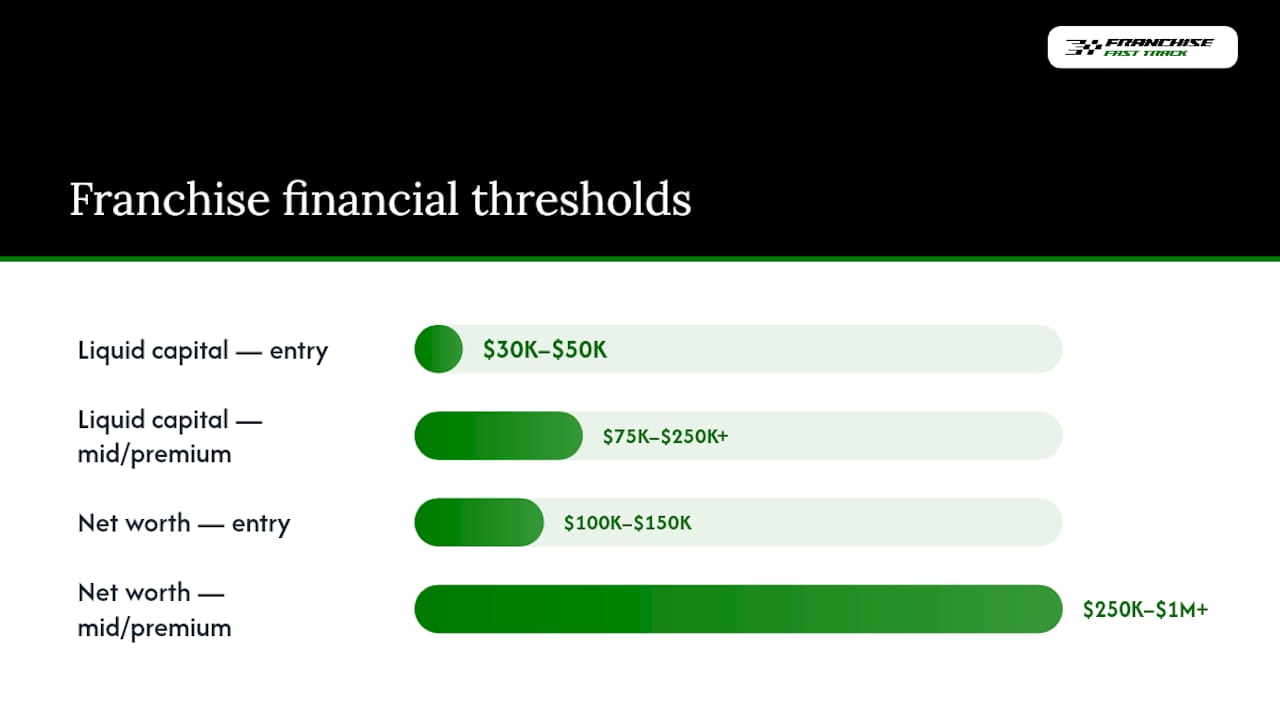
Financial thresholds. Liquid capital and net worth requirements scale with investment size. Low-cost franchise concepts typically ask for $30K to $50K liquid and $100K to $150K net worth. Mid-tier and premium brands commonly need $75K to $250K or more in liquid capital and $250K to $1M+ in net worth. A credit score check rounds out the picture, since it flags financing risk before anyone wastes a call.
Role and career background. Titles like director, VP, general manager, or C-suite executive matter less than what they signal: budget authority, P&L accountability, and the discipline to run a business unit. Buyers who spent years in corporate management or multi-unit operations tend to fit best, and they typically fall between 35 and 60 years old with net worths from $500K to $2M.
Readiness signals. A recent layoff, an early retirement, a completed M&A deal, or a LinkedIn profile marked "open to work" are the clearest tells that someone is actively evaluating a change. These signals outperform generic demographic targeting because they capture timing, not just qualification.
Territory fit. Score prospects by whether they live in or near an open territory, and separate single-unit interest from multi-unit appetite. Buyers with portfolio ambitions respond to structured data packs with AUV ranges, breakeven timelines, and development velocity, so flag them early for a different content track.
Behavioral intent. Did the prospect finish an application instead of abandoning it halfway? Have they invested in a business before? Have they attended a franchise expo or investor event? Each is a small commitment that predicts a bigger one.
- Liquid capital: $30K minimum for entry brands, $75K to $250K+ for mid to premium concepts
- Net worth: $100K to $1M+ depending on total investment
- Title band: director, VP, GM, or C-suite with budget or P&L ownership
- Transition marker: job change, exit, layoff, or "open to work" status within the last 6 to 12 months
- Territory match: confirmed residence or business ties within an open market
- Intent proof: completed application, prior investment history, or expo attendance
How do you build and prioritize an executive prospect list?
Criteria only matter once they're applied to a real list. Building one that stays current takes a repeatable process, not a one-time data pull.
- Source from signal-rich pools. LinkedIn transition and seniority filters, executive databases, investor networks, multi-unit owner records, and franchise expo attendee lists all surface different slices of the same buyer profile.
- Capture the right fields. Beyond name and title, track current employer, tenure, industry background, estimated net worth range, territory of interest, and the specific signal that triggered inclusion (layoff, exit, "open to work" flag).
- Refresh on triggers, not a calendar. Set alerts for role-end dates, executive departures, and acquisition announcements rather than batch-updating the whole list monthly. Stale data is worse than no data.
- Score for bookability. Combine capital band, readiness signal strength, and territory fit into a single weighted score. Prospects above the threshold move into active outreach; the rest sit in a nurture track, an approach detailed further in this franchise candidate nurturing breakdown.
- Respect the source terms. Public records and professional network data are fair game for research, but scraping in violation of platform terms or misusing personal contact data creates legal exposure that isn't worth the shortcut.
Pro Tip: Weight recency of the transition signal higher than the signal type itself. An executive who left a role two weeks ago is a hotter prospect than one who left eighteen months ago, regardless of title.
Signal-based LinkedIn targeting that layers transition markers with seniority filters consistently outperforms broad portal-style list building, because it selects for people who are both qualified and currently in motion. That combination is what separates a bookable cohort from a database of names.
Which outreach channels actually get executives to respond?
Portal blasting and mass email campaigns burn through goodwill fast with this audience. Executives get pitched constantly, so volume-based outreach reads as noise. Precision wins instead.
- LinkedIn direct messages built around a specific signal (a title change, a company sale, a public "open to work" flag) outperform cold portal inquiries because they prove you did the homework.
- Territory-specific opening lines that reference the prospect's background and an actual open market perform better than generic franchise pitches, a pattern outbound teams have documented in franchise development outbound processes.
- Short qualification DMs that ask about capital range, timeline, and desired involvement in a few lines, not a form, keep the exchange conversational before asking for a call.
- Email follow-up sequences reinforce the LinkedIn touch rather than replace it, giving the prospect a second channel to respond on their own schedule.
Benchmark: Signal-layered LinkedIn outreach that combines transition and seniority filters produces meaningfully higher connection acceptance and reply rates than volume-based approaches, because the message lands with someone already primed to consider a change.
Track four numbers to know if the channel mix is working: connection acceptance rate, reply rate, qualification-to-appointment conversion, and time-to-contact from first signal to first outreach attempt. Franchisors who let time-to-contact slip past 24 to 48 hours routinely lose prospects to competing opportunities, since executives evaluating a career change are usually talking to more than one option at once.
What does the qualification and validation workflow look like?
Once outreach turns into a live conversation, the goal shifts from finding the prospect to proving they're real. A short application gate, placed before any FDD conversation, does most of the filtering work on its own.
- Application gate first. A one-page form covering liquid capital range, net worth range, timeline to launch, and territory interest screens out casual browsers before they consume a discovery call slot, a tactic franchise development veterans consistently point to as the single highest-leverage filter.
- First-call verification script. Confirm capital source, target investment timeline, desired level of involvement (owner-operator vs. semi-absentee), and specific territory interest, out loud, before scheduling anything further.
- Document checklist before the FDD. Request a personal financial statement, three months of bank statements, recent tax returns, and a credit report once the first call confirms basic fit.
- Sequence peer validation after documents clear. Arrange a call with an existing franchisee only once the paperwork backs up what the prospect claimed on the call.
Pro Tip: Set a target of contacting new signal-based leads within a few hours of identification. Franchise Fast Track's model of pairing rapid outreach with an application gate is a direct contributor to its 34% lead-to-close rate, and speed is the variable most franchisors control least well.
What most franchisors get wrong about targeting executives
Most franchise development teams still treat executive targeting as a title-matching exercise: find people with "director" or "VP" in their headline and call it done. That misses the variable that actually predicts a signed agreement, which is timing. A director with no transition signal and no urgency will circle a decision for a year. A former VP three weeks removed from a layoff, with $150K sitting in liquid savings, will move in thirty days if the process respects their time.
The application gate is the part teams resist most, because it feels like it might scare off a good prospect. In practice it does the opposite: serious buyers complete it without hesitation, and the ones who stall out were never going to sign anyway.
Two things to change this week: shorten your time-to-contact target, and stop sending the FDD before you've verified capital on a live call.
— Cody
How Franchise Fast Track applies these criteria at scale
Building and refreshing a signal-based executive list, running verification calls, and managing an application gate takes real operational bandwidth, which is exactly the workload Franchise Fast Track absorbs for franchisors instead of leaving it to an internal team stretched across other priorities. The service sources and verifies prospects earning $150K to $500K+ against the same financial, seniority, and readiness criteria covered above, then delivers hundreds of booked appointments a month directly onto your calendar.
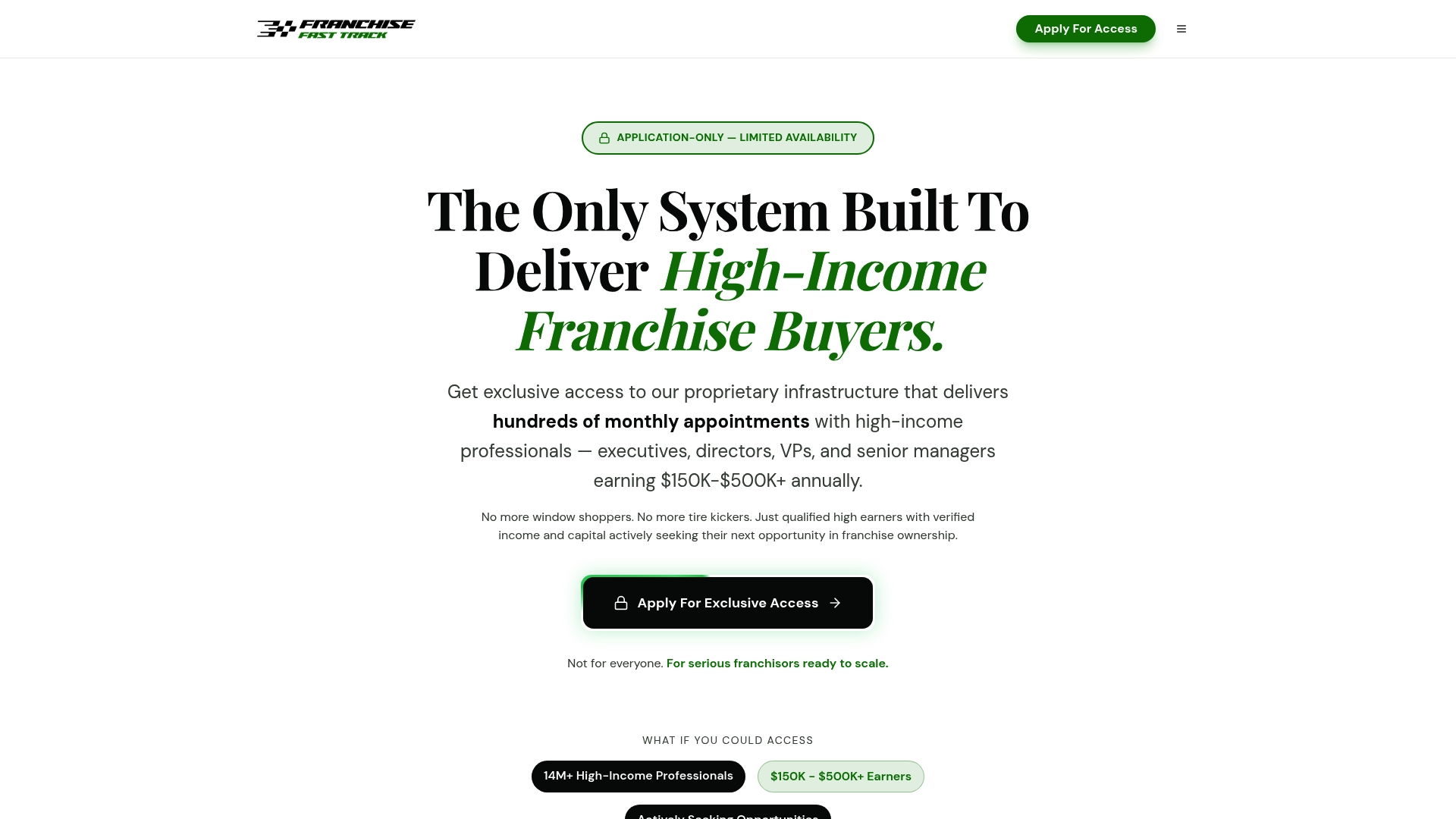
Franchisors working with Franchise Fast Track get a pre-built pipeline: verified income and intent, territory-matched candidates, and a calendar of discovery calls instead of a spreadsheet of unqualified inquiries. That verification work is a large part of why clients report a 34% lead-to-close rate, well above what unfiltered lead sources typically produce. If your current pipeline is full of names but short on qualified conversations, start with the franchise lead generation program and see what a calendar of pre-verified appointments looks like for your territory.
Sources
- Franchising
- Franchise financial qualifications — VetMyFranchise
- LinkedIn for franchise consultants: get candidates — LinkedInsider
Recommended
Ready to see results like these for your franchise?
Stop wasting money on leads that never close. Start getting hundreds of replies from high-net-worth professionals daily.