Franchisors: Book $150K–$500K Buyers with Executive Outreach Channels
The channels that work for reaching executives are LinkedIn, ultra-short email, selective phone calls, warm introductions, executive events, and direct mail, but the channel matters less than the sequencing. Executives respond best to coordinated touches that are driven by engagement signals rather than high-volume outreach across many channels simultaneously. Franchise Fast Track applies this exact logic to deliver verified appointments with buyers earning $150K to $500K a year, instead of blasting cold lists and hoping.
TL;DR:
- Combining email, LinkedIn, and calls in multichannel sequences more than doubles response rates compared to single-channel outreach.
- Cadences should be signal-driven, with frequency caps of two to three touches per week, and personalized based on engagement signals.
- LinkedIn is most effective for initial low-context outreach, while email should be concise with subject lines of one to four words for higher reply rates.
- Cold calling is rarely successful unless prospects have already engaged through email or social media, and direct mail works best for high-value, unresponsive accounts.
- Prioritize verified, income-qualified contact lists, as they significantly improve response and close rates over unqualified, guessed audiences.
Table of Contents
- Which Executive Outreach Channels Work Best?
- Building Multichannel Cadences That Executives Actually Tolerate
- The Channel-by-Channel Playbook for Reaching Executives
- Measuring and Optimizing Your Executive Outreach
- How Franchise Fast Track Validates Executive Appointment Strategies
- Legal and Ethical Considerations in Executive Outreach
- What Actually Works vs. What Sounds Good on a Slide
- Get Verified Executive Appointments Instead of Cold Lists
- Sources
Which Executive Outreach Channels Work Best?
Every channel has a job. Use the wrong one for the wrong signal and you burn goodwill you can't get back with a C-suite prospect who has an assistant filtering their inbox and thirty unread LinkedIn messages.
Here's how the main channels stack up for reaching decision-makers:
- LinkedIn: Best for cold, low-context outreach because most executives manage their own accounts and it skips the gatekeeper entirely, according to Alchemail's research on C-suite outreach.
- Email: Best for scalable, trackable first and second touches, but only when subject lines run one to four words and the body stays short.
- Phone: Best reserved for prospects who've already shown engagement. Cold calling a stranger executive rarely converts.
- Direct mail: Best for high-value accounts where digital noise has already failed. It physically stands out in a way a fourth email never will.
- Executive events and webinars: Best for warming relationships at scale and giving prospects a reason to engage on their terms.
- Warm introductions: Best conversion rate of any channel, full stop, but they don't scale without a deliberate referral process.
- SMS/WhatsApp: Best for late-stage logistics (confirming a call, sharing a document) once permission and context already exist. Never a cold channel for executives.
The signal you have determines which channel to lead with. Cold prospect with zero relationship? Start on LinkedIn or email. Someone who opened three emails and viewed your profile twice? That's visible context, and it justifies a call or a more direct ask. An account worth six figures in lifetime value that's gone quiet? That's when direct mail or an event invite earns its cost.
On response benchmarks, the data is consistent across sources: multichannel sequences that combine email, LinkedIn, and calls generate materially higher response rates than single-channel outreach, and practitioner reports on sequences using three or more channels frequently show response rates more than double what single-channel campaigns produce. The lesson isn't "use every channel." It's "use the right channel at the right moment, backed by a second channel when the first one goes quiet."
Building Multichannel Cadences That Executives Actually Tolerate
A cadence is a set of rules, not a spray-and-pray calendar. The goal is enough contact to stay visible without becoming the outreach nobody remembers because it never stopped.
Three cadence structures cover most executive outreach programs, and each fits a different starting condition.
1. The high-value account cadence (best for named-account, six-figure-deal targets)
- Day 1: LinkedIn connection request, no pitch, just a note referencing something specific and recent about the company.
- Day 3: Short email, four-word subject line, three sentences max, one clear ask.
- Day 6: LinkedIn engagement, comment or react on something they posted.
- Day 9: Second email referencing the earlier note, adds a new piece of value (an article, a data point).
- Day 14: Phone call, only if they've opened or clicked something. Otherwise, hold.
- Day 18: Direct mail piece tied to an event invite, reserved for accounts still worth pursuing.
2. The signal-based follow-up cadence (best for prospects who've shown any engagement)
- Trigger: an email open, a LinkedIn profile view, or a click.
- Within 48 hours: a second touch on a different channel than the one that triggered the signal.
- If a reply comes: move to phone or a scheduling link within 24 hours. Executives who respond expect momentum, not a slow follow-up.
- If no reply within a week: rotate channel again rather than repeating the same message.
3. The reactivation cadence (best for stalled prospects from 60 to 180 days ago)
- Lead with new information: a new hire at their company, a funding round, an award, a conference appearance.
- One email, one LinkedIn touch, spaced five to seven days apart.
- No phone call until they engage. Cold calls into a dead sequence rarely land.
Escalation should follow signals, not a calendar. Lemlist's research on multichannel orchestration makes the point directly: sequences that escalate based on engagement outperform arbitrary "call on day 7 no matter what" rules, because they preserve goodwill and increase conversion when the call finally happens. A rigid timer treats every prospect the same. A signal-based system treats a prospect who just visited your pricing page differently than one who hasn't opened an email in three weeks, and it should.
Frequency caps matter more with executives than with any other buyer segment. Cap outbound touches at two to three per week per prospect across all channels combined. Sample cadences used for C-suite sequences typically run eight to ten touches across two to three weeks, adjusted up or down based on account value and signal strength. Personalization depth should increase as the cadence progresses. Touch one can be generic-plus-one-detail. Touch four should reference something the prospect has actually done, like an opened email or a LinkedIn interaction. Sender reputation is not a footnote here. If the same sender account is pushing volume across dozens of sequences, deliverability degrades and every cadence built on top of it underperforms.
Pro Tip: Isolate a subdomain for outreach and warm it gradually before running executive campaigns at scale. Keep early volume conservative. Protecting your primary domain's deliverability matters more than hitting a weekly send target, because a burned domain kills every cadence you build afterward, not just the current one.
The Channel-by-Channel Playbook for Reaching Executives
Generic advice fails here because each channel has its own grammar. What works on LinkedIn will bomb in an email inbox, and what works in a voicemail will read as desperate in a text.
LinkedIn: engagement first, pitch second
Lead with a connection request that references something concrete: a recent post, a company announcement, a shared connection. Skip the pitch in the request itself. Once connected, engage authentically for a few days (a comment, a reaction) before sending a message. Executives are most active on LinkedIn early in the morning and again in the evening, outside standard meeting blocks, which makes those windows better for both connection requests and message follow-ups.
Email: shorter than you think, every time
Executives reply to specific, concise emails. Reply rates decline sharply once body copy passes roughly 100 words, according to Salesmotion's analysis of executive reply data.
Subject lines should run one to four words: no clever hooks, no questions dressed up as curiosity bait. Body copy should fit in three to five sentences. State who you are, why you're reaching out, and one specific ask, then stop. Timing backs this up at scale: an analysis of 5.36 million sales touches found Tuesday mornings and other early-week windows consistently outperform Friday afternoons for CEO-level opens and replies. Sender identity matters as much as content. A message from a named founder, VP, or director outperforms one from "The Team" or a generic sales alias. Follow-up emails should add new value, a fresh data point, a relevant article, an update, rather than just repeating the first ask in different words.
Phone: earn the call before you make it
Cold calling an executive with zero prior touch rarely works and it costs you a shot at a warmer follow-up later. Reserve calls for prospects who've opened multiple emails, engaged on LinkedIn, or replied with interest that stalled. When you do call, respect the 30-second rule: state who you are, reference the prior touch specifically, and get to the point immediately. If it goes to voicemail, reference that same prior touch by name ("I sent a note last week about...") rather than a generic "just following up" message.
Direct mail: analog impact for high-value accounts
Direct mail outperforms digital when an account has gone quiet after multiple email and LinkedIn attempts, or when the deal size justifies the cost. Physical mail can break through digital clutter in a way a fourth cold email cannot, and it pairs especially well with an event invitation, a printed card that invites the executive to a roundtable, followed by a digital confirmation touch a few days later.
Events and webinars: relationship infrastructure, not a pitch venue
Peer-group roundtables, small invite-only dinners, and curated webinars work because they let executives engage on their own terms without a sales conversation attached. Invitations should be personal and specific, never a mass blast. RSVP follow-up should be light: one reminder, one day-of nudge, nothing more.
Warm introductions: build the process, don't wait for luck
Referrals convert better than any cold channel, but only if you operationalize the ask. Build a simple internal template: identify who in your network already has a relationship with the target account, then send them a two-sentence ask they can forward with minimal effort. Making the introduction easy to give is what actually generates volume here.
SMS and WhatsApp: permission only
Use text-based channels strictly for logistics after a relationship exists: confirming a meeting time, sharing a document link, rescheduling. Never use SMS or WhatsApp as a cold outreach channel for executives. It reads as an overstep, and the goodwill cost outweighs any reply-rate gain.
Deep personalization matters across every channel above. Research on executive-focused personalization is blunt about this: superficial references ("I saw you're the CRO at X") actively hurt response rates, while specific, verifiable details, a recent funding announcement, a public statement, a product launch, build the credibility that gets a reply.
Measuring and Optimizing Your Executive Outreach
Reply rate is the metric everyone tracks and the one most people misread. A 2% reply rate from a list of unqualified names means your targeting is broken. A 2% reply rate from fifty verified decision-makers with real budget authority might represent your best month.
The KPIs worth tracking, in order of what actually predicts revenue:
- Reply rate: the top-of-funnel signal, but only meaningful alongside list quality.
- Meeting rate: the percentage of replies that convert to a scheduled call. This tells you whether your messaging matches what the prospect actually wants.
- Qualified appointment rate: meetings that pass a basic fit check (budget, authority, timeline).
- Lead-to-close rate: the number that actually matters to leadership, because it ties outreach volume to closed revenue.
Interpret reply rates for executives differently than for mid-level contacts. A slow reply rate from a C-suite list isn't automatically a failure signal the way it would be for a broader prospect list, since executives reply less often but with higher intent when they do. If your reply rate sits near zero after a full cadence, the problem is usually targeting or message specificity, not volume. Adding more touches to a broken sequence rarely fixes it.
Worthwhile experiments to run in parallel rather than sequentially:
- Test sender identity: a named executive vs. a sales rep vs. a founder.
- Test subject-line length: one word vs. four words vs. a short question.
- Test CTA framing: a direct meeting ask vs. a lower-commitment "worth a quick chat?" framing.
- Test channel order: LinkedIn-first vs. email-first for the same account list.
When engagement signals spike (multiple opens, a LinkedIn profile view, a click on a shared resource) that's the trigger to move a high-value account into private outreach: an event invitation, a piece of direct mail, or a direct call, rather than continuing the standard sequence. That's the moment the account has told you it's worth the higher-touch investment.
How Franchise Fast Track Validates Executive Appointment Strategies
Most of what's outlined above is strategy. Franchise Fast Track exists because strategy alone doesn't solve the hardest part of executive outreach: knowing which contacts are worth the effort before you spend it.
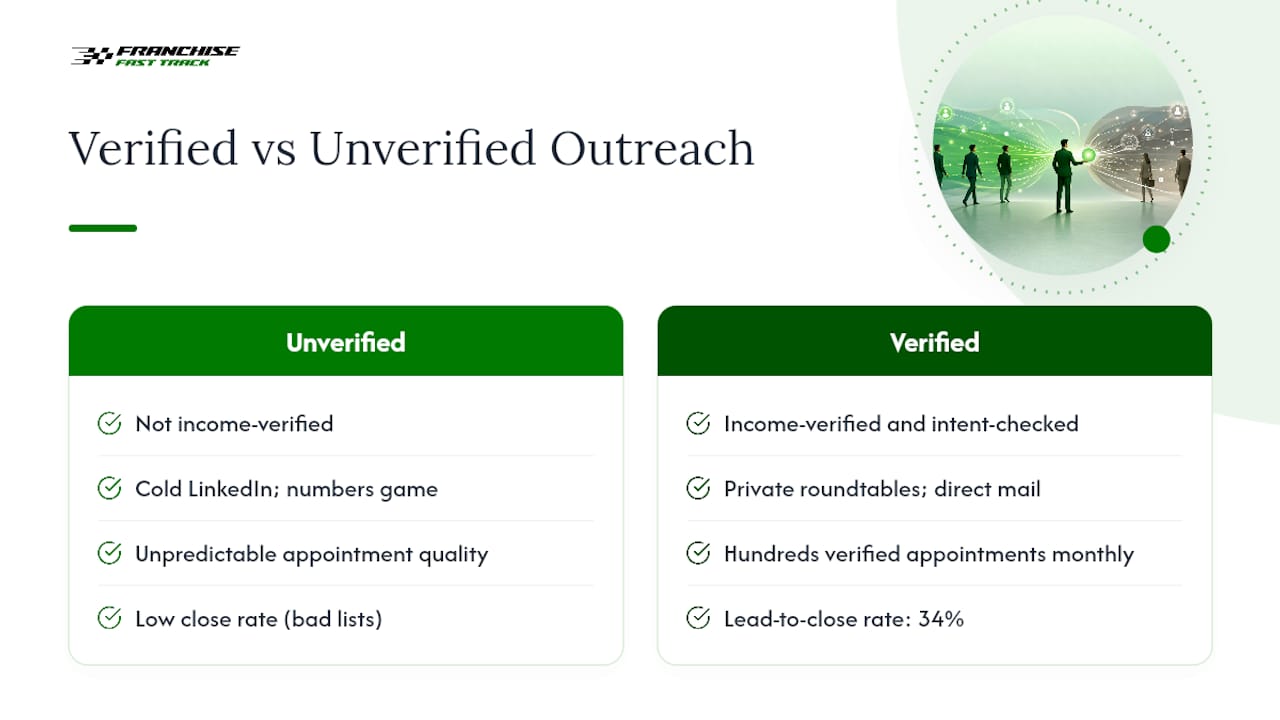
The system delivers hundreds of verified appointments each month with professionals earning between $150,000 and $500,000 annually, each one income-verified and intent-checked before they reach a franchisor's calendar. That verification step changes which channels make sense. Cold LinkedIn outreach to an unverified list is a numbers game. A private roundtable invitation or a direct mail piece to a pre-qualified, intent-confirmed executive is a different proposition entirely, because the guesswork about whether the person can actually afford the opportunity has already been removed.
The gap between chasing unqualified leads and working a verified pipeline isn't incremental. It's the difference between spending a channel budget on discovery and spending it on conversion.
This is also why the client's reported lead-to-close rate of 34% matters more than any single reply-rate benchmark. A high response rate on a bad list still produces a bad close rate. A moderate response rate on a verified, income-qualified list produces real revenue.
Pro Tip: If your team is running executive outreach cold, spend the first quarter's budget on verification and targeting criteria before you spend it on volume. A smaller, qualified list will outperform a larger, unverified one on every downstream metric that matters.
Legal and Ethical Considerations in Executive Outreach
Reaching executives at scale means handling personal and professional data, and that carries real compliance weight, not just a courtesy footnote.
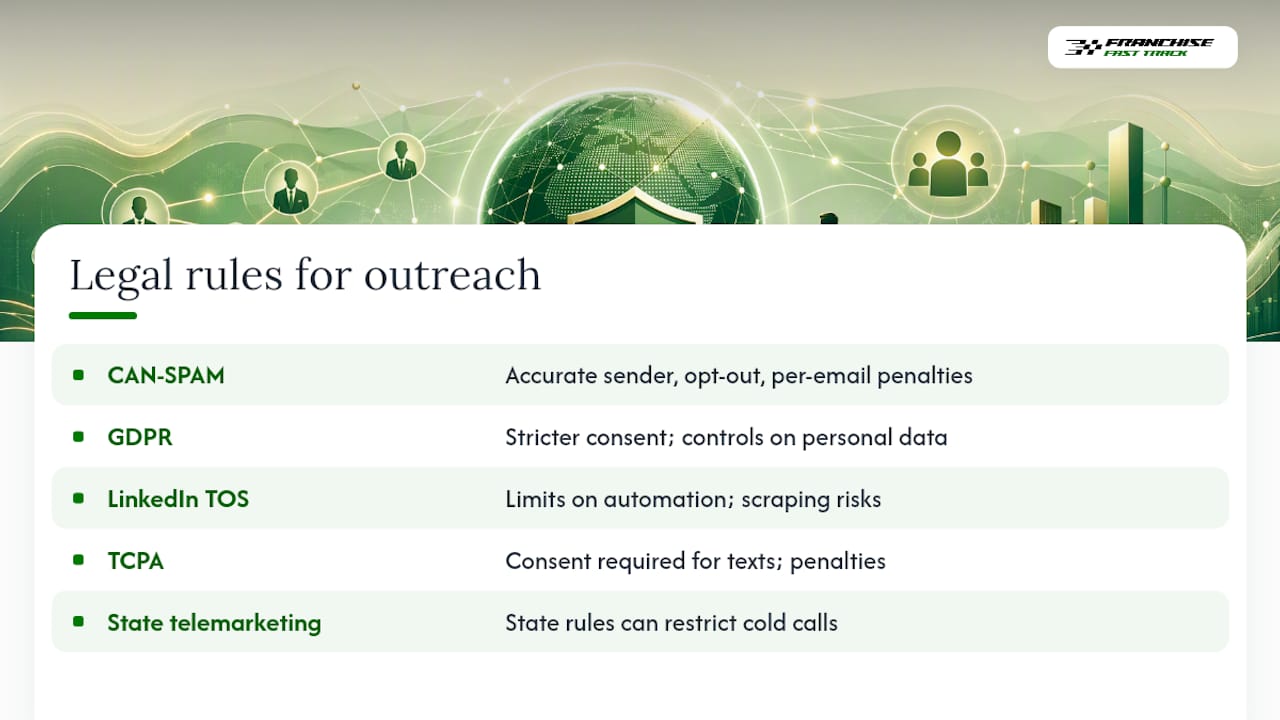
In the United States, cold email outreach falls under the CAN-SPAM Act, which requires accurate sender information, a functional opt-out mechanism, and honest subject lines. Violations carry per-email penalties, and "per email" adds up fast across a multichannel sequence sent to hundreds of contacts. If any part of an outreach program touches European contacts, GDPR governs how personal data is collected, stored, and used, with far stricter consent requirements than US law demands. LinkedIn outreach carries its own terms-of-service limits on automation and connection volume; running unofficial scraping tools or mass-automated connection requests risks account restrictions and, in some cases, legal exposure under platform terms.
Ethically, the line is simpler than the legal detail suggests: personalization should use publicly available or professionally shared information, never data obtained through questionable scraping or purchased lists of unknown provenance. Respect explicit opt-outs immediately and permanently. Direct mail and phone outreach carry lighter federal restriction than email or SMS, but state-level telemarketing rules still apply to cold calls, and unsolicited texts to a personal number without prior consent can violate the Telephone Consumer Protection Act. When in doubt on a specific jurisdiction or contact list source, a compliance review beats an assumption.
What Actually Works vs. What Sounds Good on a Slide
Three lessons stand out after looking at how executive outreach programs succeed or stall.
First, signal beats volume every time. Teams that chase touch counts instead of engagement signals burn sender reputation and goodwill simultaneously, and both are expensive to rebuild. Second, protect sender reputation like it's a shared company asset, because it is. One overeager sequence on a shared domain can quietly tax every other campaign running alongside it. Third, treat events and warm introductions as relationship infrastructure you invest in continuously, not a tactic you reach for only when email stops working.
This week: audit your current cadence for touch frequency, check whether your best-performing sequence actually matches the signals that triggered it, and confirm your sending domain isn't shared across too many unrelated campaigns.
— Cody
Get Verified Executive Appointments Instead of Cold Lists
Everything in this playbook works better with a qualified list behind it, and that's the piece most teams underbuild. Franchise Fast Track exists to solve exactly that problem for franchisors: instead of running LinkedIn and email sequences against a guessed audience, you get hundreds of appointments each month with executives, directors, and senior managers already income-verified at $150,000 to $500,000 and actively looking to buy a franchise.
The service handles the parts that eat the most time in a typical outreach program: income and intent verification, candidate vetting, pipeline setup, and calendar booking. Franchisors reviewing the franchise lead generation service can expect three things from an initial engagement:
- A defined targeting profile matched to your franchise investment level and ideal buyer income band.
- A steady flow of pre-qualified appointments booked directly onto your team's calendar.
- Ongoing candidate vetting so your development team spends time closing, not screening.
If your current channel mix is producing replies but not qualified conversations, the fix usually isn't a new subject line. It's starting from a better list. Reach out to see how the appointment pipeline could fit your current franchise development targets.
Sources
For deeper detail on specific tactics referenced above, these sources cover the data and reasoning behind the recommendations: Apollo.io's CEO outreach playbook on timing and email length, Salesmotion's reply-rate research on subject lines, lemlist's multichannel strategy guide on signal-based escalation, and BeExecutiveEvents' channel ranking for C-suite outreach.
For implementation help on the franchise side, see franchise lead generation strategy tactics and executive targeting criteria for franchisors.
- Apollo
- Cold Emailing Executives: What the Reply Data Shows | Salesmotion
- Multichannel outbound strategy: best practices that actually scale | lemlist
- The 7 Best Channels to Reach C-Suite Executives (2026 Guide)
Recommended
Ready to see results like these for your franchise?
Stop wasting money on leads that never close. Start getting hundreds of replies from high-net-worth professionals daily.