Why Franchise Growth Requires Dedicated Development Staff
Franchise growth requires dedicated development staff because expansion without structured internal expertise produces overextended systems, declining franchisee morale, and eroded unit economics. The franchise development function, as it is formally known in the industry, goes far beyond selling units. It coordinates recruitment, operational readiness, training capacity, and brand standards across every new market you enter. Franchisors who treat development as a part-time responsibility or a task shared among existing staff consistently hit a ceiling. The question is not whether you need a dedicated franchise development team. The question is when you build one and how you structure it.
Why franchise growth requires dedicated development staff
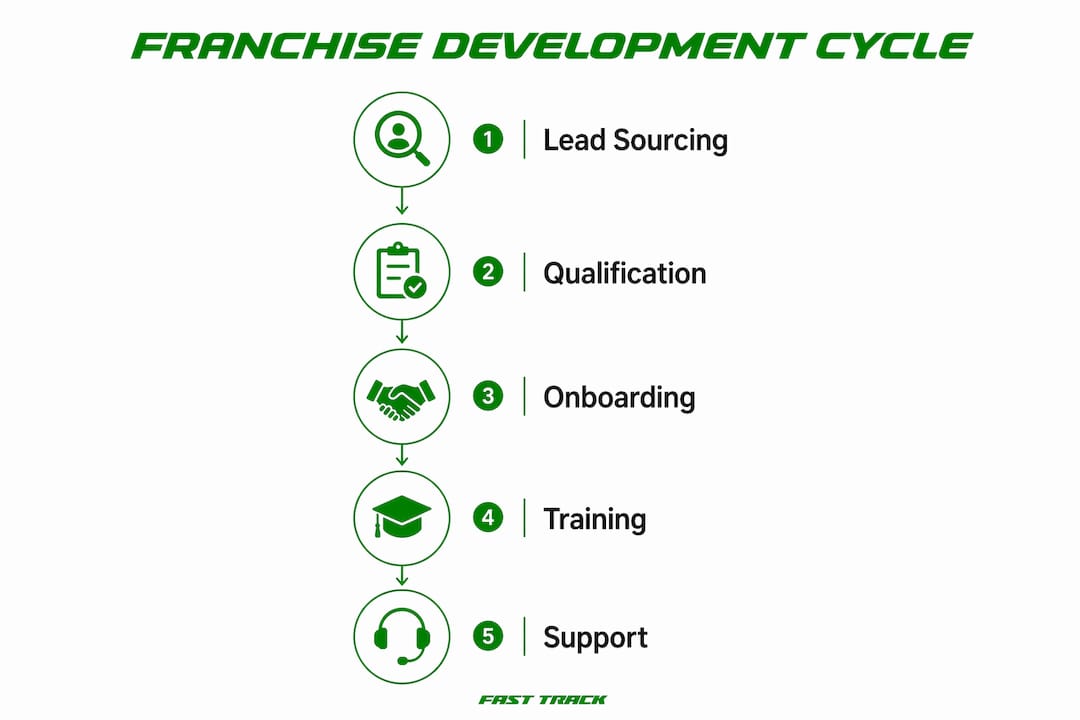
Franchise development is defined as the full-cycle process of recruiting, qualifying, onboarding, and supporting new franchisees within a structured organizational framework. It is not a sales function bolted onto operations. It is a discipline that requires its own staff, its own data, and its own accountability.
Emerging franchises reaching 20–50 units typically require their first dedicated field consultant or franchise business consultant. That threshold matters because it marks the point where a founder or operations manager can no longer personally track every new franchisee's progress, training completion, and market readiness. Below that number, informal oversight works. Above it, the system starts to fracture without dedicated support.

The staffing needs for franchises at this stage go beyond hiring a salesperson. A development team must coordinate across operations, training, marketing, and real estate to ensure every new unit opens into a prepared market. Franchise development must be integrated into the full enterprise plan, not treated as a standalone sales target. That integration is what separates brands that scale cleanly from those that grow fast and then spend years cleaning up the damage.
How dedicated staff enable strategic pacing of growth
Pacing is the most underestimated factor in franchise expansion. Selling units faster than your infrastructure can support them does not accelerate growth. It stretches your system until something breaks.
Selling into markets without existing operational infrastructure produces "stretched" systems rather than accelerated growth. A stretched system means your training team is overbooked, your field consultants are covering too many units, and your new franchisees are not getting the support they were promised. That gap between promise and delivery is where franchisee trust erodes fastest.
Dedicated development staff solve this by acting as the connective tissue between sales ambition and operational reality. They track training capacity before approving new signings. They coordinate with real estate teams to confirm site readiness. They flag when a new market lacks the support density to absorb another unit. Without that function sitting inside your organization full-time, those checks simply do not happen consistently.
Pro Tip: Before approving any new franchise signing, have your development team run a formal operational readiness check covering training slots, field support availability, and market infrastructure. Treat it as a non-negotiable step in your approval process.
Key responsibilities that dedicated development staff own at this stage:
- Tracking training and onboarding capacity before new signings are approved
- Coordinating with field operations to confirm support ratios are sustainable
- Monitoring market concentration to prevent internal cannibalization
- Aligning real estate timelines with franchisee launch schedules
- Reporting pipeline data to senior leadership for capacity planning
Each of these tasks requires dedicated attention. Assigning them to staff who already carry full operational loads guarantees they get deprioritized under pressure.
How does a development team improve lead quality and conversion?
Lead generation and full-cycle franchise development are not the same thing. Lead generation produces names. Full-cycle development produces qualified, committed franchisees who are likely to succeed inside your system.
A true development team focuses on candidates with leadership skills to implement the brand's systems, not just candidates who meet a financial threshold. Capital qualifies someone to write a check. Leadership capability determines whether they will build a team, follow your operating standards, and grow within your network. Development staff who understand this distinction produce franchisees with longer tenures and stronger unit economics.
Data is the other critical advantage. Development staff require engagement and funnel metrics beyond raw lead counts to optimize their lead-to-close ratios. A development team that tracks where candidates drop out of the funnel, which touchpoints drive the most engagement, and which candidate profiles convert at the highest rates can continuously refine their recruitment process. A generalist handling development alongside other duties rarely has the bandwidth to analyze that data, let alone act on it.
- Define your ideal operator profile, including cultural alignment and operational capability, before sourcing candidates.
- Score inbound leads against that profile before investing development time in discovery calls.
- Track funnel stage conversion rates weekly to identify where qualified candidates are dropping out.
- Align marketing messaging with the candidate profile your development team is actually trying to attract.
- Use engagement data from email, webinars, and discovery days to prioritize follow-up sequencing.
Pro Tip: Build your ideal franchisee profile around operational capability first and financial qualification second. Candidates who can execute your system reliably are worth more to your brand than well-funded candidates who cannot follow a process.
Alignment of marketing, sales, and operations is what maximizes lead quality and conversion in franchise development. Dedicated staff create that alignment because they sit at the intersection of all three functions.
What organizational structures support a dedicated development team?
The structure of your franchise development team should match the size and complexity of your system. A brand at 15 units needs different staffing than a brand at 150 units.
General guidance sets one field consultant per 15–25 franchisees, adjusted by support requirements and geographic concentration. A complex food service brand with high operational intensity needs a tighter ratio. A home services brand with simpler operations can support a wider span. The ratio is a starting point, not a fixed rule.
| Franchise size | Typical staffing structure | Primary focus |
|---|---|---|
| Under 20 units | Founder-led with fractional support | Unit sales and initial onboarding |
| 20–50 units | First dedicated field consultant | Support ratios and training capacity |
| 50–150 units | Development director plus field team | Candidate qualification and regional growth |
| 150+ units | Full development department | Multi-unit operators and system standards |
Fractional franchise development can accelerate early-stage growth, with full-time staff becoming critical as systems mature. This is a practical path for brands that are not yet ready to fund a full internal team. A fractional development director brings process and structure without the full overhead. The transition to full-time, embedded leadership happens when your pipeline volume and system complexity demand it.
Scaling responsibly requires building excess capacity before you feel strained, not after. The brands that get this right hire their second field consultant before their first one is overwhelmed. They build franchise support systems that can absorb the next 20 units before those units are sold. That discipline is only possible when someone inside the organization owns it as their primary job.
The transition from founder-led to professional development teams is the most critical organizational shift a growing franchisor makes. It requires giving up direct control of the sales process and trusting a team to represent your brand in front of prospective franchisees. Franchisors who delay that transition consistently find themselves stuck at the same unit count for years.
What happens when franchisors grow without dedicated development staff?
The consequences of unmanaged growth are predictable and well-documented. They follow a consistent pattern regardless of the brand or industry.
Scaling without dedicated infrastructure overworks support teams and drives down morale, which directly lowers unit economics. When your existing franchisees feel neglected because your support team is stretched thin serving new openings, their performance declines. That decline shows up in your system-wide averages, which then makes it harder to recruit the next generation of qualified candidates.
The specific failure points that dedicated development staff prevent include:
- Pipeline congestion from approving more signings than your training team can onboard
- Franchisee frustration when launch timelines slip because real estate or construction support is unavailable
- Brand inconsistency when new franchisees open without completing full training
- Multi-unit operator dissatisfaction when their expansion requests are mismanaged
- Candidate dropout when development follow-up is slow or inconsistent
Scaling requires dedicated, embedded leadership to build systems, mentor teams, and own outcomes. Without that ownership, every growth problem becomes a crisis instead of a managed challenge. The franchisor who has a development director fielding a franchisee complaint about slow onboarding can resolve it in a day. The franchisor who has no one owning that function lets the complaint fester until it becomes a legal or reputational issue.
The role of development in franchises is ultimately about protecting what you have built while adding to it. Every new franchisee you sign either strengthens your system or strains it. Dedicated staff are the mechanism that determines which outcome you get. You can learn more about candidate nurturing strategies that keep qualified prospects engaged through the full development cycle.
Key Takeaways
Dedicated franchise development staff are the single most important structural investment a franchisor makes to protect unit economics, maintain brand standards, and sustain profitable growth.
| Point | Details |
|---|---|
| Staff threshold at 20–50 units | Hire your first dedicated field consultant before your system shows strain, not after. |
| Pacing beats speed | Development staff align sales with training and operational capacity to prevent stretched systems. |
| Candidate quality over volume | Development teams qualify on leadership capability, not just financial thresholds. |
| Staffing ratios matter | One field consultant per 15–25 franchisees is the standard starting point, adjusted by complexity. |
| Infrastructure before growth | Build support capacity ahead of demand to protect franchisee morale and unit economics. |
The part most franchisors learn too late
I have watched franchisors build genuinely great brands and then nearly destroy them by treating development as a sales problem. They hire a closer, set a unit target, and push. The units get sold. The problems come six months later when three new franchisees are waiting on training slots, two are behind on their build-outs, and the founder is personally fielding calls at 9 PM because no one else owns the relationship.
The uncomfortable truth is that franchise development is an operations function wearing a sales uniform. The best development directors I have seen are not the best salespeople. They are the best systems thinkers. They understand that every signed franchise agreement creates a set of obligations that must be fulfilled before the next one is signed.
What I have found actually works is treating your development team's capacity as a hard constraint on your growth rate. Not a soft guideline. A hard constraint. If your field team cannot support 10 more units without dropping below your service standard, you do not sell 10 more units until you hire. That discipline feels slow in the short term. It is the only thing that produces a system worth owning in the long term.
The franchisors who build the most valuable systems are not the fastest growers. They are the most consistent ones. Consistency requires people who own the process full-time, with the data, the authority, and the accountability to make it work. That is what dedicated development staff actually are.
— Cody
How Franchise Fast Track fits into your development function
Building a dedicated franchise development team is the internal work. Filling that team's pipeline with qualified, high-income candidates is where Franchise Fast Track comes in.
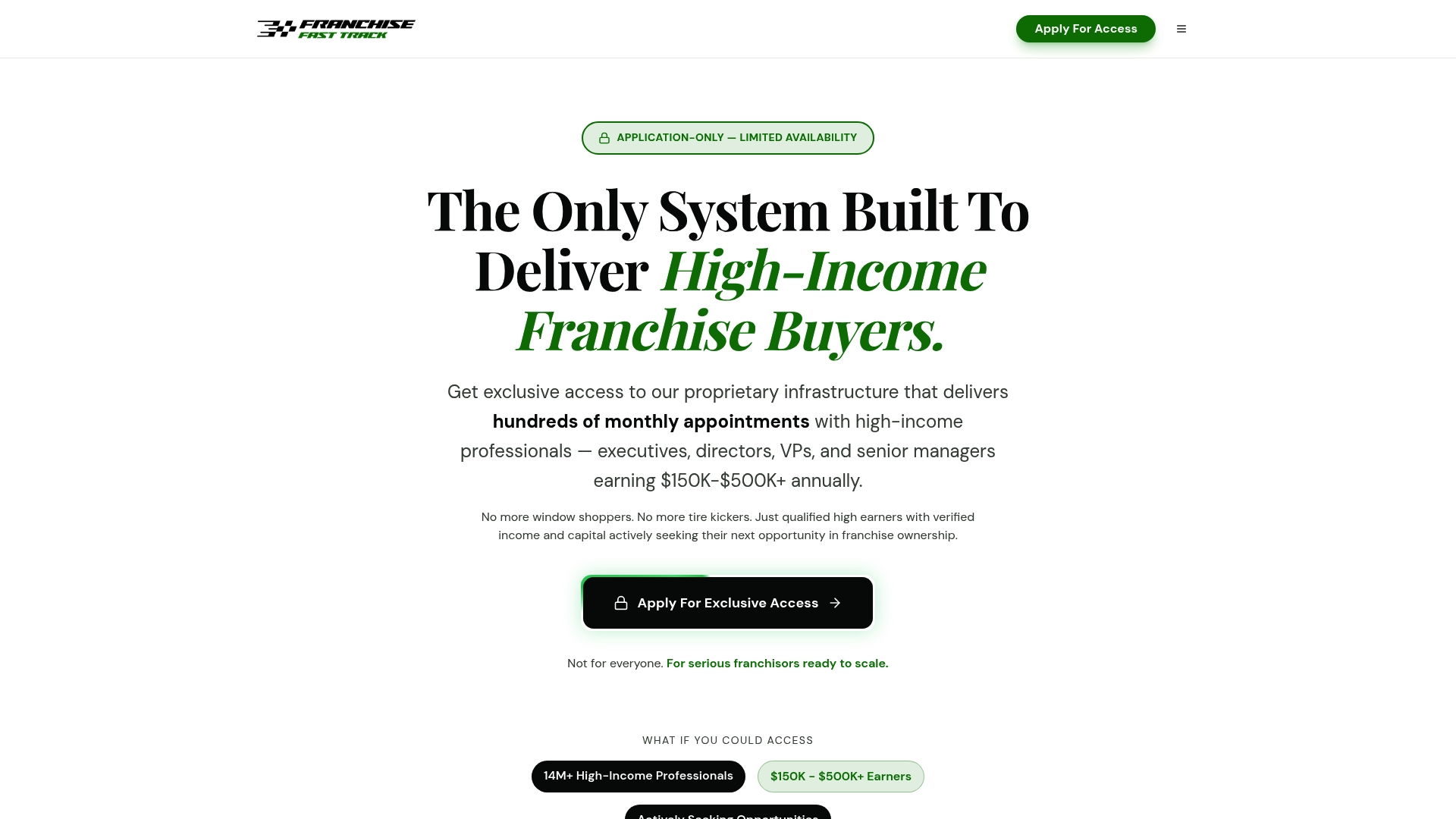
Franchise Fast Track delivers verified appointments with professionals earning $150,000–$500,000 annually, including executives, directors, and senior managers actively exploring franchise ownership. Your development team gets to spend its time on candidates who are already financially qualified and genuinely interested, not filtering through unqualified inquiries. The platform's qualified lead generation integrates directly with in-house development teams, supporting a reported 34% lead-to-close rate. If you are building or scaling your franchise development function, explore the full development services to see how outsourced top-of-funnel support fits your current growth stage.
FAQ
When should a franchisor hire dedicated development staff?
The standard threshold is 20–50 units, when a founder or generalist can no longer personally manage recruitment, onboarding, and franchisee support simultaneously. Hiring before you feel the strain is the correct approach.
What does a franchise development team actually do?
A development team manages the full cycle from candidate sourcing and qualification through onboarding, training coordination, and ongoing franchisee support. It is not a sales team. It is a cross-functional function that connects recruitment with operations.
How many field consultants does a franchise system need?
General guidance is one field consultant per 15–25 franchisees, adjusted by the operational complexity of the brand and the geographic concentration of units. High-complexity systems require tighter ratios.
What is the difference between fractional and full-time development staff?
Fractional development support works well in early-stage systems under 20–30 units, providing structure without full overhead. Full-time, embedded staff become necessary as pipeline volume grows and system complexity demands dedicated ownership of outcomes.
How does dedicated development staff improve franchisee success rates?
Dedicated staff qualify candidates on leadership capability and cultural fit, not just capital. They also pace growth to match training and support capacity, which means new franchisees open into prepared systems with adequate resources behind them.
Recommended
- Franchise Development: Outsourced Top-of-Funnel for In-House Franchise Development Teams | Franchise Fast Track
- Franchise Growth Agency: Grow Your System With Funded Franchisees | Franchise Fast Track
- A High-Growth Guide to Franchise Development Services | Franchise Fast Track Blog
- Franchise Development Services: Grow Your Brand With Qualified Candidates | Franchise Fast Track Blog
Ready to see results like these for your franchise?
Stop wasting money on leads that never close. Start getting hundreds of replies from high-net-worth professionals daily.