Turnkey Franchise Units: A Franchisor's Guide to Buyer Recruitment
A turnkey business, in franchising terms, is a ready-to-open unit the franchisor packages with site selection, build-out, equipment, training, and opening support already handled. The fastest way to fill those units is a targeted outbound appointment program that verifies income and buying intent before a rep ever picks up the phone.
Franchisors who wait for inbound inquiries end up qualifying tire-kickers. The ones who win territory faster run verification-first outreach aimed at executives and directors who can actually fund a franchise fee and build-out. Here's what a turnkey package needs to include and how to get it in front of buyers who close.
- Site selection and lease negotiation support
- Build-out, equipment, and opening inventory
- Item 11 training and operational systems
- Grand-opening marketing support
- A vetted buyer pipeline, not just a listing
Pro Tip: If your turnkey messaging doesn't specify what's excluded, expect renegotiation fights after signing. Buyers assume more is bundled in than usually is.
For franchisors who don't want to build that pipeline in-house, Franchise Fast Track delivers verified appointments with high-income prospects already screened for intent.
Key Takeaways
Turnkey conversion speed depends on verification-first buyer recruitment, precise FDD disclosure of inclusions, and a repeatable qualification workflow tied to measurable KPIs.
| Point | Details |
|---|---|
| Define turnkey precisely | List every inclusion and exclusion in writing so buyers don't assume staffing or permits are covered. |
| Disclose on time | Deliver the FDD at least 14 days before any signature or payment, per the FTC Franchise Rule. |
| Verify before you meet | Screen income, liquidity, and intent before booking a discovery call to protect closer time. |
| Track the full funnel | Measure appointment-to-offer, offer-to-award, and time-to-award, not just lead-to-close. |
| Use a specialist for volume | Franchise Fast Track delivers verified, high-income appointments built to lift lead-to-close rates and cut wasted meetings. |
Where to Verify These Details Further
- FTC's consumer guide for legal disclosure language
- Entrepreneur's turnkey franchise explainer for definitional nuance
- Franchise Fast Track's glossary for quick term lookups like Item 11 or FDD
Table of Contents
- What Does "Turnkey Franchise" Actually Mean for Franchisors?
- Why Do Turnkey Offers Convert Faster Than Ground-Up Builds?
- What Legal Disclosures Must Franchisors Get Right?
- How Do You Attract Qualified Buyers for Turnkey Units?
- How Should You Qualify and Convert Turnkey Leads?
- What Does an 8-Week Recruitment Sprint Look Like?
- What We've Learned About Turnkey Recruitment
- Ready for Verified Appointments With Qualified Buyers?
- Frequently Asked Questions
- Sources
What Does "Turnkey Franchise" Actually Mean for Franchisors?
A turnkey package bundles most of the heavy lifting into one offer: site selection, build-out, equipment, opening inventory, initial marketing, and the training system tied to Item 11 of your FDD. It typically covers startup costs and services that would otherwise force a first-time buyer to juggle contractors, vendors, and permitting on their own.
What it almost never includes: local permits, insurance, staffing, hiring, and working capital. The word "turnkey" implies the franchisor handles everything, but true end-to-end turnkey, where the franchisor even staffs the unit, is rare in practice, according to Entrepreneur's franchise buying guide.
- Include: build-out, equipment, opening inventory, training, initial marketing
- Exclude: permits, insurance, hiring, day-to-day working capital
- Selling point example: "You open with trained systems and a stocked location, not a construction project."
Say this plainly in your materials. A buyer who learns about staffing costs after signing is a buyer who resents the deal, and possibly a buyer whose attorney calls yours.
Why Do Turnkey Offers Convert Faster Than Ground-Up Builds?
Buyers hesitate on ground-up franchise deals because the timeline is fuzzy and the total cost is a moving target. Turnkey removes both objections at once. It shortens time-to-revenue, fixes most costs upfront, and hands the buyer a working system on day one instead of a construction punch list.
- Shorter decision timeline (fewer unknowns to research)
- Lower perceived project risk (franchisor absorbs coordination)
- Known costs upfront, fewer surprise change orders
- Faster time-to-opening, which shortens the sales cycle itself
Franchisors that can promise a firm opening date close faster, since clear startup milestones are one of the most persuasive elements in outreach messaging.
Pro Tip: In discovery calls, ask buyers what's stopping them from investing today. Nine times out of ten it's timeline uncertainty or cost uncertainty. Turnkey answers both, so lead with your opening-date guarantee, not your brand history.
What Legal Disclosures Must Franchisors Get Right?
The FTC Franchise Rule requires you to deliver the Franchise Disclosure Document at least 14 days before a prospect signs anything or pays a dollar. That FDD needs to spell out Item 11 (training) and Item 7 (estimated initial investment) with enough detail that "turnkey" isn't doing the legal work your contract should be doing.
Ambiguity here is where deals sour. Since the turnkey label ranges from full to partial packages, your FDD language has to state precisely which line items you cover and which the franchisee funds.
Publish a checklist that removes the guesswork:
- What's bundled into the turnkey fee, itemized by category
- Who pays if build-out runs over budget
- Payment timing and milestones tied to construction progress
- Whether the coordination fee includes a markup over vendor cost
Turnkey fees are frequently packaged as a lump sum that includes a coordination margin, so buyers should be able to request an itemized breakdown, and franchisors should be ready to provide one. Roughly 23 items appear in a standard FDD, and skipping precision on any of them invites disputes after the ink dries. Have franchise counsel review every turnkey-specific clause before it reaches a prospect.
How Do You Attract Qualified Buyers for Turnkey Units?
Volume isn't the problem most franchise development teams have. Wasted meetings are. The channels below work, but they only work if you filter for buyers who can actually fund the deal.
- Verified outbound appointment-setting. Targeted outreach that screens for income and liquidity before booking a call beats broad lead-gen on quality every time.
- Paid search and LinkedIn. High-intent keywords ("buy a franchise," "turnkey franchise opportunities") and LinkedIn targeting by job title reach buyers already in an ownership mindset.
- Referral and CPA incentives. Existing franchisees are your most credible recruiters; pay for warm introductions.
- Franchisee-to-franchisee sourcing. Operators inside your system often know peers ready to expand into a second unit.
Target executives, directors, and senior managers earning $150,000 to $500,000 annually, plus small business owners looking for a lower-risk path into ownership than starting from scratch. That income band typically has the liquidity to clear a franchise fee and qualify for financing without months of delay.
Your messaging should do the filtering for you. A landing page headline like "Own a Turnkey Location, Open in 90 Days" pulls a different buyer than "Explore Franchise Ownership." Outreach snippets that mention verified investment ranges and opening timelines qualify prospects before they ever book a call.
Pro Tip: Push income and liquidity verification to the very top of your funnel, not the middle. Every unqualified prospect who reaches a senior rep is a wasted hour that should have gone to a buyer who can close. Matching buyer profiles to the right opportunity early keeps your pipeline clean.
How Should You Qualify and Convert Turnkey Leads?
Run a repeatable workflow instead of ad hoc screening. A verification-first process, screen, verify, schedule, approve, consistently reduces wasted seller time and speeds up conversion.
- Initial screening. Confirm income range, general timeline, and territory interest.
- Verification calls. Confirm income, net worth, and liquidity against your minimum thresholds.
- Document collection. Financial statements, background check consent, franchise experience history.
- Discovery meeting. Senior rep walks the buyer through the turnkey package, costs, and territory specifics.
- Approval committee. Final review and award decision.
Qualification criteria worth codifying: minimum liquid capital, net worth floor, no disqualifying litigation history, a realistic timeline to open, and genuine territory intent rather than casual curiosity.
Track these metrics against every cohort of buyers:
- Appointment-to-offer rate
- Offer-to-award rate
- Lead-to-close rate
- Time-to-award (days from first contact to signed agreement)
- No-show rate on scheduled discovery calls
Franchisors using verified appointment programs report lead-to-close rates around 34%, well above what unfiltered inbound typically produces. That gap is the whole argument for verification-first recruiting: fewer meetings, more of them ending in signed agreements.
Hand off verified appointments to closers with a full profile attached, income tier, stated timeline, and territory preference, so the first conversation with a senior rep is a negotiation, not a re-qualification. During that conversation, lean on turnkey specifics: guaranteed opening date, fixed cost ranges, and included training as concrete points against competing offers the buyer may be weighing.

What Does an 8-Week Recruitment Sprint Look Like?
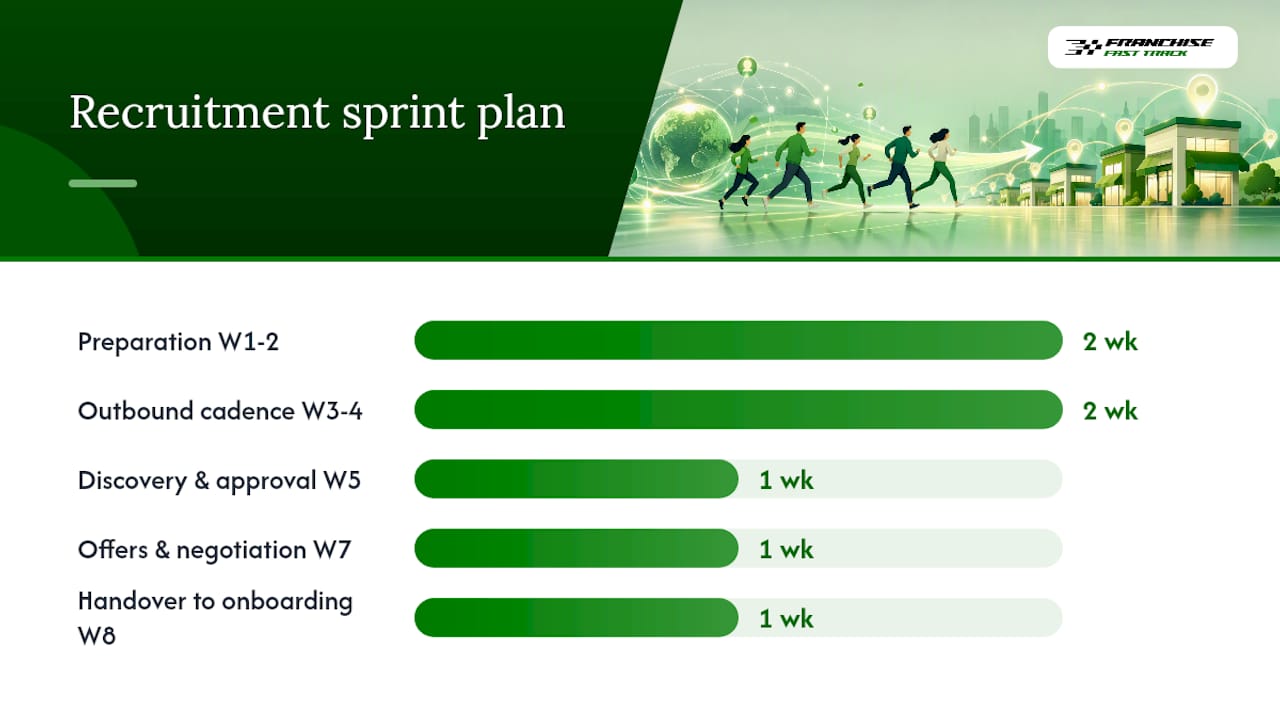
You can stand up a functioning recruitment pipeline in two months if marketing, outbound, and closing teams move on the same schedule.
| Week | Milestone |
|---|---|
| 1 | Define target buyer profile and finalize messaging |
| 2 | Build prospect lists and launch paid channels |
| 3-4 | Run outbound cadence and verification calls |
| 5 | Hold discovery meetings and route to approval committee |
| 7 | Extend offers and negotiate terms |
| 8 | Complete handover to onboarding and opening prep |
Set up your CRM before week one, not during week three. Define calendar rules for discovery meetings, write verification scripts your team actually follows, and fix the cadence of your approval committee so offers don't stall waiting on a meeting that only happens monthly.
Pro Tip: The biggest sprint killer is the handoff gap between marketing and sales. Automate calendar booking so a verified prospect lands directly on a closer's calendar, no manual routing, no delay.
What We've Learned About Turnkey Recruitment
Franchisors who run verified, high-income appointment programs consistently see shorter sales cycles than those relying on broad demand generation. The pattern holds because quality replaces guesswork: when a rep already knows a prospect's income and intent match the offer, the discovery call turns into a negotiation instead of another screening session. Franchise Fast Track built its entire model around that gap.
Ready for Verified Appointments With Qualified Buyers?
If you've been trying to fill turnkey units through inbound forms and franchise portals, you already know the problem: plenty of clicks, few buyers who can actually close. Franchise Fast Track runs verification-first outbound targeting executives, directors, and senior managers earning $150,000 to $500,000 annually, and only books the appointment once income and intent are confirmed.
That means your development team spends its time in negotiations, not qualification calls. Franchise Fast Track also handles pipeline setup and calendar booking, so verified prospects land directly on your closers' schedules without a manual handoff.
If you're ready to see what a verified pipeline looks like for your system, visit the franchise development page to discuss a pilot for your next turnkey unit rollout.
Frequently Asked Questions
What is a turnkey business in franchising? It's a franchise unit the franchisor delivers ready to open, typically bundling site selection, build-out, equipment, initial inventory, and training under one package.
Does turnkey mean the franchisor handles everything? No. Most turnkey packages are partial: franchisors coordinate build-out and vendors but rarely handle staffing, hiring, permits, or insurance.
How fast can a franchisor fill turnkey units with qualified buyers? With a verification-first outbound program, many franchisors run a full recruitment sprint, targeting, verifying, converting, in about eight weeks.
What income range should turnkey buyer targeting focus on? Executives, directors, and senior managers earning $150,000 to $500,000 annually typically have the liquidity to fund a franchise fee and qualify for financing quickly.
Why do verified appointments outperform broad lead generation? Verified appointments filter for income and intent before scheduling, so closers spend time negotiating instead of re-qualifying unqualified prospects.
Sources
Recommended
- How Do I Become a Franchise Owner: A Franchisor's Roadmap | Franchise Fast Track Blog
- How to Become a Franchise Owner: Your Essential Guide | Franchise Fast Track Blog
- Franchise Recruitment: We Headhunt Funded Franchisees for Your Brand | Franchise Fast Track
- How to Advertise a Franchise to Capital-Ready Candidates | Franchise Fast Track Blog
Ready to see results like these for your franchise?
Stop wasting money on leads that never close. Start getting hundreds of replies from high-net-worth professionals daily.