How to Vet Franchise Concepts for Clients: 2026 Guide

Vetting vet franchise concepts for clients means systematically comparing investment costs, royalty structures, operational models, and franchisor support to identify the best ownership fit in veterinary care. The pet care industry has expanded well beyond traditional animal clinics, creating a wide spectrum of veterinary franchise opportunities that range from mobile units to retail-integrated wellness centers. Franchise consultants who approach this evaluation without a structured framework risk placing clients in models that conflict with their financial capacity, lifestyle goals, or clinical background. This guide gives you the criteria, data, and process to make confident, client-centered recommendations.
What key financial metrics to analyze when vetting vet franchise concepts for clients
Financial due diligence is the first filter every franchise consultant should apply. The numbers tell you whether a concept is viable before you spend time evaluating anything else.
Initial investment ranges vary significantly by model. Mobile veterinary franchises carry entry costs between $144,000 and $234,000. In-store clinical franchises run $206,000 to $316,000. Wellness clinic concepts reach as high as $513,000 on the upper end. That spread means a client with $200,000 in liquid capital has real options in mobile and some in-store models, but is effectively locked out of premium wellness clinic concepts without additional financing.

Franchise fees add another layer of differentiation. Across veterinary franchise concepts, fees range from $10,000 to $45,000. The fee alone does not signal quality, but it does signal how much the franchisor invests in onboarding and training infrastructure.
Royalty structures deserve the closest scrutiny. Basic clinic models charge royalties between 2.0% and 3.5%, while mobile specialty franchises can charge up to 20.0%. That gap is not arbitrary. Higher royalties in mobile models often come with exclusive territories and lead generation software that lower-royalty concepts do not provide. The question is whether the value exchange justifies the ongoing cost.
Pro Tip: Always calculate the total five-year royalty burden at projected revenue, not just the percentage. A 20% royalty on a $300,000 annual revenue stream costs $300,000 over five years. That number changes the conversation.
Newer franchise concepts carry a distinct risk profile. Emerging franchises show higher investment variability and less historical revenue data, which makes financial projections less reliable. Average sales figures around $627,000 may look attractive, but without multi-year validation, those numbers carry wide confidence intervals. Clients who need predictable income timelines should weight established concepts more heavily.
| Financial Metric | What to Evaluate |
|---|---|
| Initial investment | Compare liquid capital requirement against client's available funds |
| Franchise fee | Assess what training and onboarding the fee covers |
| Royalty rate | Calculate five-year total cost at projected revenue |
| Revenue history | Prioritize concepts with at least three years of franchisee sales data |
| First-year waivers | Identify whether the franchisor offers royalty relief during ramp-up |
How do operational models affect franchisee experience in vet franchises?
The financial profile tells you what a franchise costs. The operational model tells you what owning it actually feels like day to day. These are two different conversations, and both matter.
Mobile veterinary franchises are built around fully equipped vans that bring diagnostics directly to clients' homes. The mobile model targets veterinary burnout by giving owners control over their schedules and reducing the stress that comes from high-volume clinic environments. Pets are calmer in familiar surroundings, which also improves the quality of examinations. For veterinarians who left traditional practice because of the pace, this model addresses the root cause directly.
The operational trade-off is equipment maintenance. Mobile units carry sensitive diagnostic equipment subject to vibration-related wear that fixed-location clinics never face. Franchise consultants should audit the FDD specifically for maintenance cost disclosures and ask existing franchisees what their annual equipment repair bills look like. This cost rarely appears prominently in marketing materials.
In-store clinical franchises, particularly those integrated with large pet retail environments, offer a different proposition. The retail-integrated model lets veterinarians focus exclusively on clinical care while the franchisor manages retail operations, marketing, and customer flow. Low royalties in the 2.5%–3.5% range and first-year fee waivers make the financial entry more accessible. The hidden complexity is operational dependency. Franchisees in retail-integrated clinics navigate facility coordination and customer flow patterns that standalone clinic owners never encounter.
Walk-in wellness clinics occupy a middle ground. They prioritize accessibility and volume over appointment-based scheduling, which suits clients who want to build community presence quickly. The client volume potential is high, but so is the staffing complexity.
Pro Tip: Ask your client to spend a half-day shadowing an existing franchisee in each model they are considering. No amount of FDD reading replaces watching the actual workflow.
Non-clinical pet services franchises represent a separate category worth understanding. Dog daycare, pet sitting, and pet resort concepts do not require veterinary licensure and prioritize hospitality over medical liability. For clients without clinical backgrounds who still want to operate in the pet care space, these models offer a cleaner path to ownership. Franchise Fast Track's catalog includes several pet care franchise options across this non-clinical segment.
What do franchise support systems and territory protections mean for vet franchise owners?
Support and territory structure are where many franchise evaluations fall short. Consultants often focus on the entry cost and skip the ongoing relationship with the franchisor. That relationship determines whether a franchisee thrives or stalls after year two.
Strong franchisor support in veterinary concepts typically includes:
- Marketing assistance: Digital advertising, local SEO campaigns, and branded client acquisition materials
- Training programs: Initial clinical and business operations training, plus ongoing education as protocols evolve
- Proprietary software: Scheduling, client management, and in some mobile models, lead generation platforms
- Operational manuals: Step-by-step guidance for daily clinic management, compliance, and staff protocols
Territory protection is equally consequential. Exclusive territories justify higher royalty fees in mobile specialty models because the franchisor actively generates leads within that territory and prevents other franchisees from competing for the same clients. Without territorial exclusivity, a franchisee's marketing investment can be diluted by a neighboring unit. Always confirm in the FDD whether territory protection is guaranteed or merely advisory.
Retail-based clinic franchises expose franchisees to hidden costs beyond stated fees. Facility coordination with the host retailer, dependency on the retailer's foot traffic, and shared customer service expectations create operational complexity that does not appear in the initial investment summary. Clients who underestimate these dependencies often find their first year harder than projected.
The right support framework depends on what your client actually needs. A veterinarian with strong clinical skills but limited business experience needs robust back-office support. An experienced operator with a business background may prioritize territory exclusivity over training depth. Match the support profile to the client's gap, not to the franchise's marketing pitch.
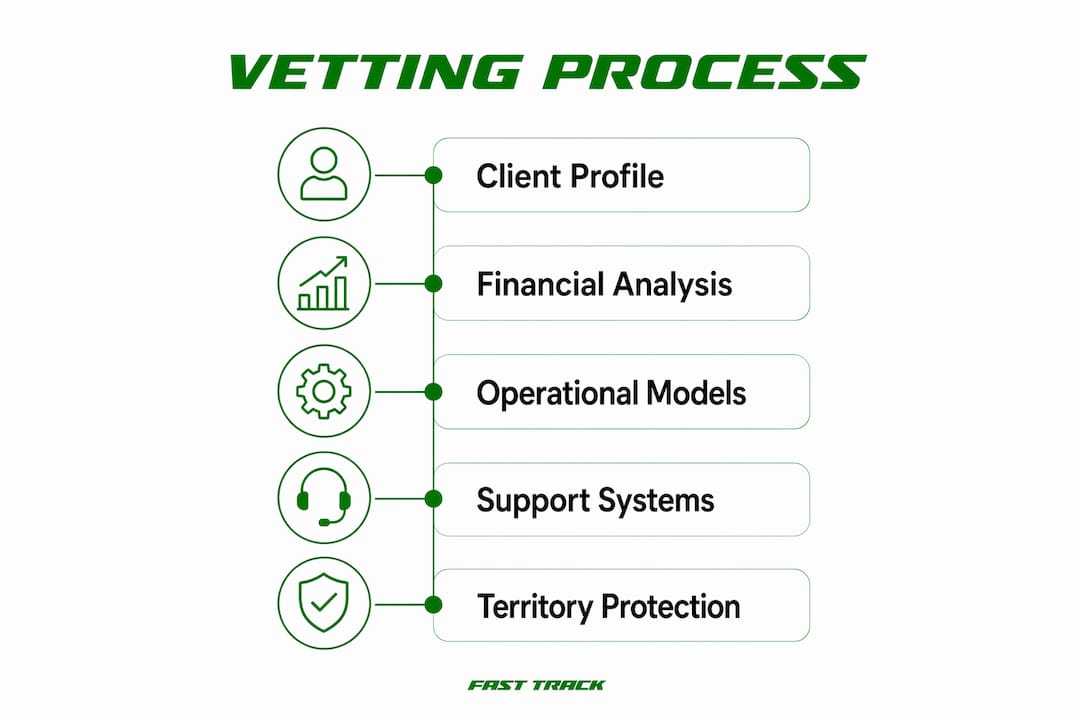
Step-by-step approach to vetting veterinary franchise opportunities
A repeatable evaluation process protects both your clients and your reputation as a consultant. The following sequence applies across all veterinary franchise models.
-
Define the client profile first. Establish liquid capital, clinical background (if any), preferred work schedule, and geographic market before opening a single FDD. The profile filters out mismatched concepts before you invest evaluation time.
-
Request and read the full FDD. Item 19 (financial performance representations) and Item 21 (audited financials) are non-negotiable reads. If a franchisor does not provide an Item 19, treat that as a red flag. Absence of financial performance data forces you to rely entirely on the franchisor's verbal claims.
-
Calculate the true five-year cost. Add initial investment, franchise fee, royalties at projected revenue, marketing fund contributions, and estimated equipment maintenance. Compare this total across concepts, not just the entry fee.
-
Interview existing franchisees directly. The FDD's Item 20 lists current and former franchisees with contact information. Call at least five. Ask specifically about support responsiveness, territory conflicts, and whether their actual revenue matched the Item 19 projections.
-
Evaluate the territory agreement. Confirm whether protection is geographic, population-based, or customer-list-based. Each structure has different implications for long-term growth.
Pro Tip: Former franchisees listed in Item 20 are often more candid than current ones. They have less to lose by telling you what went wrong.
| Evaluation Step | Key Question to Answer |
|---|---|
| Client profile | Does this concept match the client's capital, skills, and lifestyle goals? |
| FDD review | Does Item 19 show consistent franchisee revenue across multiple years? |
| Five-year cost model | Is the total financial commitment sustainable at conservative revenue projections? |
| Franchisee interviews | Do current owners confirm the support and territory terms described in the FDD? |
| Territory review | Is the protection legally binding and clearly defined in the franchise agreement? |
For consultants advising clients on franchise ownership models, the process above applies regardless of the specific veterinary concept under review. The criteria remain consistent even when the concepts differ significantly.
Key Takeaways
Vetting veterinary franchise concepts requires comparing investment ranges, royalty structures, operational models, and territory protections against each client's financial capacity and professional goals.
| Point | Details |
|---|---|
| Investment ranges vary widely | Mobile concepts start at $144,000; wellness clinics can reach $513,000, so match the model to client capital. |
| Royalties reflect value exchange | Rates from 2.0% to 20.0% reflect territory exclusivity and lead generation support, not just brand access. |
| Operational model shapes daily life | Mobile, retail-integrated, and walk-in models create fundamentally different franchisee experiences beyond the financials. |
| Hidden costs require FDD scrutiny | Equipment maintenance, facility coordination, and retail dependencies rarely appear in marketing summaries. |
| Franchisee interviews are non-negotiable | Former franchisees listed in Item 20 provide the most candid picture of real-world performance. |
What I've learned from vetting vet franchises for clients
The biggest mistake I see franchise consultants make is leading with the concept instead of the client. A mobile veterinary franchise with strong territory protection and a compelling royalty-to-value ratio is irrelevant if your client has two young kids and cannot handle unpredictable scheduling. The concept has to fit the life, not just the balance sheet.
The second pattern I've noticed is that consultants underweight the operational model conversation. Clients hear "veterinary franchise" and picture a clinic. When they discover that a retail-integrated model means navigating a retailer's store hours, customer flow, and facility management team, some of them feel blindsided. That conversation needs to happen before the FDD review, not after.
What consistently separates strong vet franchise concepts from weak ones is franchisor responsiveness during the evaluation process itself. If a franchisor is slow to provide Item 19 data, vague about territory boundaries, or reluctant to connect you with existing franchisees, that behavior predicts the support experience your client will have post-signing. The evaluation period is the franchisor's best opportunity to impress you. Take note of how they use it.
Finally, I've found that clients who enter with realistic revenue expectations outperform those who anchor to best-case Item 19 numbers. Build your client's financial model on the median franchisee performance, not the top quartile. That discipline protects the relationship when year one is slower than projected.
— Cody
How Franchise Fast Track supports vet franchise development
Finding the right veterinary franchise concept is only half the challenge. Filling it with qualified franchisee candidates is the other half, and that is where most franchisors lose time and money chasing unqualified leads.

Franchise Fast Track delivers appointments with verified high-income professionals earning between $150,000 and $500,000 annually, the exact buyer profile that veterinary franchise concepts require. The platform's franchise lead generation system connects franchisors directly with executives, directors, and senior managers who are actively seeking ownership opportunities. With a reported lead-to-close rate of 34%, Franchise Fast Track gives franchisors a measurable advantage over traditional advertising methods that produce volume without qualification.
FAQ
What is the typical investment range for a veterinary franchise?
Investment ranges run from $144,000 for mobile concepts to $513,000 for premium wellness clinic models, with franchise fees between $10,000 and $45,000. The right range depends on the client's available capital and preferred operational model.
How do royalty fees differ across vet franchise models?
Basic clinic models charge royalties as low as 2.0%–3.5%, while mobile specialty franchises can charge up to 20.0%. Higher royalties typically come with exclusive territories and lead generation tools that lower-royalty concepts do not include.
Why does territory protection matter in veterinary franchises?
Exclusive territory protection prevents neighboring franchisees from competing for the same clients and justifies higher royalty fees in mobile models. Without legally binding territory terms in the franchise agreement, a franchisee's marketing investment can be undercut by a nearby unit.
What should franchise consultants look for in an FDD?
Item 19 (financial performance representations) and Item 21 (audited financials) are the most critical sections. If Item 19 is absent, the franchisor is not required to provide revenue projections, which forces consultants to rely on unverified claims.
Are non-clinical pet franchises a viable alternative for clients without veterinary licenses?
Non-clinical pet service franchises cover dog daycare, pet sitting, and pet resort concepts that do not require veterinary licensure. These models prioritize hospitality and community impact, making them accessible to clients who want to operate in the pet care space without a clinical background.
Recommended
- Emerging Franchise Brands: Your 2026 Investment Guide | Franchise Fast Track Blog
- Blog - Franchise Fast Track | Franchise Development Insights
- Financing for a Franchise: Franchisor's 2026 Guide | Franchise Fast Track Blog
- Business Consulting Franchises: 2026 Guide for Franchisors | Franchise Fast Track Blog
Ready to see results like these for your franchise?
Stop wasting money on leads that never close. Start getting hundreds of replies from high-net-worth professionals daily.