How Franchise Development Budgets Are Allocated in 2026
Franchise development budget allocation is the process of dividing a franchisor's total development spend across marketing, lead generation, salaries, legal compliance, technology, and working capital reserves to drive consistent franchisee recruitment. How franchise development budgets are allocated directly determines whether a system grows predictably or stalls between sales cycles. The core insight: franchisors who separate local marketing spend from national branding, and operating capital from owner compensation, consistently outperform those who treat the budget as a single pool. The 70/30 Rule and tiered working capital models are now the two benchmarks shaping franchise development finance in 2026.
How are franchise development budgets allocated across key categories?
The major budget categories in franchise development are marketing and lead generation, employee compensation, legal and compliance, technology, and operational reserves. Each category carries a different cost profile depending on system size and growth stage.
First-year sales and marketing costs vary dramatically by system size. Emerging franchisors typically spend $25,000 to $75,000 in their first year, while larger systems invest $500,000 to over $2 million annually. That gap reflects the difference between a lean concept with one salesperson and a national brand running a full development team with paid digital campaigns across multiple channels.

Marketing budgets as a percentage of gross system-wide revenue typically fall between 3% and 8%. High-growth brands push toward the upper end of that range to stay competitive in crowded markets. Franchisees often contribute separately to local marketing funds, which means the franchisor's corporate budget does not carry the full load.
Legal and compliance costs are fixed but significant. Drafting or updating a Franchise Disclosure Document (FDD) runs $15,000 to $50,000 depending on complexity. Trademark registration, CPA audits required for FDD Item 21, and state registration fees add another $10,000 to $30,000 annually for active growth systems. These costs do not scale with revenue, so early-stage franchisors feel them more acutely.
Technology spending covers franchise development CRMs, lead tracking platforms, and marketing automation tools. These costs are often underestimated in early budgets. A realistic technology line item for a growing system runs $12,000 to $36,000 per year before any paid media spend.
Key budget categories at a glance:
- Marketing and lead generation: 3%–8% of gross system-wide revenue
- Employee compensation: Typically the largest single line item for mid-size systems
- Legal and compliance: $25,000–$80,000 annually for active development
- Technology: $12,000–$36,000 per year for CRM and tracking tools
- Working capital reserves: Should exceed FDD Item 7 estimates by a significant margin
How does the 70/30 Rule reshape franchise marketing budget allocation?
The 70/30 Rule allocates 70% of franchise marketing budgets to hyper-local execution and 30% to national brand support. This flips the traditional model where national campaigns consumed the majority of spend. The shift reflects a fundamental truth: customers choose a franchise location based on proximity, local reviews, and community presence, not national TV spots.
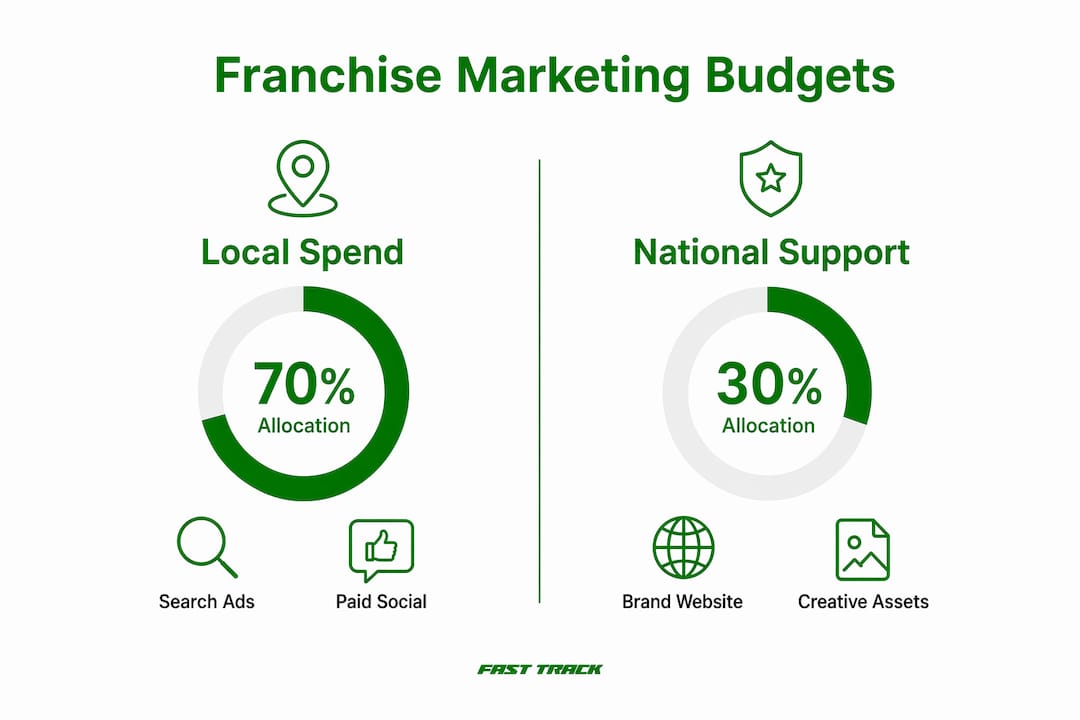
The 70% local allocation covers local search advertising, paid social targeting by zip code, Google Business Profile management, community sponsorships, and neighborhood-level content. These tactics put the brand in front of customers at the exact moment they are searching for a local service. That proximity to the moment of choice is what drives foot traffic and conversion.
The 30% national allocation funds brand credibility assets: the national website, brand standards enforcement, creative resources for franchisees, and innovation pipelines. National spend does not close local sales. It gives franchisees the credibility infrastructure they need to win locally.
Executing this model requires technology. Franchisors need a high-performance marketing strategy that includes localized landing pages, automated review management, and geo-targeted ad platforms. Without the right tools, franchisees cannot execute local campaigns at scale, and the 70% allocation produces inconsistent results across the system.
Local marketing tactics that absorb the 70% allocation:
- Local SEO and Google Business Profile optimization
- Paid social campaigns targeted by radius and demographic
- Community event sponsorships and local PR
- Neighborhood-specific email and direct mail campaigns
- Localized landing pages tied to individual franchise locations
Pro Tip: Implement Closed-Loop Tracking to connect every local ad dollar to a specific customer action. Without it, you cannot tell which local channels are producing revenue and which are burning budget.
What role does tactical lead generation spending play in franchise development budgets?
Nearly 77% of franchise development teams adjusted their budget allocations in 2025 to concentrate spending on top-performing lead generation channels. That shift was driven by AI-assisted search changing organic discovery patterns and new privacy regulations disrupting retargeting on Meta and Google. Development teams that did not adjust saw their cost per lead spike without a corresponding increase in qualified candidates.
The lead source mix in 2026 spans franchise portals, paid search, social media advertising, and broker networks. Each channel carries a different cost per lead and a different lead quality profile. Portals generate volume at lower cost per lead but often deliver lower intent candidates. Broker networks deliver higher intent but charge referral fees that can reach 40%–50% of the initial franchise fee.
Data-driven budget allocation requires tracking cost per lead, cost per application, and cost per closed deal by channel. Most development teams track cost per lead but stop there. The teams that win track all three metrics and reallocate budget monthly based on which channels produce the lowest cost per closed deal, not just the lowest cost per lead.
Budget flexibility is the practical requirement here. A development team that locks its lead generation budget in january and does not revisit it until december will miss the shifts that happen mid-year. Quarterly budget reviews tied to channel performance data are the minimum standard for a well-run development operation.
Lead generation budget allocation principles:
- Track cost per closed deal, not just cost per lead, by channel
- Review channel performance and reallocate budget at least quarterly
- Account for broker referral fees as a percentage of franchise fee revenue
- Build a contingency line of 10%–15% of the lead generation budget for channel testing
- Use franchise development cost reduction strategies to improve ROI before increasing total spend
How should franchisors build financial planning into their budget allocation?
Separating owner compensation from operating capital is the single most important financial discipline in franchise development budgeting. When franchisors draw from operating capital to cover personal expenses, they create a liquidity crisis that looks like a revenue problem. The fix is structural: owner salary goes on the payroll as a fixed line item, and operating capital stays untouched.
The 13-week rolling cash projection is the tool that makes this discipline visible. It maps every expected cash inflow and outflow across a 13-week window, giving the development team an early warning when reserves are thinning. This is especially critical in the first 12–18 months of a new unit opening, when revenue ramps slowly and fixed costs do not.
Working capital reserves often run 2–5 times higher than FDD Item 7 estimates because breakeven timelines extend from 6 to 18 months or more. Experienced franchisors recommend buffers of 25%–30% above minimum projections and include personal living expenses in the calculation. Relying on Item 7 alone is a common and costly mistake.
Tiered working capital models go further. Experienced franchisors maintain a portfolio-level reserve of $50,000 to $150,000 that is not allocated to any specific unit. This reserve absorbs unexpected costs from underperforming locations, legal disputes, or system-wide technology upgrades. It also funds the ramp-up period for additional units, which have longer breakeven curves than the first location.
Area development agreements accelerate growth but introduce a specific budget risk: if a developer defaults, the franchisor forfeits unearned development fees and may need to absorb the cost of finding replacement developers. Risk-adjusted budgeting accounts for this scenario with a dedicated reserve line.
Financial planning framework for franchise development budgets:
- Set owner compensation as a fixed payroll line item before calculating operating capital.
- Build a 13-week rolling cash projection and review it weekly.
- Set working capital reserves at 2x–5x the FDD Item 7 estimate.
- Maintain a portfolio-level reserve of $50,000–$150,000 unallocated to specific units.
- Include a risk reserve for area development agreement defaults.
- Run quarterly scenario plans covering best case, base case, and stress case revenue.
Pro Tip: Factor personal living expenses into your working capital model from day one. The most common cause of early-stage franchise failure is not poor sales. It is a franchisor who runs out of personal runway before the system reaches profitability.
| Planning Element | Recommended Approach |
|---|---|
| Owner compensation | Fixed payroll line, separate from operating capital |
| Cash flow visibility | 13-week rolling projection, reviewed weekly |
| Working capital buffer | 2x–5x FDD Item 7 estimate |
| Portfolio reserve | $50,000–$150,000 unallocated to specific units |
| Area development risk | Dedicated reserve for potential fee forfeitures |
Key Takeaways
Franchise development budget allocation works best when local marketing, lead generation, working capital, and owner compensation each occupy a clearly defined and separately managed budget line.
| Point | Details |
|---|---|
| 70/30 marketing split | Allocate 70% to local execution and 30% to national brand support for maximum conversion. |
| Working capital buffers | Set reserves at 2x–5x FDD Item 7 estimates to cover extended ramp-up periods. |
| Tactical lead generation | Track cost per closed deal by channel and reallocate budget quarterly based on performance. |
| Owner pay separation | Keep owner compensation on payroll to protect operating capital from liquidity risk. |
| First-year cost range | Emerging franchisors spend $25,000–$75,000; larger systems spend $500,000 to over $2 million. |
The budget mistake I see franchisors make most often
The most common budgeting error I see is treating the franchise development budget as a single pool with loose categories. A franchisor will set a total number, divide it roughly between marketing and salaries, and then draw from whatever line has money left when an unexpected cost appears. That approach works until it does not, and it usually stops working at the worst possible moment.
The franchisors who grow consistently do the opposite. They treat each budget category as a separate account with a hard floor. Marketing spend does not fund legal costs. Owner salary does not come from operating capital. The portfolio reserve does not get touched for routine expenses. That discipline feels restrictive early on, but it creates the financial visibility that makes growth decisions obvious rather than stressful.
The 70/30 local marketing model is the other shift I find underused. Most franchisors I talk to still spend the majority of their marketing budget on national brand assets that franchisees rarely use. The franchisees who are actually growing their locations are running local Google ads, managing their Google Business Profiles, and sponsoring neighborhood events. The franchisor's job is to fund and support that local activity, not to run another national campaign that does not move the needle at the unit level.
The last point I will make is about lead generation budget flexibility. Locking your lead generation spend for a full year is a mistake in a market where AI search and privacy regulations are shifting channel performance every quarter. Build in a 10%–15% contingency line and review channel ROI monthly. The development teams that win in 2026 are the ones who move budget toward what is working before the competition figures it out.
— Cody
How Franchise Fast Track fits into your development budget
Franchise development budgets work hardest when every dollar in the lead generation line connects to a qualified, capital-ready candidate. Most development teams spend significant budget on channels that produce volume but not quality, which drives up cost per closed deal without improving the pipeline.

Franchise Fast Track delivers appointments with verified high-income professionals earning $150,000 to $500,000 annually, including executives, directors, and senior managers actively evaluating franchise ownership. The platform's franchise lead generation system is built to replace unqualified lead volume with a predictable flow of serious buyers. Franchise Fast Track reports a lead-to-close rate of 34%, which means your development team spends less time disqualifying candidates and more time closing deals. For franchisors who want their development budget to produce measurable results, that efficiency is the point.
FAQ
What are the main categories in a franchise development budget?
The main categories are marketing and lead generation, employee compensation, legal and compliance, technology, and working capital reserves. Marketing typically represents 3%–8% of gross system-wide revenue.
How does the 70/30 Rule apply to franchise marketing budgets?
The 70/30 Rule allocates 70% of marketing spend to hyper-local execution and 30% to national brand support. This model prioritizes local search, paid social, and community engagement over broad national campaigns.
How much working capital should a franchisor hold in reserve?
Working capital reserves should run 2–5 times higher than FDD Item 7 estimates, with experienced franchisors also maintaining a portfolio-level reserve of $50,000–$150,000 unallocated to specific units.
Why do franchise development teams adjust their budgets so frequently?
Nearly 77% of development teams adjusted allocations in 2025 due to AI search volatility and privacy regulation changes. Channel performance shifts quickly, and static annual budgets miss those changes.
What is the biggest financial planning mistake franchisors make?
The most common mistake is drawing owner compensation from operating capital rather than treating it as a fixed payroll expense. This creates a liquidity crisis that looks like a revenue problem but is actually a structural budgeting failure.
Recommended
- What Is the Franchise Fee? Definition & 2026 Insights | Franchise Fast Track Blog
- Emerging Franchise Brands: Your 2026 Investment Guide | Franchise Fast Track Blog
- Financing for a Franchise: Franchisor's 2026 Guide | Franchise Fast Track Blog
- Proven Franchise Growth Strategies for 2026 | Franchise Fast Track Blog
Ready to see results like these for your franchise?
Stop wasting money on leads that never close. Start getting hundreds of replies from high-net-worth professionals daily.