How Business Owners Build Franchisee Relationships That Last
Franchisors build lasting franchisee relationships by prioritizing intentional trust-building during recruitment and the first 90 days, then sustaining that trust through consistent support, transparent data, and two-way governance. Start with three moves: confirm cultural and financial fit before the first Discovery Day conversation, establish a structured 30/60/90-day touchpoint plan before the agreement is signed, and assign a dedicated field support contact on day one.
Three immediate actions:
- Add three relationship-fit questions to your candidate qualification script this week (see Section 6 for the exact language).
- Send a written 90-day onboarding schedule to every new franchisee within 48 hours of signing.
- Schedule the first field visit for day 28, not day 90.
Expected results when you execute all three: higher lead-to-close rates, faster unit ramp-up, and dramatically lower early churn.
- Candidates who receive a clear onboarding roadmap before signing convert at higher rates.
- Franchisees who meet their field support contact in week one report fewer escalations in month three.
- Development directors who screen for relationship fit spend less time managing post-sale conflict.
Pro Tip: Send a personalized welcome video from the CEO or development director the day the agreement is countersigned. It costs five minutes and signals that the relationship starts now, not at training.
Table of Contents
- Why does trust between franchisor and franchisee drive real earnings?
- What should the first 90 days of franchisee onboarding look like?
- What are the five core strategies for building franchisee trust?
- Which operational support systems and KPIs protect franchisee relationships?
- What discovery questions predict long-term franchisee fit?
- How do you fix a franchisor-franchisee relationship that's breaking down?
- How Franchise Fast Track connects better sourcing to stronger relationships
- Key Takeaways
- Why a relationship-first approach to franchising matters
- Franchise Fast Track puts pre-qualified buyers in your pipeline
- Sources and further reading
Why does trust between franchisor and franchisee drive real earnings?
Trust is not a soft metric. 93% of business leaders link it directly to improved corporate earnings, according to a PwC survey summarized by Harvard Law. In franchising, that connection is even more direct: a franchisee who trusts the system follows the playbook, shares operational problems early, and stays through the hard quarters.
When trust breaks down, the costs are concrete. Franchisees withhold field intelligence, compliance slips, and unit-level economics deteriorate before anyone at the support center notices. Early trust, built during recruitment and the first 90 days, acts as a buffer when challenges arise later.
- Reduces churn by surfacing problems before they become defaults.
- Speeds issue resolution because franchisees call support instead of suffering silently.
- Improves unit economics as franchisees who feel heard share best practices that strengthen the whole network.
What should the first 90 days of franchisee onboarding look like?
The first 90 days set the relationship baseline. Every handshake, follow-up email, and policy decision in this window either builds confidence or erodes it. Structure the period deliberately.
30/60/90-day timeline:
- Day 1–7: Welcome call with development director; written onboarding schedule delivered; field support contact introduced by name.
- Day 8–14: Documentation review (FDD, operations manual, brand standards); POS and technology setup confirmed.
- Day 15–30: Initial training sessions completed; local marketing launch checklist signed off; first field visit scheduled.
- Day 31–60: First-month performance review (revenue vs. target, labor efficiency, training completion rate); franchisee NPS pulse survey sent.
- Day 61–90: Second field visit; 90-day business review with unit-level P&L walkthrough; initial sales targets assessed; feedback loop opened for franchisee input.
Milestone KPIs to track:
| KPI | Target / Cadence |
|---|---|
| First-30-day revenue vs. plan | Reviewed at day-30 call |
| Support ticket response time | Under 24 hours |
| Franchisee NPS (pulse) | Sent at day 31–60 and day 61–90 |
| Labor efficiency ratio | Reviewed at 60-day P&L walkthrough |
Invite high-potential candidates to observe an active training class before they sign. Seeing the training quality and meeting the community firsthand removes doubt and accelerates the decision.
What are the five core strategies for building franchisee trust?
Transparency, consistent operational support, two-way communication, uniform enforcement, and a long-term focus on unit profitability are the five strategies that practitioners and researchers consistently identify. Here is how to apply each one.

1. Transparency — Franchisees judge culture by what franchisors do, not what they say. Share financial benchmarks, marketing performance data, and the reasoning behind system-wide decisions. When you make a mistake, say so.
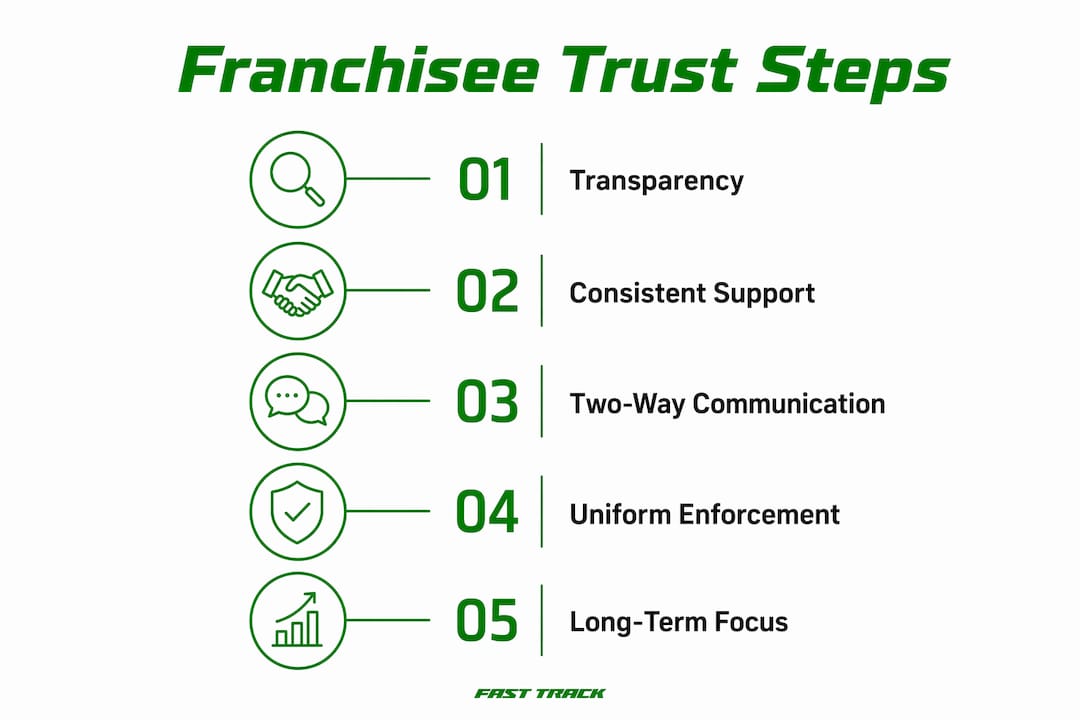
2. Consistent operational support — Predictable field visits and fast responses to support tickets signal reliability. Franchisors who demonstrate consistent, transparent actions strengthen trust far more than any mission statement.
3. Two-way communication — Create structured feedback channels: advisory councils, quarterly surveys, and regional roundtables. Then act visibly on what you hear. Franchisees notice when their input changes a policy.
4. Uniform enforcement — Favoritism destroys networks faster than almost any operational failure. Apply standards the same way for every operator. When an exception is necessary, document the rationale and share it.
5. Long-term commitment to unit profitability — Pilot new initiatives with franchisees before rolling them out system-wide. Share margin-improvement tools proactively. Make decisions that prioritize sustainable franchisee profitability over short-term royalty gains.
"The fastest way to lose trust is to hide information; the fastest way to earn it is to share it." — C-Suite Network
Pro Tip: At Discovery Day, walk candidates through a real unit-level P&L, not a pro forma. Showing actual numbers, including the hard months, signals the transparency that high-income candidates are specifically looking for.
Start a Franchise Advisory Council as soon as you have four or five owners. Early governance norms are far easier to establish than to retrofit later.
Which operational support systems and KPIs protect franchisee relationships?
Trust lets franchisees follow the operational playbook with confidence; without it, even well-designed supply chains and manuals underperform. The support infrastructure you build is what makes trust tangible day to day.
Core support functions:
- Scheduled field visits (minimum quarterly for new franchisees)
- Dedicated support hotline with documented SLA
- Recurring training refreshers via a learning management system (LMS)
- Vendor management and preferred-supplier access
- Local marketing support and co-op fund transparency
Operational tool stack:
| Tool | Role in relationship management |
|---|---|
| CRM (e.g., HubSpot, Salesforce) | Tracks candidate pipeline and post-sale touchpoints |
| Ticketing system (e.g., Zendesk) | Logs support requests; enforces response-time SLAs |
| LMS (e.g., Trainual, Lessonly) | Delivers and tracks training completion |
| Franchise intranet / portal | Centralizes SOPs, brand assets, and communications |
A scalable franchise support system reduces friction at every touchpoint. When franchisees can find answers without waiting, the relationship stays productive instead of transactional.
What discovery questions predict long-term franchisee fit?
Recruiting for relationship fit reduces downstream conflict. The candidate who looks great on paper but resists following a system will cost you far more than the one who asks harder questions upfront. Screen for both.
Sample discovery questions:
- "Walk me through a time you managed a team through a process change you didn't design. What did you do?"
- "What does your current income look like, and how long can you operate without drawing a salary from the business?"
- "What draws you to this specific brand rather than franchising generally?"
- "How do you typically handle a situation where you disagree with a policy from above?"
- "What does success look like for you at year three?"
Pre-qualification signals to confirm:
- Income verification: $150K–$500K+ annual earnings, liquid capital adequate for the investment range
- Ownership intent: actively seeking franchise ownership, not passively exploring
- Team management experience: has hired, managed, and held people accountable
- Urgency: a defined decision timeline, not indefinite consideration
Red flags: candidates who resist system compliance, cannot articulate why this brand specifically, or show capital that only barely meets the minimum.
Letting strong candidates observe a live training session before they sign is one of the highest-conversion tactics available. It validates training quality and lets them meet the community before committing.
Pro Tip: Add a candidate nurturing sequence between the first call and Discovery Day. Candidates who receive relevant content in that window arrive better prepared and convert at higher rates.
How do you fix a franchisor-franchisee relationship that's breaking down?
Most relationship breakdowns follow predictable patterns. Catching them early is far cheaper than remediation after a franchisee has lawyered up or gone dark.
Common pitfalls and remediation steps:
- Favoritism: Audit the last 12 months of territory decisions, fee waivers, and performance exceptions. Document the criteria used. Publish a written exceptions policy within 30 days.
- Inconsistent enforcement: Convene a standards review with your field team. Align on a single enforcement rubric and apply it at the next audit cycle.
- Slow support response: Pull your ticketing data. If average response time exceeds 24 hours, assign a dedicated triage owner and set a public SLA.
- Opaque decision-making: For the next three system-wide changes, publish a one-page rationale document before rollout. Share it with the advisory council first.
- Failure to act on feedback: Review the last two franchisee surveys. Identify one item that was raised and not addressed. Fix it, then communicate what changed and why.
Governance fixes to implement now:
- Create a written decision framework: Is it good for the brand? Is it good for the network? Is it good for the individual franchisee?
- Document escalation paths so franchisees know exactly who to contact and when.
- Run advisory council meetings as half-day sessions, not 30-minute check-ins, to create space for real peer exchange.
How Franchise Fast Track connects better sourcing to stronger relationships
Better candidate sourcing is the upstream variable that most franchisors underweight. When the candidates entering your pipeline are already financially qualified and actively seeking ownership, the entire onboarding relationship starts from a position of mutual seriousness.
Franchise Fast Track delivers hundreds of appointments per month with verified high-income professionals earning $150K–$500K+ annually, and clients report a 34% lead-to-close rate. Those are executives, directors, and senior managers who have already been screened for income, intent, and availability.
| Sourcing metric | Franchise Fast Track benchmark |
|---|---|
| Monthly qualified appointments | Hundreds per month |
| Reported lead-to-close rate | 34% |
| Candidate income range | $150K–$500K+ annually |
| Candidate profile | Executives, directors, senior managers |
The practical handoff: once a candidate books an appointment, your development team should receive a pre-call brief with income verification and intent signals already confirmed. That brief replaces the first 20 minutes of every discovery call and lets you spend that time on relationship-building instead of basic qualification.
Key Takeaways
Franchisors who build trust intentionally during recruitment and the first 90 days convert more candidates and retain them longer.
| Point | Details |
|---|---|
| First 90 days are decisive | Structure every touchpoint from day 1 to day 90 before the agreement is signed. |
| Trust drives earnings | 93% of business leaders link trust to improved corporate earnings — the ROI case for relationship investment is clear. |
| Screen for relationship fit | Discovery questions on management style, capital adequacy, and system compliance predict long-term success. |
| Uniform enforcement protects the network | Favoritism and inconsistent standards are the most common causes of relationship breakdown. |
| Franchise Fast Track | Delivers hundreds of pre-qualified appointments monthly with a reported 34% lead-to-close rate, giving development teams a stronger relationship starting point. |
Why a relationship-first approach to franchising matters
The playbook in this article reflects a conviction that recruitment and early onboarding deserve the same executive attention as unit economics and royalty structures. The franchisors who struggle most are rarely the ones with the weakest brand or the thinnest margins. They are the ones who treated the relationship as something that would develop naturally after the agreement was signed. It does not. The candidates most worth having, the high-income professionals who will build multi-unit operations and refer peers into your system, are evaluating the relationship from the first email. A recruitment-first playbook, grounded in pre-qualified sourcing and a structured first 90 days, is the most direct path to hitting your development targets.
Franchise Fast Track puts pre-qualified buyers in your pipeline
Most franchise development teams spend the majority of their time disqualifying candidates who should never have entered the pipeline. Franchise Fast Track solves that problem at the source. The system delivers hundreds of appointments per month with verified high-income professionals, and clients report a 34% lead-to-close rate because every conversation starts with a candidate who has already been screened for income, intent, and readiness.
Your development team gets a pre-call brief with income verification and intent signals confirmed before the first conversation. No cold outreach, no unqualified leads, no wasted Discovery Days. If you are serious about franchise lead generation that converts, see how the system works and book a strategy call.
Sources and further reading
- PwC Trust Survey — Harvard Law summary: Primary source for the 93% trust-and-earnings statistic used in the "Why trust matters" section.
- Modern Restaurant Management — Building trust from day one: Evidence base for the first-90-days framework and the trust-as-buffer claim.
- C-Suite Network — From courtship to commitment: Source for transparency actions, advisory council timing, and training-as-recruitment tactic.
- Forbes Finance Council — Trust helps drive franchise success: Practitioner perspective on trust as a franchise performance driver.
- 1851 Franchise — Long-term success and nurturing franchisee relationships: Source for the feedback-loop claim linking franchisee support to unit economics.
- Franchise Fast Track — Franchise lead generation: Service overview and proof points for the pre-qualified appointment system.
- Franchise Fast Track blog — Scalable support systems: Practical design patterns for field support infrastructure.
- Frangelic — Franchise lead generation strategies: Partner resource on lead-generation tactics and recruitment market trends.
Recommended
- How to Franchise Your Business for Sustainable Growth | Franchise Fast Track Blog
- How to Become a Franchise Owner: Your Essential Guide | Franchise Fast Track Blog
- How to Open a Franchise: The Franchisor's Playbook | Franchise Fast Track Blog
- Business Format Franchising: Guide for Franchisor Growth | Franchise Fast Track Blog
Ready to see results like these for your franchise?
Stop wasting money on leads that never close. Start getting hundreds of replies from high-net-worth professionals daily.