Franchising Small Business: How to Convert in 2026
A conversion to franchising doesn't fail at the first sale, it fails when the disclosure document exposes thin unit economics, undocumented operations and unaudited financials. The 2024 Franchising Economic Outlook projecting 821,000 franchised establishments and $893.9 billion in output shows the scale a new entrant joins, but franchising small business operations is a sequence of gates, not a revenue contest.
Table of Contents
- Readiness Thresholds to Clear Before Filing an FDD
- How to Standardize Operations into a Repeatable System
- How to Build the FDD Item by Item
- Compliance Layers From Federal Rule to State Registration
- Training and Field Support Before the First Opening
- Go-to-Market Sales Pipeline Across Four Lead Channels
- Gate Franchise Sales on Unit-Level Retention
Readiness Thresholds to Clear Before Filing an FDD
The FDD can reveal readiness gaps before the first franchise sale. Revenue alone does not show whether unit economics transfer, controls support reliable reporting, or the management team can operate without the founder. A useful planning assumption is to build several years of company-unit evidence before filing, but the evidence itself, not a fixed timeline, determines whether the concept is ready.
Seven Gates in Filing Order
These are planning benchmarks, not regulatory minimums. The FTC Franchise Rule sets no minimum company size, so filing eligibility does not establish franchise readiness.
| Readiness test | Planning threshold | Evidence to produce |
|---|---|---|
| Company unit history | At least three company-owned units with 36 months of unit P&Ls, five preferred | Monthly profit-and-loss statements for each unit |
| Four-wall profitability | Positive results in every company unit for 12 consecutive months | Unit-level P&Ls that include occupancy and labor |
| Single operating format | Every company unit runs the same core offer and layout | Operations audits covering all company units |
| Audited financial history | Three years of audited franchisor statements for Item 21 | CPA engagement letter and audited statements |
| Capital reserve | Funds for counsel, audit and registration, plus 12 months of development payroll | Dated budget with vendor quotes |
| Leadership bench | A franchise development lead and operations trainer who are not the founder | Organization chart and written job descriptions |
| Trademark position | Federal applications filed for the core brand name | USPTO filing receipts and clearance search results |
Market growth creates opportunity, but also raises the standard for a new entrant. The International Franchise Association projection of 851,000 franchise establishments in 2025, with 2.5% growth and $936.4 billion in output describes a large, expanding sector. In QSR, home services and senior care, candidates can compare a new system with established brands. The FDD's Item 20 outlet history and Item 21 audited statements make that comparison concrete.
Two gates merit particular scrutiny: whether profits hold beyond the flagship, and whether financial records meet disclosure requirements. A single profitable location cannot establish performance across different formats, wage markets or rent levels. Tax returns alone do not replace the audited financial statements required for Item 21. Testing which businesses make suitable franchise models against the readiness table helps distinguish transferable unit economics from results tied to one strong local operator.
Sharpest test: If only the founder can open a unit, the business fails the people gate regardless of revenue.
Without comparable monthly P&Ls across the company units, FDD drafting risks documenting assumptions instead of repeatable results. Where that evidence is incomplete, continue operating and recording company units until the gaps are addressed.
How to Standardize Operations into a Repeatable System
The deliverable is a standard a non-founder can run without calling the founder for judgment calls. Standardization for franchising small business units isn't documenting best practices in general terms, it's removing every decision that currently lives in one person's memory.
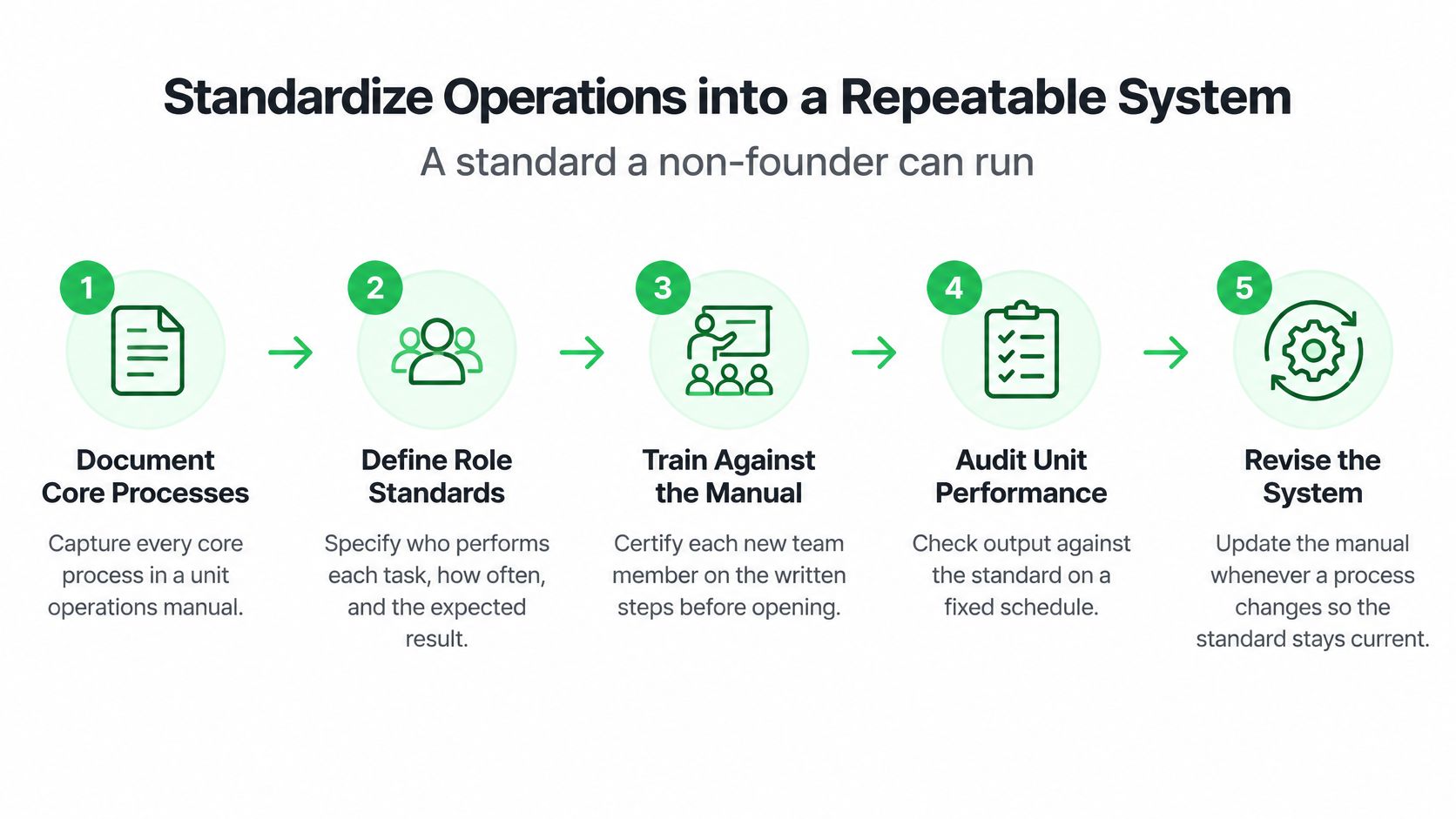
Six Steps From Founder Knowledge to Version 1.0
- Document every core process in a unit operations manual. Start with opening, production or service delivery, pricing, cash handling and closing. Name one owner for each process so revisions have accountability, and write the expected result alongside the steps.
- Remove site specific variations. Company units run the same menu, service menu or product mix, whether the concept is automotive services, fitness and wellness or health and beauty. Retire any local workaround that can't be taught to a new hire in another state.
- Build a unit P&L template on one reporting basis. Split occupancy, labor, food or materials, royalty equivalent charges and marketing so every operator reports identically. Without that template, Item 19 substantiation and field consulting both rest on incomparable numbers.
- Approve suppliers and specifications, and record the economics. List required vendors, product specifications and any rebates or markups the brand keeps. Those records feed the Item 8 disclosure directly, so informal rebate arrangements become a compliance problem at filing.
- Hand the manual to a manager outside the founding team. That manager runs two company units for at least one full quarter and logs every deviation, missing instruction and workaround. A manual that hasn't survived a non-founder test isn't a system, it's a draft.
- Freeze version 1.0 only after the deviation log shrinks to a short list. Publish a dated change log for each revision after that point. Undated manual updates create disputes about which standard a franchisee was trained against.
A brand that documents what the founder does instead of what the unit must do sells a job description, not a system.
The failure pattern repeats across verticals. A QSR founder documents recipes but not labor deployment by daypart, or a home services founder documents the repair but not dispatch, quoting and callback handling. The missing processes are usually the ones that protect margin, which is why step three and step five carry more weight than formatting the manual itself.
How to Build the FDD Item by Item
The Federal Trade Commission's Franchise Rule requires 23 specified categories of information in the FDD, including Items 7, 19, 20 and 21. Those disclosures make the document a test of readiness, not just a sales tool: they expose whether the proposed investment range, unit economics, operating records and financial statements can withstand review before the first franchise sale.
Build Order After Item 7
Start with Item 7, the estimated initial investment range. Build its low and high figures from invoices and records for the three most recent company openings, including equipment, pre-opening costs and working capital. Estimates alone are harder to defend in candidate diligence and lender underwriting. A range based on one unusually favorable opening can mislead: low rent, a landlord contribution or founder-performed construction may understate what a franchisee will spend in retail, education or real estate brokerage.
Set Items 5 and 6 against unit economics before fixing the initial fee, royalties, advertising fund and technology charges. Model the full fee stack against four-wall margins. Charges that support franchisor revenue but strain unit economics raise the risk of early franchisee turnover, which would be reported in Item 20.
Item 20 requires outlet counts and a reconciliation of openings, transfers, terminations and non-renewals against agreement records. Item 21 calls for audited franchisor financial statements, so engage the CPA firm early rather than assuming an audit can be completed to match the drafting schedule. The order matters: outlet histories and financial statements depend on records that should exist before the FDD is assembled.
| FDD item | What it covers | Development task |
|---|---|---|
| Item 5 | Initial franchise fee and when it is due | Set the fee against comparable systems and the cost to onboard a new unit |
| Item 6 | Ongoing royalties, ad fund, technology and other fees | Model the full fee stack against unit margin before setting rates |
| Item 7 | Estimated initial investment range | Build low and high ranges from the three most recent openings, including working capital |
| Item 8 | Restrictions on sources of products and services | Disclose approved suppliers and any rebates the franchisor keeps |
| Item 19 | Financial performance representations | Include only figures supported in writing, or omit the section |
| Item 20 | Outlet counts and franchisee turnover over three years | Report company and franchised units, openings, transfers, terminations and non-renewals |
| Item 21 | Audited franchisor financial statements | Provide three years of audited statements from the CPA firm |
Items 1 to 4 disclose franchisor background, management, litigation and bankruptcy. Items 22 and 23 cover contracts and the receipt page. The FTC Franchise Rule requiring a disclosure document with 23 specified categories of information, including Item 7, Item 19, Item 20 and Item 21 defines the categories that must be addressed. For a guide to how they fit together, see 2026 FDD guidance from Franchise Fast Track.
Item 19 Discipline
Item 19 is optional. If the franchisor makes sales, income or profit claims, those figures must appear there with a reasonable basis and written substantiation. Unsupported figures stay out. For small-business concepts with only company-operated units, document the population, geography, format and operating period behind each figure, then check that those units resemble the opportunity a candidate is evaluating.
Average and top-quartile results can mislead when they describe mature company units but are presented to a candidate opening a first location in a new market. Treat historical performance as historical, not as a forecast. Publishing an unsupported figure creates regulatory and rescission exposure; omitting Item 19 is a defensible choice when the records cannot support a representation.
Compliance Layers From Federal Rule to State Registration
The compliance stack runs federal to local, and each layer imposes its own timing. The FTC timetable requiring FDD delivery at least 14 calendar days before signing a franchise agreement or paying money governs every signing date in the pipeline. Development teams need a receipt log that timestamps delivery and sets the earliest signing date at day 15.
The 14 Day Rule in Practice
An FDD delivered on March 2 sets the earliest signature or payment on March 16. The receipt log should record both dates for every prospect before any sales conversation advances, and that log belongs in the CRM as a hard gate, not in a salesperson's email. Deals that compress this window don't close faster, they create rescission risk that follows the franchisor.
State registration sits on top of the federal rule. Registration states such as California, New York and Illinois require filing and annual renewal before offers are made there, and candidates and counsel routinely find California franchise disclosure filings to compare versions. Material changes to litigation, fees or financial data trigger amendments, so every change needs tracking from the day it occurs, not at renewal.
Relationship laws add a third layer. Many states limit termination, non-renewal and transfer rights, which means the franchise agreement must be drafted against the most restrictive state in the brand's footprint rather than the home state. Canada is secondary but real for United States brands expanding north, as Alberta and Ontario impose their own disclosure obligations on offers made there.
Trademarks and the Compliance Calendar
Trademarks come last in the sequence but carry first order risk. Federal applications for core marks and a clearance search belong before any public franchise marketing, since rebranding after territories are sold is far costlier than clearing the name first. Counsel and the auditor should work to a single compliance calendar with quarterly reviews covering registrations, amendments, audit milestones and trademark deadlines.
Sales discipline closes the stack. Every salesperson, broker and executive presenter gets briefed on what can't be said before the first call, with Item 19 as the boundary. A compliance calendar without that briefing leaves the highest risk layer, live conversation, unmanaged.
Training and Field Support Before the First Opening
Training is a gate, not a launch event. No unit opens until the owner and manager pass a certification test with a fail and retrain rule, and that rule has to exist before the first franchised opening is scheduled. Concepts franchising small business operations routinely promise support in Item 11 that the current headcount can't deliver.

Curriculum Built by Role
Pre-opening training specifies hours by role for owner, manager and crew, published as figures in the curriculum. Any hour count not yet drawn from actual training logs gets labeled a planning assumption, then replaced with measured data after the first cohort. Vertical specific modules belong in the initial curriculum, not as add-ons, covering food safety for QSR, patient care for senior care and licensing for education concepts.
Those commitments also protect economics. Structured training investments that strengthen unit economics reduce early labor waste, callbacks and brand standard failures that otherwise show up as first year closures. Undertrained operators don't usually fail on the core product, they fail on staffing, cash handling and local compliance.
Field Support Staffing and Cadence
The field model assigns each business consultant a fixed unit range, with planning ratios such as one consultant to 12 to 20 units tested against response time. A support hotline runs with written service level targets so franchisees know when an answer arrives. Quarterly brand standards audits produce a scored report sent to both franchisee and franchisor, creating a shared record rather than competing recollections.
A franchisee advisory council with elected operators from at least three regions gives structured feedback a route into system decisions. Item 11 requires an accurate description of this assistance, so training hours and support staffing in the disclosure must match the team the franchisor can actually field. The gap that breaks most rollouts is training built around the founder's way of working rather than the manual, because that training can't be repeated by the operations trainer hired to replace the founder in the classroom.
Go-to-Market Sales Pipeline Across Four Lead Channels

A sales pipeline should be judged at each conversion gate, from first contact to a signed agreement. For franchising small business concepts, lead volume alone says little about readiness: candidate capital, the cost of screening, and the claims made during sales all need scrutiny before the first sale. The sales funnel infographic showing 359,815 messages sent, 2,454 replies, and 38.2% conversion to potential opportunities. illustrates one outbound campaign. Its conversion figure is a campaign-specific result, not a benchmark for other channels.
Qualification Starts With Item 7
Set capital, liquidity and experience thresholds against the Item 7 investment range before booking a discovery call. Candidates unable to fund the high end of the stated investment range, plus working capital, should not advance solely on enthusiasm. A structured Franchise Fast Track sales playbook can help teams apply the same screen at first contact and record why candidates pass or fail.
| Lead channel | What it produces | Screening burden |
|---|---|---|
| Franchise portals | Inbound inquiries with varying levels of verification | High, many leads require manual review |
| Paid ads on Meta and Google | Click-driven inquiries with varying levels of intent | High, capital and intent may remain unclear until a call |
| Broker referrals | Candidates screened to varying degrees by the broker | Depends on the broker's process |
| Verified outbound | Candidates introduced after screening | Lower when capital and other criteria are checked before introduction |
No comparable cost or yield figures are available here for all four channels, so the table does not rank them. Track each channel in its own ledger, including spend, qualified conversations, capital-screen failures, applications and signed agreements. Cost per lead alone obscures the staff time spent screening candidates who cannot meet Item 7. A channel-level record makes those bottlenecks visible without implying that one source performs better than another.
Item 19 as the Sales Script Boundary
The FTC position that financial performance representations require a reasonable basis, written substantiation and disclosure in Item 19 sets a boundary for outbound campaigns, broker scripts and executive presentations. Sales representatives should be able to trace every financial performance claim to its support and confirm that it is properly disclosed. If a claim is not substantiated and presented in accordance with Item 19, it should not be improvised orally or in writing. Brief brokers and sales representatives on this rule before they speak with candidates, including teams selling QSR, real estate brokerage, home services, and health and beauty concepts.
Dashboard rule: Track qualified conversations, discovery-to-application rate and days from FDD delivery to signature for each channel separately.
The pipeline also tests whether disclosure, screening and sales practice agree. Review the channel ledger alongside candidate qualification records and sales scripts before increasing lead volume. The FDD should describe the opportunity being sold, while the team's records show how candidates are evaluated and advanced.
Gate Franchise Sales on Unit-Level Retention
Headline system growth doesn't prove readiness to sell more territories. Aggregate outlet counts can rise while closures, transfers and non-renewals erode the base underneath, which is why unit level retention is the gating metric for franchising small business expansion.

The Survival Benchmark
A historical analysis of more than 20,500 small businesses finding 65.3% of franchises survived four years versus 72.0% of independent businesses, with retail at 61.3% versus 73.1%, is dated and shouldn't be used as a current failure rate. Its value is narrower and more useful. Franchise status alone doesn't eliminate execution, capital, market or unit economics risk, so stress testing belongs in underwriting rather than optimism about the model.
Three Gates Before a Second Wave
Scaling metrics come from Item 20, specifically net unit growth, closures, transfers and non-renewals per year, plus the share of openings still trading at 24 months. Comparable store sales and retention outrank gross openings because they show whether existing operators are building durable units. Three gates should clear before a second wave of sales opens.
- Company unit gate: Company units have passed the readiness table for 12 consecutive months.
- First cohort gate: The first franchised cohort shows turnover within an agreed numeric ceiling, set before the wave as the maximum share of outlets transferring, terminating or failing to renew in a year.
- Pipeline capacity gate: The development pipeline absorbs new volume without lowering qualification standards, with cash reserved for consultant hiring and franchised unit ramp.
The turnover ceiling shouldn't be invented internally. Development teams pull Item 7 and Item 20 data for peer brands in the same vertical from the FDD database at franchisefasttrack.io/fdd-database and benchmark investment ranges and turnover against those peers. A ceiling set below peer performance signals either unrealistic underwriting or a support model that hasn't been tested at scale.
Brands that gate on retention sell fewer territories in year one and keep more of them in year four. That trade favors franchisors, because Item 20 history compounds. Every closure disclosed in the next filing raises the cost of every qualified conversation after it.
Franchise Fast Track gives development teams the peer Item 7 and Item 20 benchmarks, FDD data and verified candidate pipeline needed to gate conversion on evidence rather than revenue claims. Brands evaluating franchising small business expansion against established competitors can start with the franchise and FDD directories at Franchise Fast Track and measure their readiness gates against systems already trading in their vertical.
Ready to see results like these for your franchise?
Stop wasting money on leads that never close. Start getting hundreds of replies from high-net-worth professionals daily.