Franchise Due Diligence: A Checklist for Investors
The correct franchise due diligence workflow has four gates, and the first one is essential, obtain the current FDD before any signature or payment. The reason is simple, the FTC Franchise Rule gives buyers a 14-day review window, then forces a structured check of 23 disclosure categories before capital moves.
Franchisors that treat that window as a formality expose the rest of the system to avoidable risk. For brands with 50+ locations, the key question is not whether the FDD exists, but whether the disclosure stack, unit economics, franchisee references, and legal review all point to the same conclusion.
Table of Contents
- The Four-Gate Due Diligence Workflow
- Decoding Critical FDD Items 19, 20, and 21
- Building a Defensible Unit Economics Model
- Conducting Strategic Franchisee Reference Interviews
- Evaluating System-Level Fragility and Growth Quality
- Final Verification and Next Steps for Investors
The Four-Gate Due Diligence Workflow
The FTC framework turns franchise due diligence into a defensible sequence, not a vibe check. A franchisor must deliver the FDD at least 14 days before a prospective franchisee signs or pays, and that waiting period creates a real review window instead of an immediate commitment requirement, as explained in the FTC's consumer guidance on checklist before you sign the deal.
Gate 1, secure the current FDD before any money moves
The first gate is delivery control. The buyer should have the latest FDD in hand before any discussion turns to deposits, legal signatures, or build-out planning, because the FTC says franchisors may update the document during the calendar year and must update it after fiscal year-end. That means an older copy can be outdated even when the 14-day clock has already run.
The best discipline is blunt. Obtain the current document, confirm the delivery date, and read it as a regulated information package, not a sales brochure. For a broader operating view of the process, the internal what Franchise Fast Track does overview shows how verified sourcing can support this type of screening.
Gate 2, reconcile all 23 required disclosures
The second gate is document reconciliation. The FTC's rule ties the FDD to 23 disclosure categories, including litigation history, bankruptcy history, fees, territorial restrictions, supplier constraints, training, advertising obligations, financial-performance representations, and the contracts the buyer will sign. That list matters because a missing section can hide risk that never surfaces in a pitch call.
Practical rule: if a term sounds material in the sales process, it should be visible in the disclosure stack.
Item 20 is especially important because it reports openings, closures, terminations, transfers, and operating locations over the preceding three years, while Item 19 can include financial-performance representations when the franchisor chooses to disclose them. Those sections should be read together, not separately, because growth without turnover context tells only half the story.
Gate 3, validate the economics with independent evidence
The third gate is independent validation. That means comparing the FDD against outside quotes, franchisee interviews, and a model that tests whether the concept survives normal operating friction. A useful cross-check is the Franchise Fast Track FDD guide, which reinforces how to treat the FDD as a starting point for verification rather than a conclusion.
The model should not stop at revenue. It needs labor, occupancy, royalties, advertising, maintenance capital, debt service, and owner compensation, because a concept can show healthy top-line numbers and still fail at the unit level. The FTC's disclosure structure gives the data, but it does not do the analysis for the buyer.
Gate 4, secure legal, accounting, and franchisee-reference reviews
The fourth gate is external review. A franchise attorney should review the agreement, a CPA should stress-test the economics, and current and former franchisees should be contacted directly. That final step matters because the FTC's own guidance treats franchisee conversations and disclosure comparison as foundational, not optional.
A disciplined team closes this gate only after the written record is complete. That record should include the latest FDD, a reconciliation log, a model with downside cases, and notes from franchisee calls. Without that file, diligence becomes memory, and memory is not an audit trail.
Decoding Critical FDD Items 19, 20, and 21
Item 19, Item 20, and Item 21 carry most of the analytical weight because they connect system claims to system behavior. Item 19 governs what a franchisor can say about performance, Item 20 shows how units open, close, transfer, and terminate, and Item 21 reveals whether the franchisor's own books support the story.
Item 19 sets the legal boundary around performance claims
Item 19 is the compliance trapdoor. If a franchisor chooses to make a revenue, earnings, or profit claim, that claim belongs in Item 19 and must have a reasonable factual basis, with the data source, limitations, and assumptions disclosed. If the claim appears in a deck, a call, an email, or a website but not in Item 19, that is not a harmless omission, it is a disclosure problem.
The right way to read Item 19 is to test the sample, not just the headline. A serious review stratifies results by geography, opening year, and operating maturity, then compares medians and lower-quartile outcomes instead of leaning on averages. Averages can flatter a system with a few strong operators, while the median shows where the middle unit actually sits.
A revenue claim that cannot survive an Item 19 comparison should not be treated as an operating assumption.
Item 20 exposes turnover, not just growth
Item 20 is the most useful anti-hype section in the FDD. It reports system openings, closings, transfers, terminations, and the contacts for current and former franchisees, which makes it the best source for detecting whether growth is durable or merely cosmetic. A system can add units and still lose quality if exits, transfers, or reacquisitions are doing too much of the work.
The contact list also matters because it lets analysts separate franchisor-curated references from the broader population. If the only voices available are polished operators, the sample is biased before the first question is asked. The FTC's structure gives enough information to find people who are closer to the middle of the distribution, not just the top.
Item 21 shows whether the franchisor is financially grounded
Item 21 contains audited financial statements, which means the platform's own economics can be checked against its sales narrative. That review should focus on liquidity, debt, audit quality, and the mix between recurring royalty revenue and initial franchise fees. When the franchisor's economics rely too heavily on selling new units, the model can be under more strain than the marketing story suggests.
For teams that want operational support while working through this disclosure stack, virtual paralegals can help organize document review and comparison work without replacing legal judgment. The point is not automation for its own sake, it is preserving accuracy across a large volume of source material.
| FDD Item | What it tells the analyst | What can go wrong if ignored |
|---|---|---|
| Item 19 | Authorized performance claims | Unsupported earnings stories |
| Item 20 | Openings, closures, transfers, terminations | Hidden churn or weak retention |
| Item 21 | Audited franchisor financials | Weak liquidity or fee dependence |
Building a Defensible Unit Economics Model
A unit economics model should begin with the fact that many franchise concepts may only produce 5% to 15% net profit margins after labor, occupancy, royalties, advertising, debt service, and replacement capital, a range reflected in franchise unit economics breakdown. Revenue can look healthy while excess cash remains thin.
Build the model from the bottom up
Start with the cost stack, not the sales line. Begin with Item 19 where available, then add labor, rent, occupancy-related charges, royalty, advertising, maintenance capex, and debt service. The result should be a four-wall view of the unit, because franchised businesses rise or fail at store level before they become portfolio stories.
Practical rule: if the model works only at the best operators' sales level, the model is too optimistic.
Maturity matters more than the average often suggests. A new unit rarely behaves like a mature unit, so the model should show opening year, ramp period, and stabilized operations separately. If a concept depends on a fast ramp that most operators never reach, the economics are fragile even when the system looks healthy from a distance.
Test the downside, not just the pitch case
The strongest underwriting questions are simple and harsh. What happens if labor rises, rent resets at renewal, the ramp is slower than planned, or customer demand softens? Those are normal operating risks in QSR, home services, real estate brokerages, fitness and wellness, automotive services, health and beauty, retail, education, and senior care.
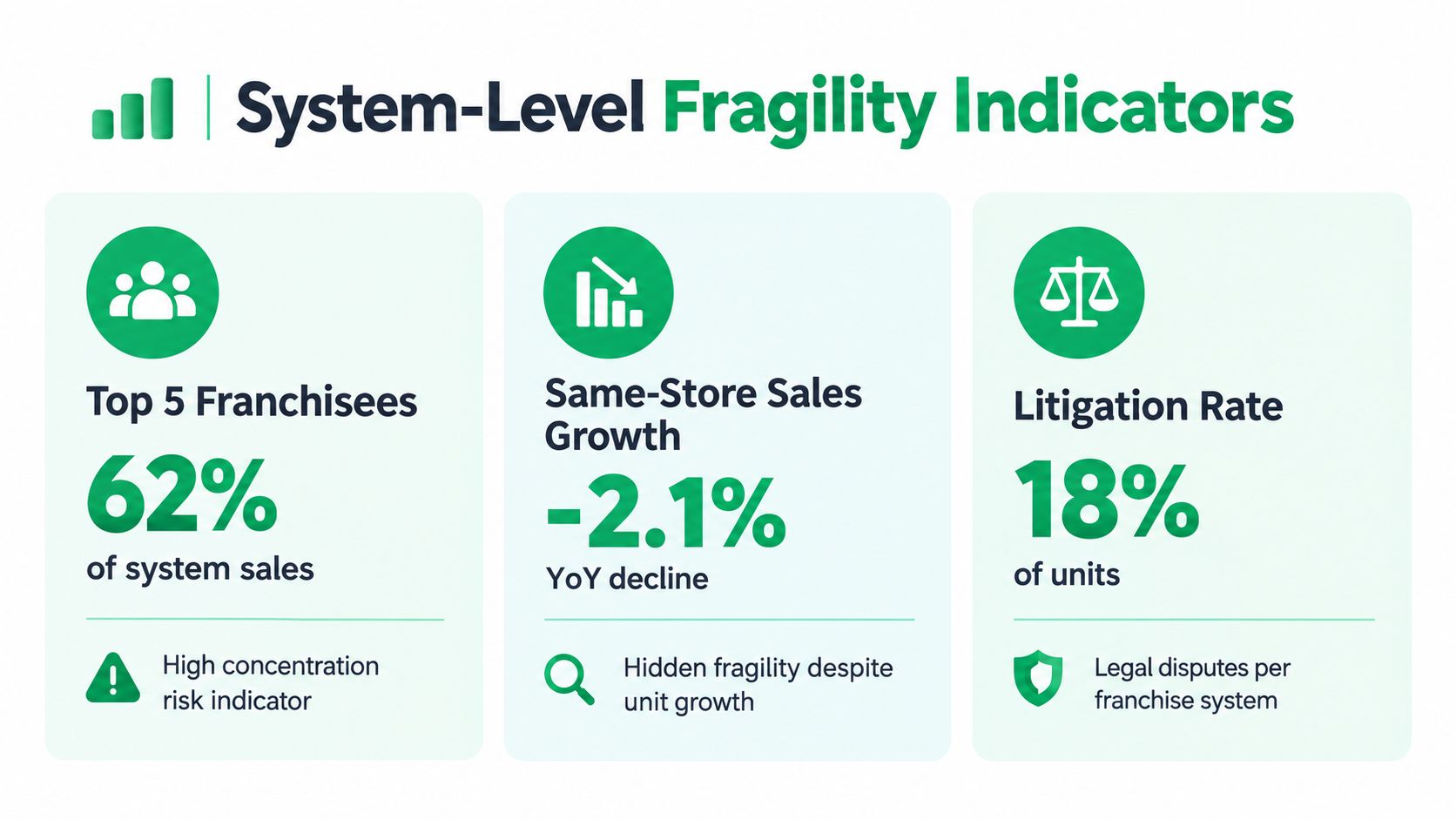
System-level fragility becomes visible when growth is concentrated. A brand can show unit expansion while weaker operators exit, the middle underperforms, and a few well-capitalized groups carry the growth story. The analyst's job is to determine whether the average operator is succeeding or whether concentration is masking stress. That distinction changes how much confidence a buyer should place in reported growth.
A defensible model treats each line item as an operating claim that needs to survive stress. If the economics collapse after small changes in wage rates, occupancy, or ramp timing, the brand may be scaling units faster than it is scaling durable cash flow.
Conducting Strategic Franchisee Reference Interviews
A franchisor's preferred reference list is usually designed to sound reassuring. That makes it the wrong place to stop, because the most valuable calls are often with operators who are harder to find, newer in the system, or less enthusiastic about the brand's marketing polish.

Use Item 20 to build a stratified sample
The cleanest interview list is stratified by performance and tenure. Current franchisees should include mature operators, newer operators, and units that resemble the target market. Former franchisees should be included as well, especially where Item 20 shows transfers or recent exits that need explanation.
A single reference from a top performer is not due diligence. It is marketing with a human voice. The stronger approach is to compare what current operators say about training, support, marketing fund effectiveness, and day-to-day economics against what former operators say about the same topics once the incentive to stay polite has disappeared.
Watch for concentration risk in the reference pool
Reference quality matters as much as reference volume. If the approved list is dominated by multi-unit operators, the sample may overstate resilience because the most capitalized owners can absorb issues that single-unit operators cannot. That is especially dangerous when the system's growth story rests on a small number of large operators.
The conversation should be direct and unvarnished. Ask what surprised them, what support was delivered when performance slipped, and whether they would make the same decision again with current knowledge. Answers that stay vague under pressure often reveal more than polished praise.
Good franchisee interviews don't confirm the pitch, they test the gaps between the pitch and the operating reality.
Evaluating System-Level Fragility and Growth Quality
A franchise system can add locations while underlying operator quality weakens. Headline growth and durable health are different measurements, so concentration, churn, and lender quality need to be reviewed together.
Why lender data changes the interpretation of risk
The U.S. Government Accountability Office reviewed 170 SBA-backed loans to selected franchisees and found that 74 had defaulted, with 55 of those defaults, or 74% of all defaults in the reviewed population, coming from four lenders with the highest loan volume and default rates. That finding shows why a single default rate cannot be read in isolation. Lending outcomes can shift with lender concentration, underwriting practice, borrower capitalization, and brand economics.
Public loan data has to be reconciled with the FDD, audited financial statements, Item 20 outlet histories, and franchisee interviews before anyone draws a conclusion about system quality. A single statistic may be directionally useful, but it does not replace a full diligence file.
Compare growth narratives against operator concentration
Many checklists stop at litigation, fees, territory, and capital requirements. That misses a harder question, whether expansion is being carried by a small cluster of multi-unit owners while the broader base struggles. If a handful of operators account for a disproportionate share of openings or sales, the system may be more fragile than the unit count suggests.
Look at growth and operator quality together. If turnover, transfers, or terminations rise during the same period as expansion, the brand may be growing through churn rather than broad-based success.
For a broader operator-level view of system quality, improve your franchise success rate by treating growth, retention, and operator mix as one analytical problem instead of separate talking points.
Read closure patterns as a system signal
Closures need context. Net closures can reflect failure, market exits, consolidation, or business-model changes, so the raw count becomes useful only when tied to cohort timing and franchisee type. A young system with fast churn is different from a mature system undergoing consolidation, and both differ from a brand that is expanding while operators come under strain.
Maturity, concentration, and financing quality belong in the same memo. If a platform's story depends on a few strong operators while the broader base is under pressure, the growth chart can look better than the economics deserve. That is the point where real underwriting starts.
Final Verification and Next Steps for Investors
Final verification should end with a documented answer to one question, does the same evidence support the same conclusion across disclosure, financing, and operator interviews? If the answer changes depending on which source gets attention, the diligence file is incomplete.
Close the loop across the three evidence streams
The cleanest protocol is to reconcile the FDD, the lender record, and the franchisee interviews one final time. Item 19 should align with actual operating ranges, Item 20 should explain turnover and retention patterns, and Item 21 should support the franchisor's own financial strength. If those pieces do not fit together, the system needs more work before capital is committed.
A single default rate, growth count, or success story cannot represent the health of an entire franchise system. Analysts and development leaders should treat that as a warning, not a convenience.
For teams building a larger sourcing and verification process, the franchise industry intelligence platform can support research across brands, franchisees, and disclosure files. Franchise Fast Track also maintains a franchise directory, a multi-unit franchisee directory, and an FDD database, which makes it easier to cross-check claims against a broader data set.
Franchise Fast Track organizes verified franchise data, FDD records, and multi-unit operator intelligence so brands and analysts can compare claims against source material instead of relying on a pitch deck. For teams evaluating franchise due diligence at scale, Franchise Fast Track provides a practical starting point for finding the records and contacts that matter most.
Ready to see results like these for your franchise?
Stop wasting money on leads that never close. Start getting hundreds of replies from high-net-worth professionals daily.