8 Examples of Family Brands: Franchise Lessons for 2026
The trust gap between family or private businesses and other companies narrowed from 16 points in 2015 to 8 points in 2025, even though 74% of family-business leaders believed their organizations were more trusted than non-family businesses, according to reporting cited in PwC's 2025 Global Family Business Survey. That gap is the core test for examples of family brands in U.S. franchising. Family ownership doesn't guarantee trust, retention, or unit growth. Governance, operator selection, and disclosure quality do.
The eight systems below collectively operate well over 10,000 U.S. units, but their paths diverge sharply. Some remain family-controlled, others moved to Blackstone, Roark Capital, or public markets, and one keeps most units company-operated. Each example is read through operator selection, cluster expansion, ownership transition, and the FDD items a development team should pull first, especially Item 1, Item 7, Item 19, Item 20, and Item 21. For franchisors with 50 or more locations, the useful question isn't whether a founder story sounds good. It's whether the model still produces qualified operators and clean outlet data after the second or third generation.
Table of Contents
- 1. Chick-fil-A and Cathy Family Ownership at Scale
- 2. Culver's and Midwest Family Roots Scaled Across 25 Plus States
- 3. Jersey Mike's Subs From Point Pleasant Beach to a Private Equity Platform
- 4. Little Caesars and the Ilitch Family Pizza Franchise Model
- 5. Dickey's Barbecue Pit as a Dallas Family Brand Turned Platform Investment
- 6. RE/MAX as a Family Founded Real Estate Brokerage Franchise at Global Scale
- 7. Waffle House as a Family Controlled Southern Chain With a Limited Franchise Footprint
- 8. Franchise Industry Context and Why Family Founded Systems Matter at 50 Plus Locations
- How the eight family-founded systems compare on scale, ownership, and the FDD items to review
- Turning Family-Brand Lessons Into Franchise Development Benchmarks
1. Chick-fil-A and Cathy Family Ownership at Scale
Chick-fil-A was founded by S. Truett Cathy in Hapeville, Georgia, in 1946 and remains controlled by the Cathy family through privately held ownership. The brand operates more than 3,000 restaurants across roughly 48 states and the District of Columbia. That's scale without a conventional franchise equity pitch. Chick-fil-A selects operators, owns the restaurant building and equipment, and weights operating fit and training more heavily than operator capital alone.
Company-reported average annual sales per restaurant have exceeded $9 million in recent years, placing units among the highest-volume fast-food restaurants in the country. Growth from a single Atlanta-area location in 1967 to more than 3,000 restaurants shows a system built on throughput, service standards, and tight site control. Mall, freestanding, and university formats all operate under company-owned real estate, which changes development math versus a standard QSR franchise.
What development teams should test
- Operator selection: Study the selection framework when building an ideal franchisee profile for a high-touch system where the operator works in the business daily.
- Unit economics: Compare per-unit sales against internal Item 19 disclosures before setting development targets, because volume alone doesn't prove margin.
- Real estate control: Track how corporate ownership of sites affects opening velocity in dense metro markets and who carries lease risk.
Practical rule: Verify current investment and fee structures in Item 7 (initial investment) and Item 5 (initial fees), because the operator model doesn't map cleanly onto conventional franchise agreements.
2. Culver's and Midwest Family Roots Scaled Across 25 Plus States
Culver's was founded in 1984 in Sauk City, Wisconsin, by Craig and Lorna Culver, built around the ButterBurger and frozen custard. The system now operates more than 1,000 restaurants across more than 25 states, with the densest concentration in the Upper Midwest. That density isn't accidental. Culver's historically entered new territories in clusters so supply chain, field support, and local marketing could concentrate behind a small number of openings instead of scattering across a map.
Clustered entries across Wisconsin, Illinois, Michigan, and Minnesota came before expansion into southern and western states. Frozen custard also gives the concept a second reason to visit beyond lunch and dinner, supporting multi-daypart revenue that a burger-only menu can't match. Development teams evaluating comparable regional QSRs should find scalable quick-service franchise brands and compare their territory maps against Culver's pacing, not just their unit counts.
FDD checks for a regional to national move
Item 7 shows the capital a franchisee must commit, which screens out thinly capitalized single-unit buyers early. Item 20 shows whether clustered expansion produces retention or heightened turnover once a market passes its first wave of openings. A worked example makes the point. Say a brand opens eight units in one metro over two years. If transfers spike in year three, clustering lowered support cost but didn't solve operator fit. Model dual-daypart economics before adding dessert or secondary lines, and build clustered maps before entering new states to keep field support cost per open under control.
3. Jersey Mike's Subs From Point Pleasant Beach to a Private Equity Platform
Ownership transitions test a franchise system harder than any growth phase. Jersey Mike's Subs was founded in 1956 by Peter Cancro in Point Pleasant Beach, New Jersey, and grew to more than 2,500 locations under long family control. In early 2024, Blackstone was announced as majority investor in Jersey Mike's, with Cancro retaining a meaningful ownership position and continuing in leadership.
That structure matters for franchise analysts. Founder participation and management continuity reduce the signal that a sponsor bought the brand to cut support and accelerate signings at any cost. The test comes in the first FDD cycles after closing. Item 19 average sales disclosures show whether unit economics held through the change, and Item 21 audited financial statements show whether the franchisor balance sheet supports the development plan being sold to new candidates.
Monitoring an ownership transition
- Item 20 sentiment signal: Watch closures and transfers during the transition window, because franchisees vote with exits before they speak in surveys.
- Peer benchmarking: Use Item 19 volumes against sandwich peers in comparable trade areas rather than national averages that hide weak markets.
- Territory pacing: Plan around saturation indicators, especially when developing territories with multi-unit operators who can absorb a slower ramp better than first-time owners.
A development team reading Jersey Mike's should separate two questions. The first is whether family control built durable unit economics, which Items 19 and 20 answer across multiple filing years. The second is whether institutional ownership changes the support model, which only post-closing FDD cycles can show. Family control built the asset. Institutional capital priced it. Those are two different skill sets, and the FDD separates them.
4. Little Caesars and the Ilitch Family Pizza Franchise Model
Little Caesars was founded in 1959 by Mike and Marian Ilitch in the Detroit area and has been held through Ilitch Holdings for most of its history. The system operates more than 4,000 U.S. locations, plus a larger global footprint. Few family-founded pizza systems have sustained that count, and the model explains why. Entry cost has historically run lower than many national QSR peers, and the operating format centers on carryout and delivery rather than dine-in labor.
The Hot-N-Ready program became the signature value offer, training customers to expect speed and a low price point without a long ticket time. Dense development in Michigan and the broader Midwest built brand recognition before national expansion spread units into more diverse trade areas. Value positioning travels well, but it also compresses margin when cheese, labor, or delivery costs rise faster than menu price.
Where the numbers decide
Development executives should start with Item 7 for initial investment ranges and position entry cost as a recruitment lever only when the operator profile is capital-constrained but operationally strong. Item 20 outlet growth and transfer patterns then show whether low entry cost produced durable operators or churn. Reading franchise growth beyond outlet counts helps frame that distinction. A brand can add units while gradually losing its best operators through transfers.
Low investment gets candidates into a pipeline. It doesn't keep units open in year four, and Item 20 turnover is where that difference shows up.
Benchmark carryout mix and delivery penetration against internal digital ordering data quarterly. If third-party delivery grows but store margin falls, the value model is subsidizing someone else's marketplace.
5. Dickey's Barbecue Pit as a Dallas Family Brand Turned Platform Investment
A family name can survive an ownership change; the operating model usually changes with it. Dickey's Barbecue Pit began as a Dallas restaurant built around the Dickey family name, then moved from family operation into a later private-equity majority investment and a broader multi-state system. For development teams, the useful question is not whether the brand still sounds family run. It is whether sponsor control changed territory discipline, support staffing, unit economics, and the type of operator the system now rewards.
The marketing can keep the heritage while reporting becomes more institutional behind it. Dickey's also leans on catering for corporate and event-based sales, giving franchisees a revenue channel outside the four walls. That channel can lift a barbecue unit near office corridors and do far less in a residential trade area with weak weekday demand. Site criteria have to reflect that split, and franchisors should ask for evidence by trade area rather than accepting a systemwide catering story.
Diligence for a catering heavy QSR
- Channel separation: Track catering contribution separately from in-store sales in Item 19, because blended averages can hide weak dine-in stores propped up by a few large accounts.
- Protein exposure: Model beef and pork cost swings before setting menu price increases or royalty expectations, since barbecue carries more commodity risk than chicken or sandwich concepts.
- Item 7 capital intensity: Review total investment for smoker, kitchen, and catering capacity, because a full barbecue format is not a low-cost box.
- Ownership transition: Use Item 1 and Item 20 to connect the ownership history with outlet transfers, closures, and whether post-investment growth was funded by durable operators.
Concentrating early development within a defined radius builds regional awareness and catering referrals before expansion stretches supervision. The FDD shows whether franchisees funded that growth profitably.
6. RE/MAX as a Family Founded Real Estate Brokerage Franchise at Global Scale
An office can hold its full agent roster through a slow housing year while transactions per agent fall sharply. The franchisor keeps collecting per-agent fees. The owner absorbs the volume hit. That gap between roster stability and revenue is the signature risk of a brokerage model, and RE/MAX is the family-founded system that tested it at scale. Husband-and-wife founders Dave Liniger and Gail Liniger started the company in 1973 in Denver, Colorado, building one of the first real estate brokerage networks around franchised offices and independent agents. It grew into a network of thousands of offices and agents across many countries, then went public as RE/MAX Holdings in 2013 (NYSE RMAX).
Brokerage fees don't behave like QSR royalties. Revenue reaches the franchisor through agent counts rather than unit sales, so an office can look stable on Item 20 while productivity erodes underneath. Reading Item 5 and Item 6 fee structures alongside Item 19 shows where the money actually flows and who carries the downside when transaction volume drops. The 2013 listing is also the ownership transition in this system, the point where economics the Linigers designed had to answer to public shareholders.
Indicators that matter in brokerage systems
- Agent count per office: The leading indicator of franchisee health, because recruiting losses precede office closures.
- Royalty structure: Compare per-agent fees against Item 6 and Item 19 disclosures when benchmarking competing brokerage systems.
- Rate sensitivity: Model interest rate scenarios in development forecasts, since transaction volume, not territory demand alone, drives brokerage cash flow.
The opening scenario runs about a year ahead of disclosure: a retention problem forms inside the roster while Item 20 still reports a stable office count. For a franchisor weighing whether this family model is replicable, agent count per office is the unit of account, and per-agent fees can insulate the franchisor from a franchisee's decline. Both facts belong in the forecast before the comparison is made.
7. Waffle House as a Family Controlled Southern Chain With a Limited Franchise Footprint
Waffle House is the counterexample that keeps this list honest. Joe Rogers Sr. and Tom Forkner opened the first location in Avondale Estates, Georgia, during Labor Day weekend in 1955, and Joe Rogers Jr. became chairman in 1973, a documented second-generation transition described in The Daily Meal's profile of family-owned chains. The system now runs roughly 1,900 locations across 25 states, and most of them are company-owned. Family influence here rests on direct control of physical restaurants, not royalty income from a large franchisee base.
That ownership mix changes how the numbers read. A heavily company-owned system carries labor, food cost, and capital expenditure on its own books, so system-wide sales do not convert into franchisor royalty the way they do in a franchise-heavy QSR. A development analyst should split company-operated units from franchised ones before benchmarking Waffle House against any franchised competitor.
Reading a mostly company-owned system
- Item 1 scope check: Confirm the franchised unit count is material before drawing conclusions about a development model, and browse franchise disclosure documents to verify the current program description.
- Item 20 separation: Split company-owned outlets from franchised outlets in every growth calculation, or closure rates will mislead.
- Item 21 exposure: Review the financial statements for the cost of running restaurants directly, including 24-hour labor coverage and food cost absorbed at the corporate level.
The regional density across the Southeast still offers a usable lesson for franchisors. Concentrated markets support supervision, distribution, and brand familiarity for a 24-hour concept, and the ownership mix shows the family chose control over development velocity. For a franchisor weighing the same trade-off, the implication is direct: keeping units company-owned preserves operating standards but caps growth at the pace of internal capital.
8. Franchise Industry Context and Why Family Founded Systems Matter at 50 Plus Locations
The U.S. franchise sector spans thousands of distinct systems spread across nearly every consumer and business category. Scale alone doesn't explain why family-founded systems matter. Within that base, Chick-fil-A, Culver's, Jersey Mike's, Little Caesars, Dickey's, RE/MAX, and Waffle House share a pattern: each built its operating standards under founder or family control before institutional capital, public markets, or large-scale company operation reshaped governance. Decades of founder control tends to produce tight operator selection and brand continuity. The ownership transition is the event a development team should study, because it pressures development pace, fee structures, and franchisee relations at the same time.
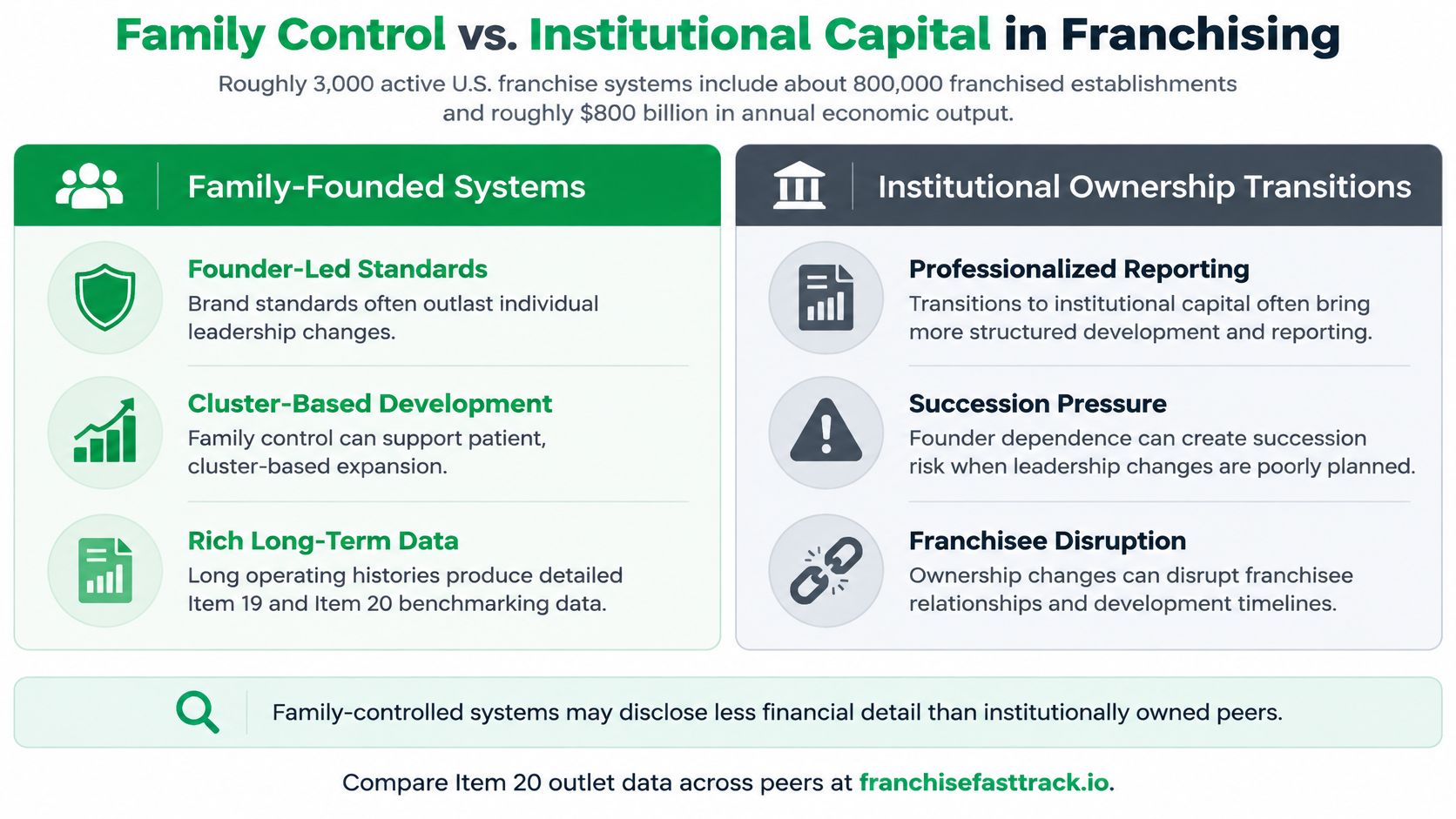
Perception adds another filter. A 2025 study of 400 Mexican consumers evaluating 25 brands across seven categories, reported in a Springer study on perceived family-business status, found perceived family-business status often didn't align with actual ownership, because judgments were shaped more by storytelling and symbolic cues. Family ownership that isn't communicated isn't a consumer asset. The sample sits in an emerging market, so U.S. development teams shouldn't treat the finding as universal, but the direction is useful: heritage needs active signaling, not assumptions.
Development leaders can test peers side by side through franchise development for established brands resources, Item 20 outlet and turnover comparisons, and Item 21 reviews of reporting infrastructure. An Item 19 history, where the franchisor discloses one, shows whether unit economics survived the ownership change. Local visibility affects whether family heritage registers with customers at the unit level, a point covered in franchise ranking advice from Magnitude Marketing.
How the eight family-founded systems compare on scale, ownership, and the FDD items to review
Seven founder-led systems set the comparison, and the final row is a sector benchmark.
| System or benchmark | Founded | U.S. Locations | Ownership Today | FDD Item to Review |
|---|---|---|---|---|
| Chick-fil-A | 1946, Hapeville, Georgia | More than 3,000 | Privately held and controlled by the Cathy family | Items 5 and 7: initial fees and investment |
| Culver's | 1984, Sauk City, Wisconsin | More than 1,000 | Founded by Craig and Lorna Culver; confirm current equity in Item 1 | Items 7 and 20: investment, outlet growth, and turnover |
| Jersey Mike's Subs | 1956, Point Pleasant Beach, New Jersey | More than 2,500 | Blackstone holds a majority investment; Peter Cancro retains an ownership position | Items 19 and 21: sales disclosures and audited financials |
| Little Caesars | 1959, Detroit area | More than 4,000 | Ilitch family, through Ilitch Holdings | Items 7 and 20: investment, outlet growth, and transfers |
| Dickey's Barbecue Pit | 1941, Dallas, Texas | More than 500 | Roark Capital holds a majority investment | Items 7 and 19: investment and unit economics |
| RE/MAX | 1973, Denver, Colorado | More than 8,000 offices | Publicly traded as RE/MAX Holdings | Items 5, 6, and 19: fees and revenue disclosures |
| Waffle House | 1955, Avondale Estates, Georgia | More than 2,000 | Closely held by the Rogers family; primarily company-operated | Item 1: franchise program and scope |
| U.S. franchising benchmark | No single founding date | About 800,000 franchised establishments | Mixed franchisor ownership | Items 20 and 21: outlet trends and audited financials |
The development lesson is that scale alone does not prove the family model can be copied. Waffle House reached more than 2,000 restaurants while staying primarily company-operated, so Item 1 matters more than franchise fee math. Jersey Mike's and Dickey's moved under sponsor control, which shifts diligence toward Item 19 performance representations and Item 21 audit quality. Chick-fil-A, Culver's and Little Caesars keep the review on Item 7 capital loads and Item 20 turnover, where selection discipline, clustering and transfer activity show whether founder control became an operating system. For a franchisor, the benchmark row is the warning: an 800,000-establishment sector rewards evidence, not origin stories.
Turning Family-Brand Lessons Into Franchise Development Benchmarks
Start by mapping each family-founded system's ownership history against its Item 20 outlet trends and Item 21 audited financials. That single exercise separates heritage marketing from operating evidence. A brand that kept closures low through a second-generation transition or a sponsor acquisition has governance worth copying. A brand that grew unit count while transfers climbed has a development problem that founder stories will not fix.
Next, convert the strongest models into screening criteria and pacing rules. Chick-fil-A's selection rigor becomes hard thresholds on income, capital, and intent for every candidate. Culver's clustered Midwest expansion becomes a market-by-market entry plan that protects support density. Waffle House's decision to stay primarily company-operated becomes a control benchmark: franchise fees matter less where brand consistency is the asset. None of those models transfers automatically to home services, fitness and wellness, automotive services, health and beauty, education, or senior care, since labor intensity, ticket size, and territory economics differ too much. The discipline transfers, though. Tight screening, measured market entry, and honest turnover reporting work in every vertical.
Ownership transitions deserve a dedicated review cycle. Jersey Mike's under Blackstone and Dickey's under Roark Capital show how sponsor ownership can professionalize reporting and development staffing while retaining founder presence. RE/MAX shows a public-market path where agent economics, rather than unit sales, drive system health. In each case, Item 1 ownership disclosures, Item 19 performance representations, and Item 20 transfers during the first years after a transaction tell a development team whether franchisees stayed committed or started exiting. PE and M&A teams evaluating a family-controlled target should map succession history against those disclosures before pricing growth assumptions.
Franchise Fast Track's FDD database holds more than 68,000 FDDs for side-by-side review, and its multi-unit franchisee directory lists more than 31,000 multi-unit franchisees so benchmarks can be tested against real operators who already run units at scale. Its registry covers 7,000 or more franchise brands alongside a classified contact database of more than 3.5 million franchise industry employees, giving development teams a way to identify comparable family-founded systems instead of relying on headline rankings. Access is application-only, limited to a small number of brands at a time and to one franchisor per concept category per market, so the practical move is to review the model and apply for exclusive access before a competing concept in the same category claims the slot.
The practical standard is simple. Treat family founding as a starting hypothesis, then prove it with outlet data, audited financials, and operator retention across at least one full ownership or economic cycle.
Franchise Fast Track helps established franchisors turn family-brand benchmarks into a verified operator pipeline, combining a 68,000-plus FDD database, a 31,000-plus multi-unit franchisee directory, and US-based screening of executives, directors, VPs, and senior managers earning $150,000 to $500,000+ annually against a defined ideal franchisee profile. Development leaders at systems with 50 or more locations, a minimum $150K franchise investment, and a team that can handle 20+ qualified discovery calls a month can review the model, check category availability, and apply for exclusive access through Franchise Fast Track.
Ready to see results like these for your franchise?
Stop wasting money on leads that never close. Start getting hundreds of replies from high-net-worth professionals daily.