Cajun Operating Company: Franchise Structure Explained
Cajun Operating Company is not just a brand owner, it is the Delaware-incorporated operating vehicle behind a 1,566-restaurant system that generated about $1.2 billion in system-wide sales over the twelve months ending July 11, 2021, with roughly 90% franchised units KBRA report on Cajun Global LLC. That mix matters because it tells franchise development executives exactly where the economics sit, at the franchise layer, not inside a heavily company-operated estate.
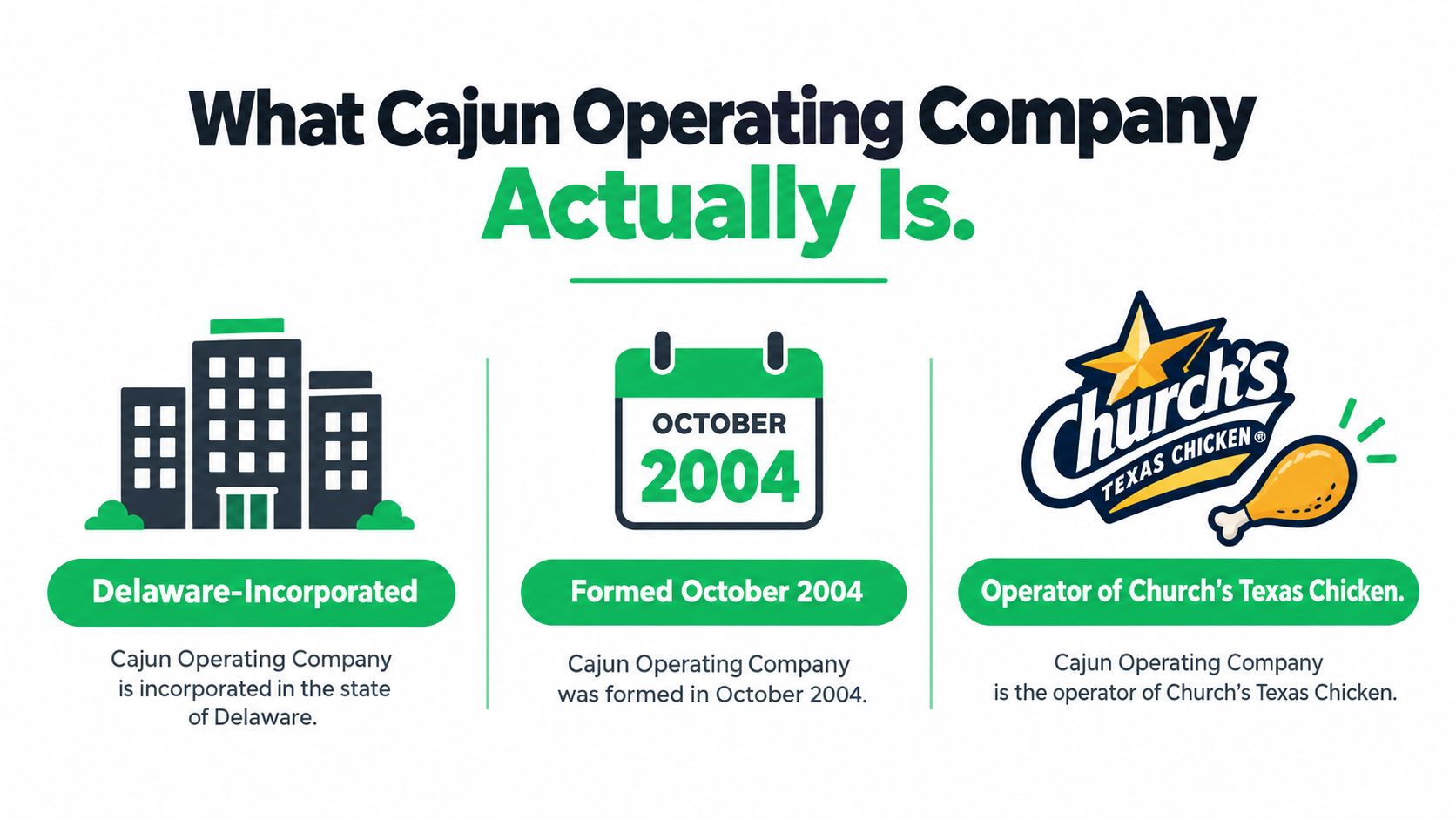
Table of Contents
- What Cajun Operating Company Actually Is
- From San Antonio to a Global QSR Network
- How the Cajun Entities Fit Together
- System Scale and the 28-State Footprint
- Reading the FDD Economics the Right Way
- Item 20 Numbers Beyond the Location Count
- Screening Candidates Against Cajun's Actual Requirements
- Why Cajun Operating Company Matters for Franchise Development Teams
What Cajun Operating Company Actually Is
Cajun Operating Company was incorporated in Delaware in October 2004 after Arcapita acquired Church's from AFC Enterprises for about $390 million Church's history page. Cajun is the corporate operating entity, while Church's Texas Chicken and Texas Chicken are the customer-facing brands. For franchise analysts, that split matters because it separates the legal wrapper from the guest-facing concept.
Church's history shows the brand had already moved beyond its original Texas base before Cajun became the central corporate vehicle. It expanded into Canada through its first international franchise in Vancouver and reached its 1,700th restaurant worldwide by 2000, which points to a system that was already scaled long before the current entity structure took shape Church's history page.
A 2021 rating-agency report placed the system at 1,566 restaurants worldwide and roughly $1.2 billion in system-wide sales, with about 90% of locations franchised KBRA report on Cajun Global LLC. That profile points to a royalty-driven model. The economics sit in the franchise base, not in a large company-operated estate.
The question that matters is which legal entity collects the fees, controls development rights, and carries the obligations behind the system.
For operators evaluating guest engagement and repeat traffic, how BonusQR helps restaurants shows how local execution can support frequency at the store level. For development teams, how franchisors scale with FDDs explains why the FDD is the document that turns system scale into enforceable territory rights and fee structure.
From San Antonio to a Global QSR Network
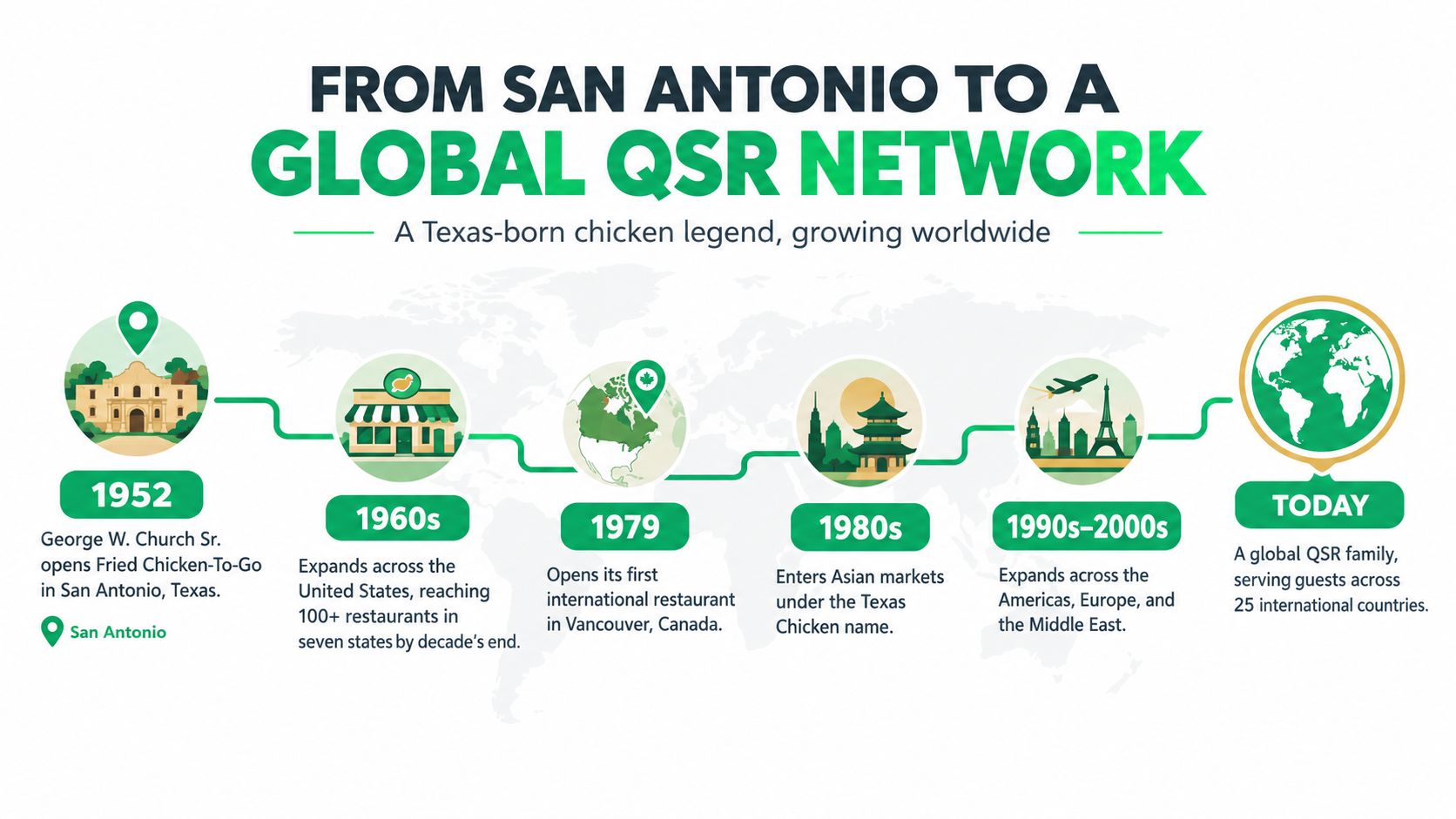
Church's began in 1952, when George W. Church Sr. opened the first Fried Chicken-To-Go restaurant in downtown San Antonio, Texas. That origin matters because it shows the business started as a local fried chicken concept, then expanded into a multi-state and later multinational quick-service restaurant system.
Church's own history shows the pace of that expansion. The brand had already moved past 100 restaurants across seven U.S. states before it became a broader international system, and the first franchise in Vancouver, Canada marked an early test of cross-border development. By 2000, the chain had opened its 1,700th restaurant worldwide, which indicates a mature network built on franchise scale rather than a start-up rollout.
The current Cajun corporate structure came later. In 2004, Arcapita's roughly $390 million acquisition led to the Delaware incorporation that formed the present vehicle. In 2011, franchise and development agreements were moved to affiliated Cajun entities as part of a financing and securitization structure, so the Cajun name now refers to a legal and financial stack, not just a storefront brand.
That sequence matters for franchise analysis. The corporate form followed the operating brand, and the filings now need to be read as financing documents as much as restaurant disclosures. For a useful parallel on system growth and territory control, see Franchise Fast Track on scaling networks.
How the Cajun Entities Fit Together
The Cajun structure routes economics through three distinct layers: the operating entity, the affiliated agreement holders, and the securitization vehicle that sits behind franchise cash flows.
The first layer is the operating company tied to Church's Texas Chicken. The second layer emerged in 2011, when franchise and development agreements were transferred to affiliated Cajun entities as part of a financing and securitization structure. For analysts, that means the entity named in a filing is not always the same entity that receives every payment stream.
The third layer is the financing vehicle. A 2021 credit report described Cajun Global LLC as the special-purpose issuer behind senior secured notes backed by restaurant-related cash flows, and it identified a pool of 1,346 franchised restaurants with about 73% of collections coming from the franchise segment. That structure matters because royalties, fees, leases, and intellectual property are all part of the capital stack, not just the operating brand.
A franchised system with securitized collections has two audiences: the franchisee and the note investor. That is why legal form drives the economics more than the logo does.
For development teams, the reading discipline is straightforward. A Cajun filing should not be treated like a single-entity restaurant chain with one clean revenue line. It is a layered system in which the franchisor, affiliated entities, and financing structure affect what gets collected, pledged, or approved. A closer review starts with legal roles behind franchising, then moves into the disclosure package itself.
System Scale and the 28-State Footprint
Church's system was at 1,543 restaurants worldwide at the end of 2018, with 1,086 in the United States and Puerto Rico and 567 outside the United States and its territories. Of the domestic total, 921 franchised / 165 company-owned units were in the United States and Puerto Rico, which shows a system that was already heavily franchised on its home market base. By the 2021 rating report, the system had reached 1,566 worldwide locations and approximately $1.2 billion in system-wide sales, with about 58% of restaurants located in 28 U.S. states, including Washington, D.C. KBRA report on Cajun Global LLC
That geography matters because scale changes the operator profile. A brand with units spread across domestic and international markets needs franchisees who can handle multi-unit complexity, territory coordination, and consistency across different labor and supply conditions. The system's footprint therefore shapes the development pipeline, since a concept at this size cannot rely on a small set of single-unit buyers.
Church's official directory also lists 319 locations in Texas alone Church's Texas locations directory. That concentration points to durable regional strength in the brand's founding state, even as the network extends well beyond Texas. A later franchise-data summary places the system at 885 total locations, including 722 franchised and 163 company-owned units ClearlyFDD Church's Texas Chicken summary. The gap between the rating report and the later summary is a reminder that outlet counts move with reporting year, so Item 20 has to be read against the exact fiscal period in the FDD.
| Snapshot | Worldwide units | Franchised | Company-owned | Key geography |
|---|---|---|---|---|
| End of 2018 system position | 1,543 | 921 franchised / 165 company-owned, domestic only | 165 domestic company-owned | 1,086 in the U.S. and Puerto Rico, 567 outside the U.S. and its territories |
| 2021 credit report | 1,566 | About 90% franchised | About 10% company-operated | 28 U.S. states, including Washington, D.C. |
| 2026 franchise-data summary | 885 | 722 | 163 | Texas listed at 319 locations |
For development planning, the point is scale, not size for its own sake. The brand has enough units to require territory discipline, multi-unit operator depth, and a strong candidate pipeline, which is why outbound candidate qualification often matters more than broad portal traffic for a system at this level.
Reading the FDD Economics the Right Way
Church's historical disclosure set the economic frame clearly: a $644,366 to $1.6 million opening investment range, a $20,000 initial franchise fee, 5% royalties, and a 5% advertising contribution historical franchise disclosure. It also required $1 million in net worth and $300,000 in liquid capital PeerseSense summary. Those figures matter because they separate candidate interest from actual development capacity.
Item 7 and Item 19 need to be read together
The strongest operating benchmark in the disclosure set is the Item 19 median unit volume of about $1.1 million in the 2026 summary, based on 2025 fiscal-year gross sales Franchise Watch Desk FDD summary. Church's also reported average unit volume above $1 million on its news page Church's news page. Taken together, those figures show sales scale, not retained profit. Food cost, labor, occupancy, debt service, and advertising still sit below the top line.
The cleaner way to read the economics is to master the Franchise Disclosure Document before drawing conclusions about store-level returns. A franchise disclosure document checklist helps keep Item 7, Item 19, and Item 21 in the right order. Item 7 shows what capital the buildout requires. Item 19 shows what a representative unit has generated. Item 21 then tests whether the operator has the financial capacity to support development and ongoing obligations.
A historical filing adds useful perspective. In 2008, the system reported $868.2 million in U.S. systemwide net sales from 232 company-operated and 972 franchised restaurants, while Cajun Operating Company reported about $270 million in revenue from company-restaurant sales, royalties, and initial franchise fees from its historical financial statements. That split shows why Item 19 cannot be treated as a profit proxy. Revenue at the system level, and revenue at the corporate level, are different questions.
Bottom line: Item 19 is a sales benchmark, Item 7 is a capital requirement, and Item 21 shows whether the applicant can support the deal. Using any one of them as a stand-in for profit leads to bad underwriting.
| Economics item | Disclosed figure | What it actually tells the analyst |
|---|---|---|
| Opening investment | $644,366 to $1.6 million | Capital needed before opening day |
| Initial franchise fee | $20,000 | Entry fee, not operating cushion |
| Royalty | 5% | Ongoing top-line charge |
| Advertising contribution | 5% | System marketing obligation |
| Net worth threshold | $1 million | Balance-sheet qualification |
| Liquid capital threshold | $300,000 | Cash readiness for development |
Item 20 Numbers Beyond the Location Count
Item 20 is where scale can be checked against churn. Church's 2026 summary reported 21 openings and 13 closures during 2025, ending the year at 885 total locations, including 722 franchised and 163 company-owned units. Read together, those figures show gross growth and attrition in the same filing, which is more useful than a raw system total.
The cleaner development signal is the movement between beginning-of-year units and exits. One FDD-tracking source reported that 13 of the 714 franchised outlets open at the start of the year left the system, which produces an annualized exit rate of 1.8% ClearlyFDD Church's Texas Chicken summary. As a single-system figure, the 1.8% exit rate is a turnover signal, not a profit metric. It helps analysts separate openings, stable units, and closures instead of treating every reported restaurant as the same kind of asset.
Movement data like this is typically pulled from FDD tables using tooling such as extract images from any page when analysts rebuild Item 20 histories from scanned filings and image-based disclosures.
What development leaders should measure
For a franchise sales organization, Item 20 belongs on the dashboard, not in the footnotes. Three counts matter most.
- Signed deals: commitments that show recruiting progress, but not operating proof.
- Opened units: restaurants that have cleared real estate, permitting, construction, and training.
- Stabilized units: locations that have had enough operating time to show whether the model holds.
If those figures are blended together, development momentum can look stronger than it is. That matters in a franchise-led QSR system because delays in site control, financing, buildout, or operator training can widen the gap between award and opening.
A cleaner way to read the movement data is to pair opening and closure counts with the franchise success rate guide. The point is not to celebrate unit count for its own sake. It is to test whether the brand is recruiting, opening, and keeping franchisees at a pace that supports territory expansion.
| Church's Texas Chicken Item 20 movement in 2025 | 2025 value | Implication |
|---|---|---|
| Openings | 21 | Gross expansion was positive |
| Closures | 13 | Attrition still matters |
| Net change | 8 | Growth existed, but not at a runaway pace |
| Franchised exits from beginning-of-year outlets | 13 of 714 | Exit rate deserves attention |
| Annualized franchisee exit rate | 1.8% | Turnover signal, not a profit metric |
A development executive who reads Item 20 this way can tell whether the pipeline is producing real restaurant openings or only signed paperwork. That difference is where franchise sales quality shows up.
Screening Candidates Against Cajun's Actual Requirements
Church's historical disclosure gives the development structure a clear shape. It sets a $10,000 development fee for each restaurant committed under a development agreement, plus a separate $15,000 initial franchise fee for each restaurant. It also requires the franchise agreement to be signed within 120 days after the franchisor accepts a site and before the restaurant opens. That window matters because it turns site approval into a defined contract deadline, not an open-ended approval process.
The format menu is broader than a free-standing box
The same disclosure allows for freestanding buildings, storefront and mall locations, college and university sites, convenience stores, travel plazas, and urban, suburban, or rural sites, subject to approval. That flexibility tells development teams two things. The brand can fit several real estate types. Site selection still has to be disciplined, because format flexibility does not remove the need for operational fit.
The qualification profile should be read as an operating requirement, not just a balance-sheet test. The system's batch-production model, small-batch chicken preparation, hand-battering, and double-breading require standardized execution throughout the day Church's news page. Candidates therefore need more than passive capital. They need multi-unit management depth, working capital reserves, food-safety discipline, labor-management systems, and the ability to execute the production rhythm consistently.
A franchisor can sell a location to a capital source once. It can only scale a network with operators who can open, staff, and run the restaurant the same way every day.
For a 1,500-plus-unit QSR system, screening should focus on the operator, not just the checkbook. The useful questions are about buildout capacity, market coverage, training discipline, and whether the candidate can absorb a standardized operating system across multiple sites. That is the difference between a signed deal and a durable restaurant network.
Why Cajun Operating Company Matters for Franchise Development Teams
Cajun Operating Company matters because it sits at the intersection of scale and financing. A KBRA report on the Cajun Global securitization described a 1,500-plus-unit QSR platform with a roughly 90% franchised mix, and said about 73% of collections in the note structure came from the franchise segment. That means franchise development is tied directly to the credit profile of the parent structure. Candidate quality is simultaneously an operational and a financial issue for the parent structure.
For CDOs, VPs of Franchise Development, and brand presidents, the underwriting lens should start with Item 7, Item 19, Item 20, and Item 21, then move to territory design and candidate sourcing. A system this size does not need generic lead volume. It needs verified, capital-ready, multi-unit-capable operators who can open and stabilize locations. Outbound qualification usually outperforms franchise portals, broad paid ads, and broker referrals when the goal is cost-efficient qualified conversations.
The practical next step is to start with the FDD database for Item 7, Item 19, and Item 20 comparisons, then layer the multi-unit franchisee directory when the target is operator screening. That sequence gives development teams a cleaner read on disclosure patterns, unit economics, and the types of operators most likely to fit a system built for scale.
Ready to see results like these for your franchise?
Stop wasting money on leads that never close. Start getting hundreds of replies from high-net-worth professionals daily.