Outbound Sales Agency for Franchisors: 2026 Guide
Outbound prospecting accounts for 31% to 42% of B2B pipeline generation, and 82% of buyers accepted meetings when sellers reached out first. For franchise development teams, that makes an outbound sales agency a revenue system, not a side experiment.
That matters most in high-consideration franchise recruitment, where the candidate isn't just booking a meeting, they're evaluating capital risk, territory fit, operating experience, and FDD disclosures before any serious commitment.
Table of Contents
- The Historical Performance of Outbound Sales in Franchise Development
- Modern Outbound Metrics That Matter for Franchise Recruitment
- Distinguishing Franchise Outbound from Standard B2B Appointment Setting
- KPI Framework for Measuring Outbound Agency Performance
- FDD Compliance Requirements for Outbound Franchise Outreach
- Onboarding an Outbound Agency for Franchise Development
The Historical Performance of Outbound Sales in Franchise Development
Outbound selling didn't begin as a software-era tactic, and it didn't become credible because email made it cheap. It became durable because every major improvement in telecom and sales infrastructure widened the gap between random outreach and disciplined prospecting. For franchisors, that history matters because it shows why outsourced prospecting is a mature operating model, not a novelty.
From 1908 telephone bureaus to 1965 structured selling
The lineage is older than most franchise sales teams realize. In 1908, New York's Equitable Trust Company ran a dedicated telephone bureau with 12 agents. By 1957, Time Inc.’s Life Circulation Company had built a Manhattan call center for subscription sales, and its five operators averaged about 200 calls per day. In 1965, American Express showed the commercial ceiling of structured outbound selling when its operation generated nearly $10 million in new charges during its first year. Those milestones, taken together, show a throughline of specialized staff, targeted contact, and measurement, the same mechanics that matter in franchise development.
Predictive dialing, then regulation, then contraction
The 1980s changed the operating math. Predictive-dialing systems from manufacturers including Mitel reportedly pushed agent utilization above 60%, tripled contact rates, and cut customer-acquisition costs to below $10 per customer, versus about $100 per thousand television advertising impressions. By its reported peak in 2000, telephone marketing generated roughly $585 billion in U.S. sales and employed 5.6 million people across 69,500 call centers. The channel then contracted sharply, falling to $61.4 billion in U.S. telephone-marketing expenditure by 2020, with the National Do-Not-Call Registry introduced in 2003 reshaping the environment. The practical takeaway is simple, outbound didn't disappear, it narrowed into a more selective discipline.
Practical rule: the historical winners didn't maximize call volume, they tightened targeting, improved timing, and built repeatable qualification rules.
For franchisors, that matters because the channel's best use case is no longer mass interruption. It's focused contact with a defined population of qualified operators, executives, and capitalized prospects.
Modern Outbound Metrics That Matter for Franchise Recruitment
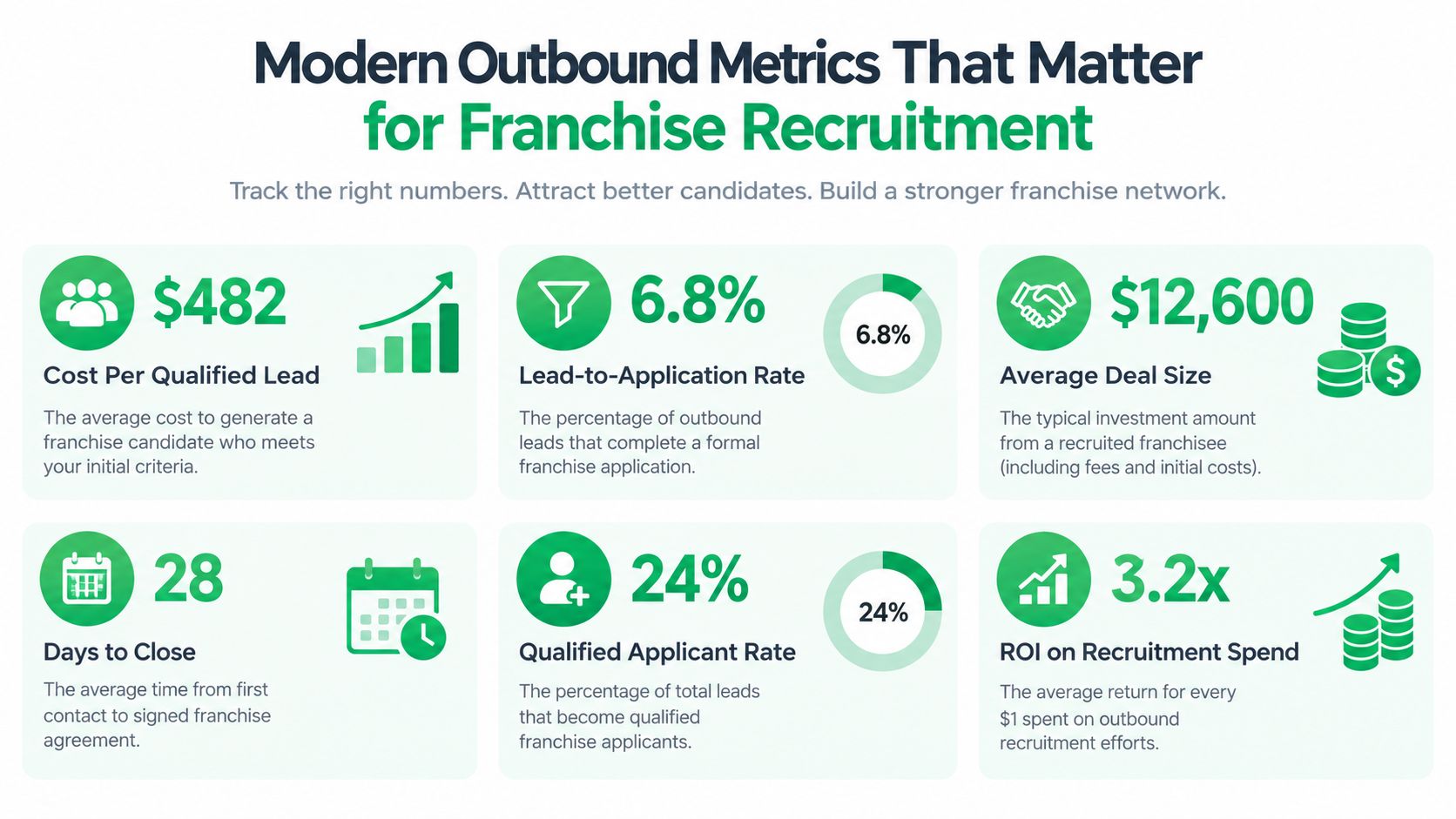
Modern outbound still produces pipeline, but only when the agency treats targeting as the main variable. Benchmarks show that outbound contributes approximately 31% to 40% of pipeline generation through SDR activity, while another benchmark places outbound at 42% of average B2B pipeline, compared with 31% from inbound. In other words, outbound remains commercially relevant, but it wins when the list is disciplined and the message is relevant. See the broader benchmark set in this franchise lead generation company context.
What buyers accept and what they ignore
The strongest reason franchisors should care is not message volume, it's receptivity. A RAIN Group study of 488 B2B buyers found that 82% accepted meetings with sellers who reached out first. That doesn't mean every contact gets through, only that first contact can work when the audience is real and the value proposition is specific.
Why the cold outreach numbers force selectivity
The weak side of the equation is just as clear. Reported cold-call success rates sit in the 2.3% to 2.7% range, which is exactly why the agency's value can't be measured as “more calls made.” It has to be measured as more relevant conversations with the right people. A separate benchmark says personalized cold emails produce a 32% higher response rate than generic messages, which supports a franchise-recruitment model built on income verification, geography, and concept fit rather than broad outreach.
The real job of an outbound agency is to turn a large addressable market into a smaller set of prioritized conversations.
That distinction matters even more for franchisors targeting executive-level candidates, multi-unit operators, and high-income professionals. Those prospects don't need more noise, they need a reason to engage, and a reason to trust the sender.
Distinguishing Franchise Outbound from Standard B2B Appointment Setting
Franchise recruitment is not standard appointment setting with a longer sales cycle. It's a qualification process around capital, operating background, and willingness to enter a regulated purchase path. That's why the comparison set for software or services often breaks down, even when the outreach mechanics look similar.
Why rep-free buying changes the playbook
Gartner reported that 61% of surveyed B2B buyers preferred a rep-free buying experience, based on 632 buyers surveyed in late 2024. For franchise development, that's a warning sign if the agency thinks its job is to push prospects into generic demos. High-consideration franchise candidates usually want proof, not persuasion, and they want it in a format that fits the FDD and the development process. The outreach function needs to behave like a research and qualification layer, not a calendar-filling machine.
The trust data points in the same direction. In a 2025 outbound survey, professionals were more likely to engage when they recognized the sender, 84%, when outreach was personalized, 81%, and when relevant proof was included, 80%. That tells franchise brands something important, more outreach can in fact underperform when the audience already distrusts generic vendor behavior.
The five qualification criteria that matter
A serious franchise outbound program should screen for five things before a meeting ever lands on a development calendar.
- Verified investment capacity, so the conversation starts with real capital fit, not aspiration.
- Operating experience, because management background changes the quality of the candidate.
- Preferred geography, since territory availability shapes both interest and feasibility.
- Motivation, which separates casual curiosity from an actual development process.
- Concept fit, which avoids wasting time on candidates who match the income profile but not the brand model.
Practical rule: a well-run outbound program for franchisors should qualify people out early, not chase every possible yes.
That is especially true in QSR, home services, real estate brokerages, fitness and wellness, automotive services, health and beauty, retail, education, and senior care. Each vertical carries different operating burdens, and a one-size-fits-all pitch usually creates false positives instead of qualified candidates.
KPI Framework for Measuring Outbound Agency Performance
An outbound sales agency should be measured as a funnel, not as a reply box. The difference is operational, not cosmetic. If the agency can't show what happens from contact to conversation to held meeting to accepted opportunity, then the brand is paying for activity, not development.
The sequence that actually matters
A useful operating model tracks dial-to-connect, connect-to-conversation, conversation-to-meeting, meeting-held, qualified-opportunity, and opportunity-to-close separately. That prevents a common mistake, treating one strong KPI as proof that the whole system works. In a 2024 benchmark, 55,701 dials produced 9,247 connections, 5,265 conversations, and 254 booked meetings, for a 4.82% conversation-to-meeting success rate. The point isn't the exact rate as a universal target, it's the discipline of reading the full funnel.
| Essential Outbound KPIs for Franchise Recruitment | Benchmark Range | Measurement Purpose |
|---|---|---|
| Dial-to-connect | Varies by list quality and territory | Measures reachability and list hygiene |
| Connect-to-conversation | Varies by persona and channel | Shows whether the opener earns attention |
| Conversation-to-meeting | 4.82% in the 2024 benchmark | Shows conversion from interest to booking |
| Meeting-held | Should be tracked separately from booked | Filters no-shows and weak qualification |
| Qualified-opportunity | Cohort-specific, not calendar-based | Measures sales-accepted fit |
| Opportunity-to-close | Brand-specific | Ties outbound to franchise awards |
HubSpot's sales-statistics summary says three-email campaigns produce the highest average reply rate at about 9%. That's useful, but only as a directional comparison, not a forecast. A three-touch sequence that ignores qualification is still a weak sequence.
Why denominator discipline protects the budget
Franchise development teams should require a qualification record before calendar placement. That record should show investment capacity, operating background, geography, motivation, and concept fit, then the team should audit a sample of meetings for false positives. Compensation should favor held sales-accepted meetings and qualified opportunities, not raw activity or unfiltered calendar volume. If a provider wants to call something a win, it should survive the downstream funnel.
The right partner can bring process discipline, not just volume. For teams comparing providers and internal execution, a data-driven franchise sales framework is more useful than a meeting-count promise.
FDD Compliance Requirements for Outbound Franchise Outreach
Outbound franchise messaging operates under a legal boundary that standard B2B appointment-setting rarely faces. The FTC Franchise Rule treats the Franchise Disclosure Document as a diligence document, not a marketing brochure, so every call, email, deck, and follow-up asset has to stay inside it. For a franchisor, the agency must fit the FDD, not work around it.
Item 19 is the earnings-claim boundary
Item 19 is the designated section for financial performance representations. If a franchisor makes claims about sales, income, or profits, those claims must appear in Item 19 and rest on a reasonable factual basis. Unsupported earnings language does not belong in outreach copy, voice scripts, presentations, or PDF attachments. For brands in QSR, home services, fitness and wellness, automotive services, senior care, and other capital-intensive categories, that boundary is a compliance control, not a style preference.
Item 20 and Item 21 serve different diligence purposes
Item 20 provides measurable evidence of system expansion and franchisee turnover across the preceding three fiscal years. The FTC says those tables show growth and owner turnover, including outlets that closed, transferred, or transferred back to the franchisor. It also requires disclosure of current franchisee identities and outlet contact information, plus the name, city, state, and current or last-known telephone number of former franchisees where required. That makes Item 20 useful for territory analysis and for building a real operator reference network.
Item 21 serves a different purpose. It contains the franchisor's three most recent audited annual financial statements, so it evaluates the corporate entity behind the system rather than the unit-level performance claims in Item 19. Senior candidates and PE or M&A teams care about that distinction because the franchisor's financial condition affects training, technology, field support, and expansion capacity.
Outreach teams should never add unsupported claims to a compliant FDD. They should point qualified candidates to the right item and keep every message aligned with the current document.
A practical compliance workflow pairs approved messaging with source-controlled documents and a review process for any financial statement language. It also needs item-level precision, because Item 19, Item 20, and Item 21 answer different diligence questions. A Franchise Fast Track FDD analysis becomes useful as a reference point when a team needs to keep those distinctions clear.
Onboarding an Outbound Agency for Franchise Development
The cleanest outbound setup starts with data, not copy. A franchisor needs the current FDD, a clear ideal franchisee profile, territory logic, and a candidate definition that matches the sales process already in place. If the brand can't explain who belongs in the funnel, an agency will just create busier noise.
The operating inputs that need to be ready first
The data package should include Item 20 territory signals, the approved messaging boundaries from the FDD, and the intake criteria the development team uses after first contact. The agency then needs a conversion model that tracks candidates from qualified conversations to discovery calls, applications, approvals, awarded territories, franchise agreements, and opened units. Without that chain, attribution gets blurry fast, especially when portals, brokers, paid search, and social also influence the same prospect.
How to structure the relationship
Contract terms should define exclusivity, data ownership, response handling, and the exact definition of a qualified meeting. That matters because the International Franchise Association's 2025 survey of 171 senior executives representing 229 brands found that 54% planned to rely on internal franchise sales teams for growth. The external agency should therefore function as a top-of-funnel and intelligence layer, not a replacement for the internal team.
A good way to test fit is to compare two or three approaches before locking into a long commitment. That can include different messaging angles, different qualification thresholds, and different channel mixes. For brands weighing pay-per-meeting structures or contact-sourcing models, Fypion Marketing's pay-per-meeting outreach overview is a relevant external comparator for how agency economics get framed in adjacent outbound markets.
| Contract Area | What the Franchisor Should Control | Why It Matters |
|---|---|---|
| Exclusivity | Market and concept restrictions | Avoids channel conflict |
| Data ownership | Lists, replies, and scoring history | Prevents lock-in |
| Compensation | Held meetings and qualified opportunities | Aligns with downstream value |
| Qualification rules | Investment, geography, operating fit | Reduces false positives |
Franchise Fast Track also operates with a registry of 7,000+ franchise brands, 68,000+ FDDs, 31,000+ multi-unit franchisees, and 3.5 million classified franchise industry contacts, which is relevant when a development team wants outreach built on verified franchise data rather than generic prospect lists. For franchisors comparing outbound partners, the right next step is to review Franchise Fast Track and judge whether the qualification model fits the brand's FDD, territory strategy, and internal sales capacity.
Ready to see results like these for your franchise?
Stop wasting money on leads that never close. Start getting hundreds of replies from high-net-worth professionals daily.