7 Mobile Repair Franchise Models to Compare in 2026
7 mobile repair franchise systems split into 3 positioning models, and the lowest opening cost does not identify the strongest development candidate. Electronics specialists such as Experimax and uBreakiFix by Asurion emphasize device ecosystems, CPR Cell Phone Repair and Batteries Plus add accessory, resale, or broader service diversification, and mall-based formats trade territory control for foot traffic.
The comparison sits inside a U.S. franchising base of roughly 3,000 active systems, 800,000 franchised establishments, and $800 billion in annual economic output, according to the International Franchise Association's franchising outlook. Those figures frame scale only; ranking a single brand starts with its current FDD, not industry aggregates. The useful screen is comparative: business mix, startup exposure in Item 7, recurring fee burden, revenue diversification, territory logic in Item 20, franchisor strength in Item 21, and any performance representation in Item 19.
Operating discipline then decides whether the model converts demand. Intake, parts control, warranty tracking, and technician workflow shape same-day margin, so systems evaluating repair franchise management software should test software claims against actual repair mix, first-time-fix rates, and callback volume rather than headline ticket averages.
Table of Contents
- 1. uBreakiFix by Asurion
- 2. CPR Cell Phone Repair
- 3. Techy
- 4. Batteries Plus
- 5. Experimax
- 6. iFixandRepair
- 7. The FIX (The Fix Solutions)
- Top 7 Mobile Repair Franchise Comparison
- Rank Models by Economics Before Territory
1. uBreakiFix by Asurion
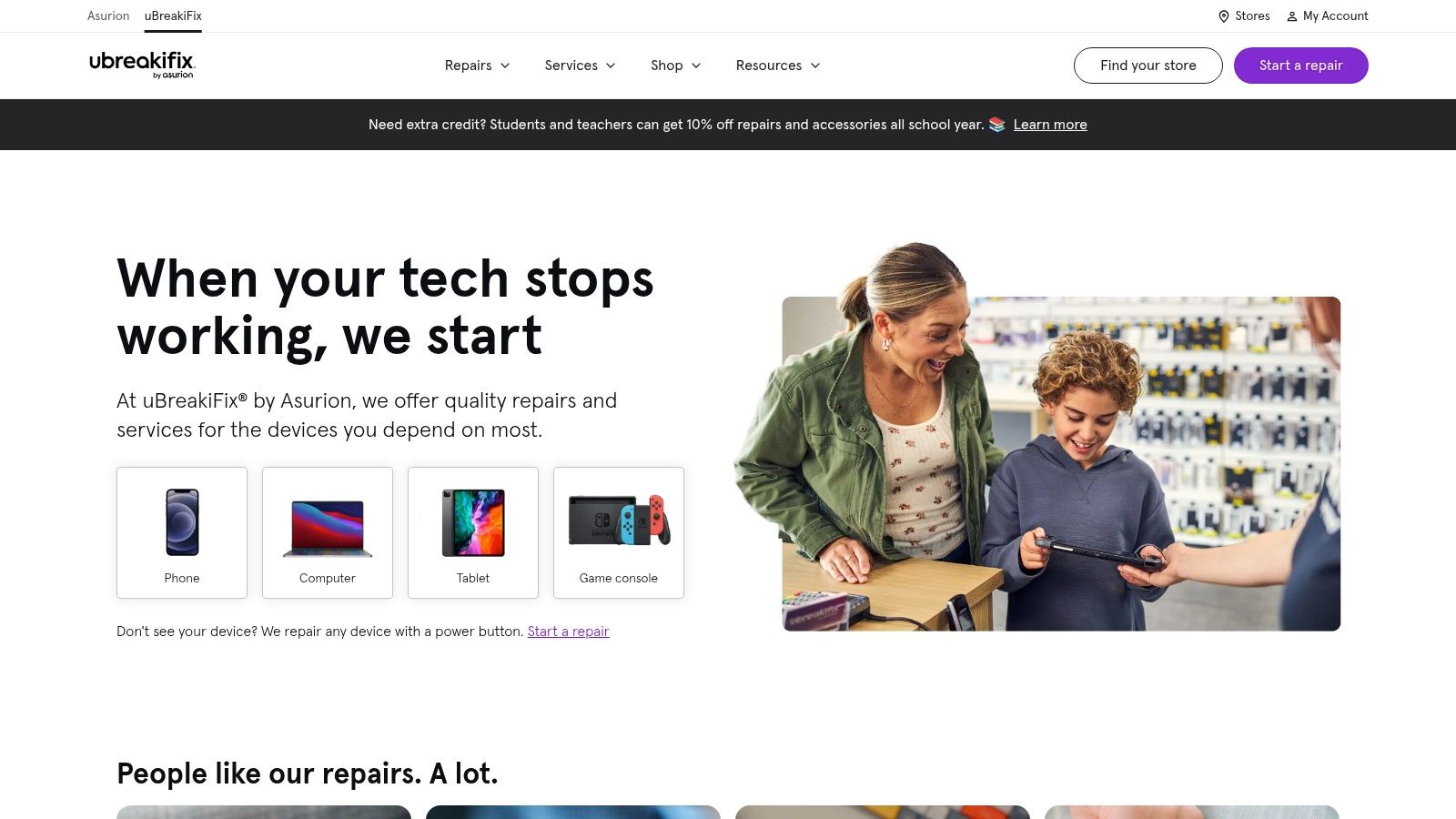
uBreakiFix by Asurion is the scale reference point for any mobile repair franchise comparison. Founded in Orlando in 2009 as a mail-in service, the brand shifted to brick-and-mortar locations when customers preferred same-day service, began franchising in 2012, and had expanded to more than 920 locations across the United States and the Caribbean by 2016, according to the documented history of uBreakiFix expansion and its 2019 acquisition by Asurion. Asurion acquired the chain in August 2019.
That history matters because the model didn't stay phone-only. Stores repair phones, tablets, computers, game consoles, and other powered devices, and the network supplements stores with mobile service units. The connection to Asurion protection-plan programs may generate repair referrals, while established training, operating playbooks, and supply chain access support conversion of independent shops and multi-unit development.
Authorization as a Development Asset
Samsung stated in August 2023 that uBreakiFix by Asurion had been an authorized repair provider for Galaxy smartphones since 2018 and planned 50 flagship Samsung repair locations by the end of 2023, as detailed in Samsung's announcement of expanded flagship repair locations with uBreakiFix by Asurion. Asurion subsequently reported nearly 700 stores, nearly 400 mobile repair vehicles, more than 3 million devices repaired in the preceding year, and over 24 million devices repaired cumulatively in that same Samsung coverage context.
Analyst check: Authorization, parts access, and technician certification can outweigh a lower franchise fee when software pairing and serialized components limit independent repair.
The tradeoffs are operational standards, fee burden, and dense competition in major metros. Anecdotal online feedback about sales pressure or margin concerns shouldn't substitute for Item 20 validation calls. Analysts benchmarking the brand against a directory of emerging franchise systems should separate protection-plan referral volume from walk-in demand that a new territory must generate locally.
2. CPR Cell Phone Repair
CPR Cell Phone Repair competes as a long-standing device repair brand with a broader retail layer than a repair-only counter. Locations handle phones, tablets, computers, and gaming devices, and many stores also sell accessories and buy or sell devices. That mix gives operators revenue sources beyond the repair ticket, but it also adds inventory, pricing, and quality-control decisions that a pure service model avoids.
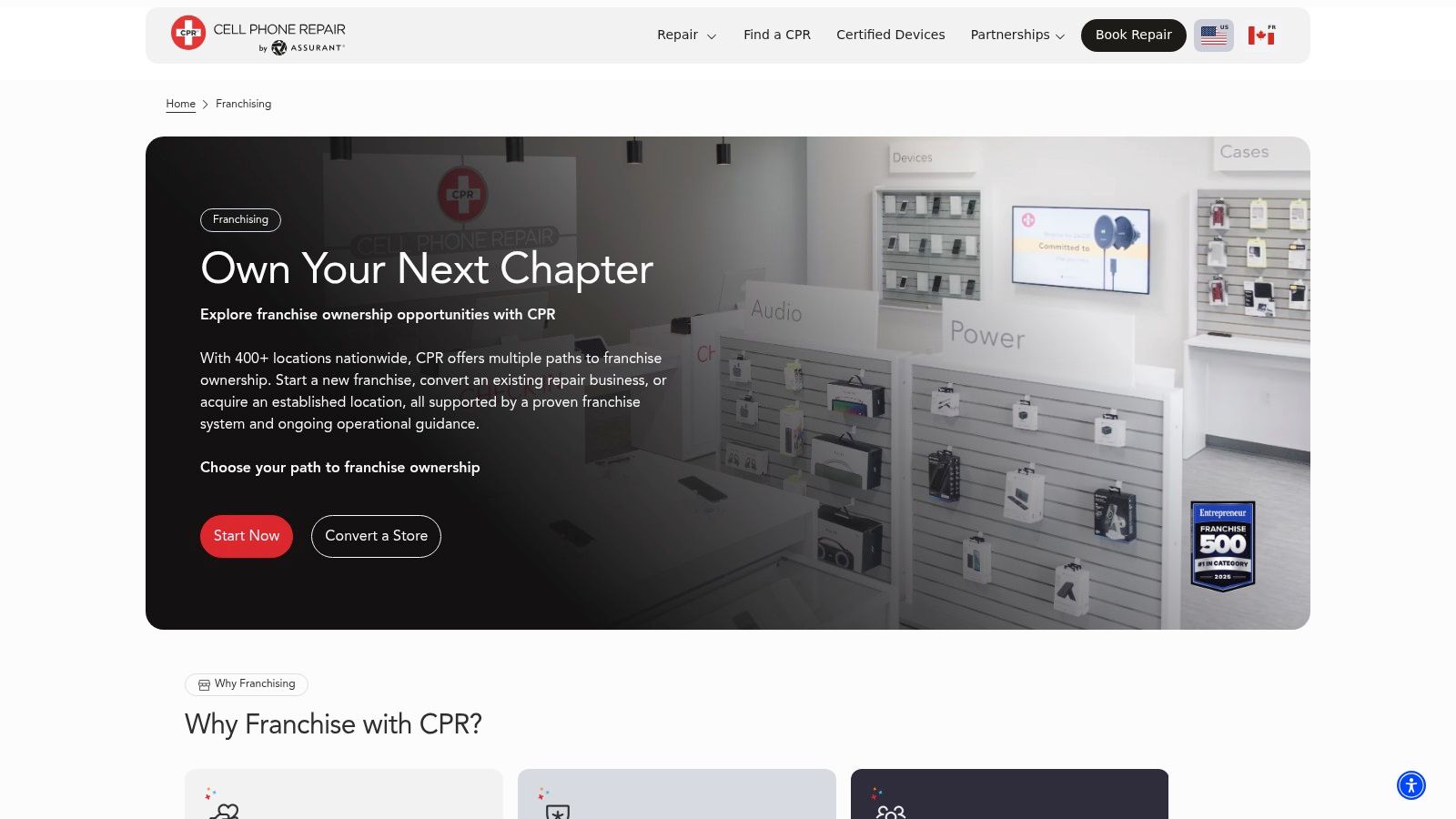
The system's conversion program for independent repair businesses is the development lever to examine first. Conversions can accelerate market entry where experienced technicians already exist, yet Item 20 must show whether converted units survive at the same rate as new openings. Centralized marketing and training support multi-unit growth, but customer experience can vary by store and operator, so territory awards should weight local execution history heavily.
Fee Burden and Repair Mix
The reported ongoing royalty near 5.8% in the plan materials requires confirmation in the current FDD before any pro forma uses it. Analysts should model that recurring burden against repair categories, not a blended ticket. Industry data reports third-party smartphone repairs average about 40% less than OEM-authorized service, while a typical U.S. screen repair costs approximately $150 versus roughly $699 for a replacement device, according to compiled smartphone repair industry statistics on pricing and consumer preferences.
Screen replacement represents approximately 43% of global repair market activity in 2026 in that same data set, and 57% of consumers prefer same-day smartphone repair while 49% would pay extra for that service. For CPR, the question for franchise development teams is whether accessory and device resale margins offset royalty and parts costs on high-volume, low-ticket screen and battery work.
3. Techy
Techy, formerly known as Dr Phone Fix, positions the store as a multi-service electronics destination rather than a single-category repair shop. The menu covers phone, computer, and tablet repair plus accessories, device sales, and smart-home installations. That last category changes the labor model, since in-home installation introduces scheduling, travel time, and liability questions that counter-based repair doesn't carry.
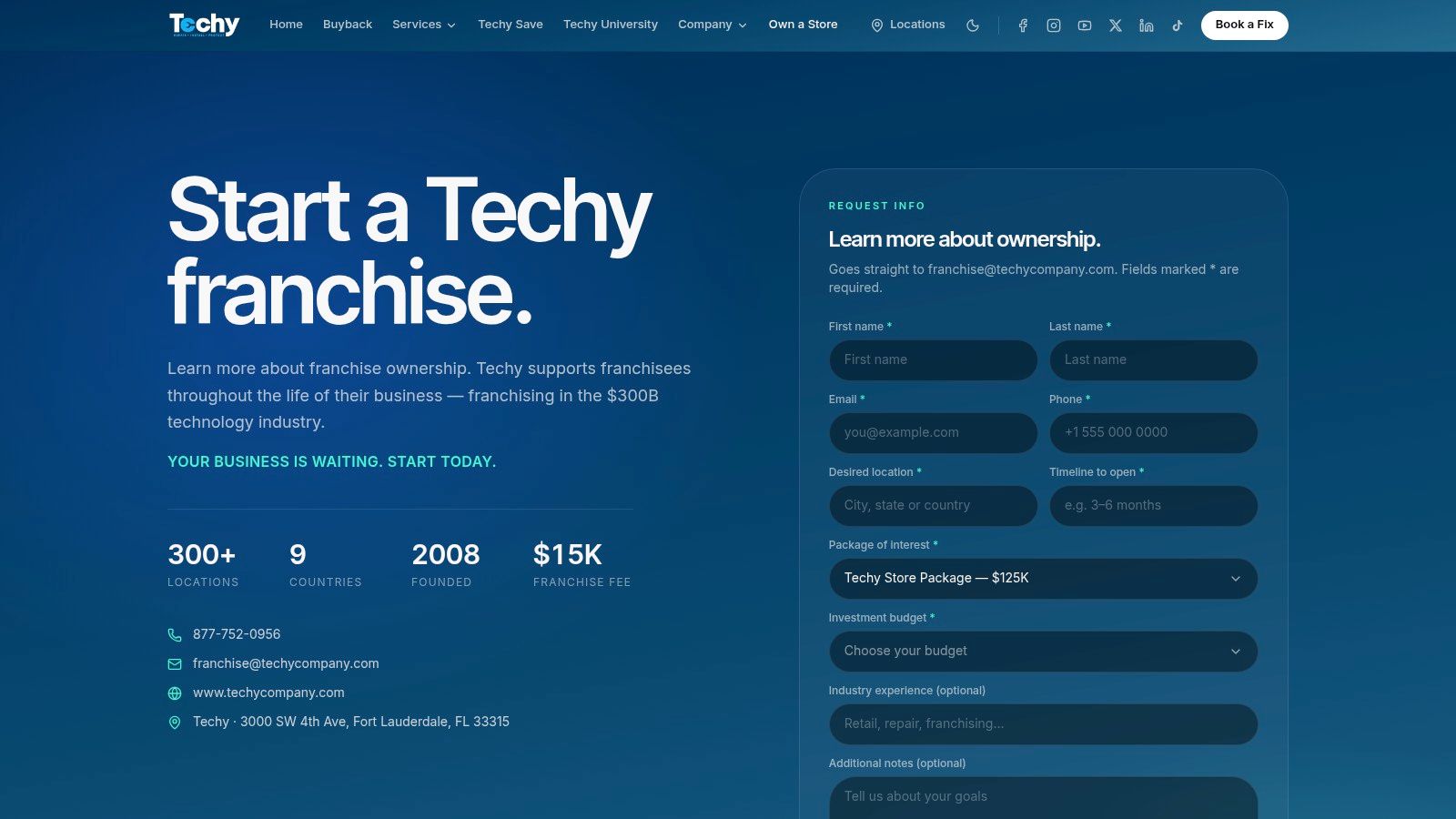
The brand targets mall and power-center locations and promotes open territories, cloud-based operating tools, and centralized phone support. Site flexibility can help development teams place units where independent repair competition is fragmented. Smart-home work may also raise average customer spend beyond what a cracked screen generates, provided technicians can complete both categories without extending repair cycle time.
Where Diligence Should Concentrate
The name evolution from Dr Phone Fix makes historical comparisons harder. Analysts shouldn't accept systemwide claims without reconciling which outlets operated under which brand, for how long, and under what fee structure. Current investment range and any Item 19 performance details require confirmation in the latest FDD.
- Territory mapping discipline: Open territory claims need population, device density, and competitor counts by trade area.
- Multi-unit references: Operators running more than one unit reveal whether centralized phone support holds up at scale.
- Service mix margin: Smart-home installation revenue should be separated from repair gross profit in validation.
For a franchise lead generation company evaluating candidate quality, Techy illustrates a recurring screen. A prospect drawn to diversified services still needs technician hiring capacity, because diversification without staffing depth turns into longer queues and warranty exposure.
4. Batteries Plus
Batteries Plus isn't a repair-only concept, and that's the analytical point. The specialty retail model built on batteries and lighting adds in-store phone and tablet repair and key fob programming as service layers. Repair functions as a traffic and attachment driver inside a broader retail operation, not as the sole revenue engine.
Commercial and institutional programs add a second distinction. B2B accounts can create recurring orders for batteries, lighting, and related services that consumer repair brands must replace with constant walk-in acquisition. Diversified products and services may smooth seasonality, since battery replacement, lighting, and key services don't follow the same demand curve as phone screens.
Inventory Complexity Is the Cost of Diversification
Owners manage inventory across multiple product categories, and training must cover a wider range of tasks than device repair alone. That complexity raises working-capital and shrink questions that Item 7 should quantify through initial inventory ranges. Development executives comparing Batteries Plus with repair specialists should normalize for retail inventory before concluding that one model carries higher startup exposure.
Diversification only improves unit economics when each category turns inventory and labor at its own measured rate.
The broader franchise context also matters for competitive positioning. The International Franchise Association projects 851,000 franchise establishments for 2025, a 2.5% year-over-year increase, with $936.4 billion in total franchise output and more than 9 million franchise jobs, according to the IFA 2025 franchising outlook announcement. Within that crowding, a marketing company for franchises would need to position Batteries Plus on commercial capability and retail breadth, not on repair speed alone, because automotive services, home services, and retail concepts all compete for the same multi-unit operators.
5. Experimax
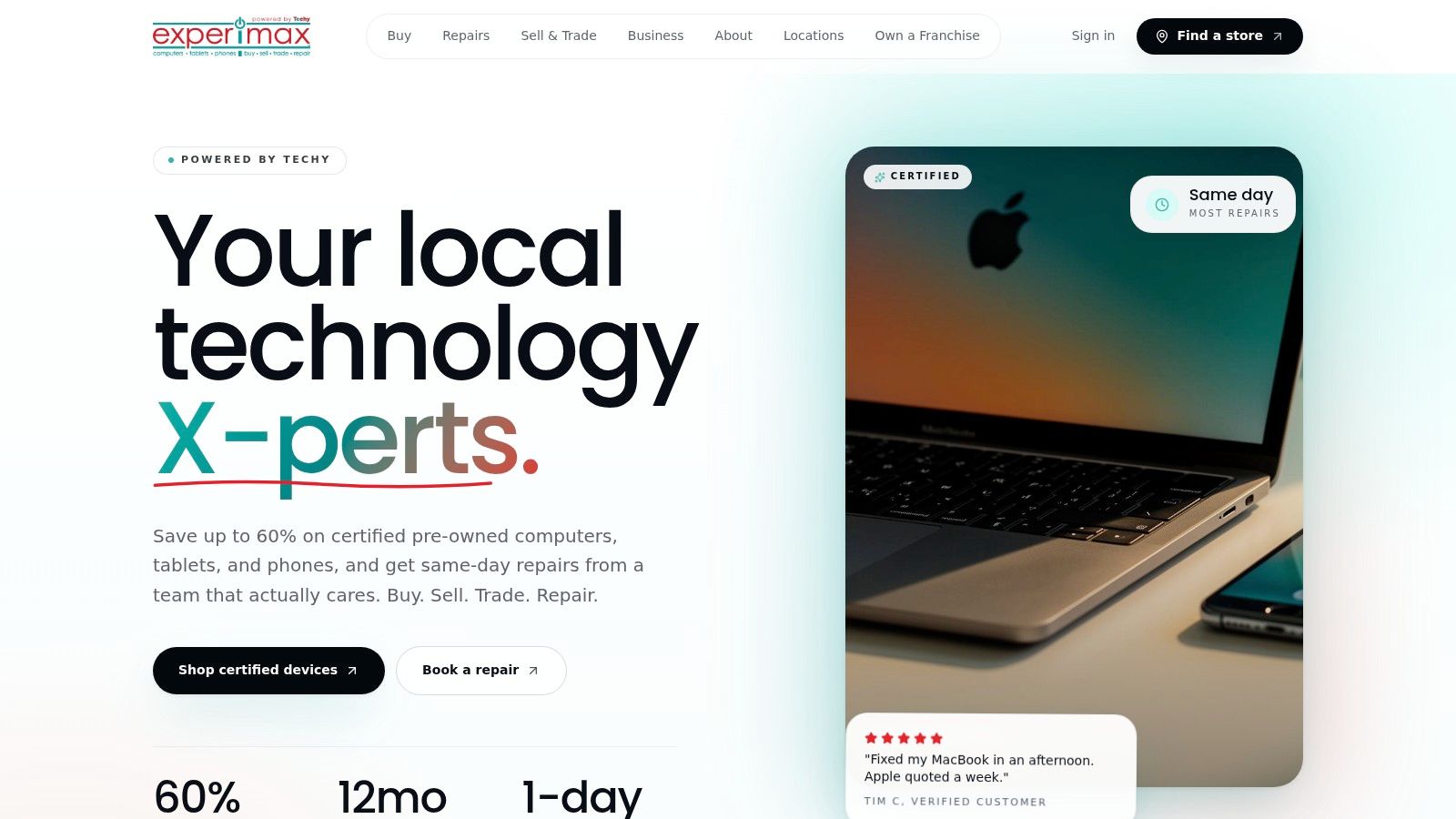
Experimax builds its mobile repair franchise position around an Apple-forward ecosystem that pairs repair with pre-owned device sales, trade-ins, and accessories. The retail-and-service structure can convert a customer who decides against repairing an older device into a pre-owned purchase instead of a lost visit. Accessory merchandising adds sales to repair visits without additional technician minutes.
Specialization cuts both ways. A focused Apple identity helps differentiation and can simplify parts and training depth, but it narrows the addressable repair pool in markets where Android share is strong. Used-device market cycles also affect the retail side, so resale margin shouldn't be modeled as stable service revenue.
The Price Threshold Test
Consumer willingness to repair has a specific ceiling that Experimax operators face at the counter every day. A 2025 survey across the United States and six European markets found roughly 60% of consumers considered repair acceptable only at a reasonable price, generally 15% to 20% of the cost of a new device, while 26% had repaired a phone during the previous year and more than 75% believed devices should be easier to fix, according to the NIM 2025 consumer repair and e-waste survey.
That threshold explains why trade-in capability matters. When a repair quote exceeds what a customer accepts relative to replacement cost, a pre-owned alternative keeps the transaction in store. Analysts should still verify current investment figures, supply arrangements, and unit economics in the latest FDD, and compare inventory intensity with other retail-heavy models such as those examined in a window washing franchise cost comparison for a sense of how service brands disclose working capital differently.
6. iFixandRepair
iFixandRepair pursues foot traffic first. The U.S. system places phone, tablet, and computer repair with accessory sales in malls and retail centers, aiming to capture walk-in and impulse business that destination repair shops must buy through search advertising. Accessory retail complements the repair ticket during the wait and after pickup.
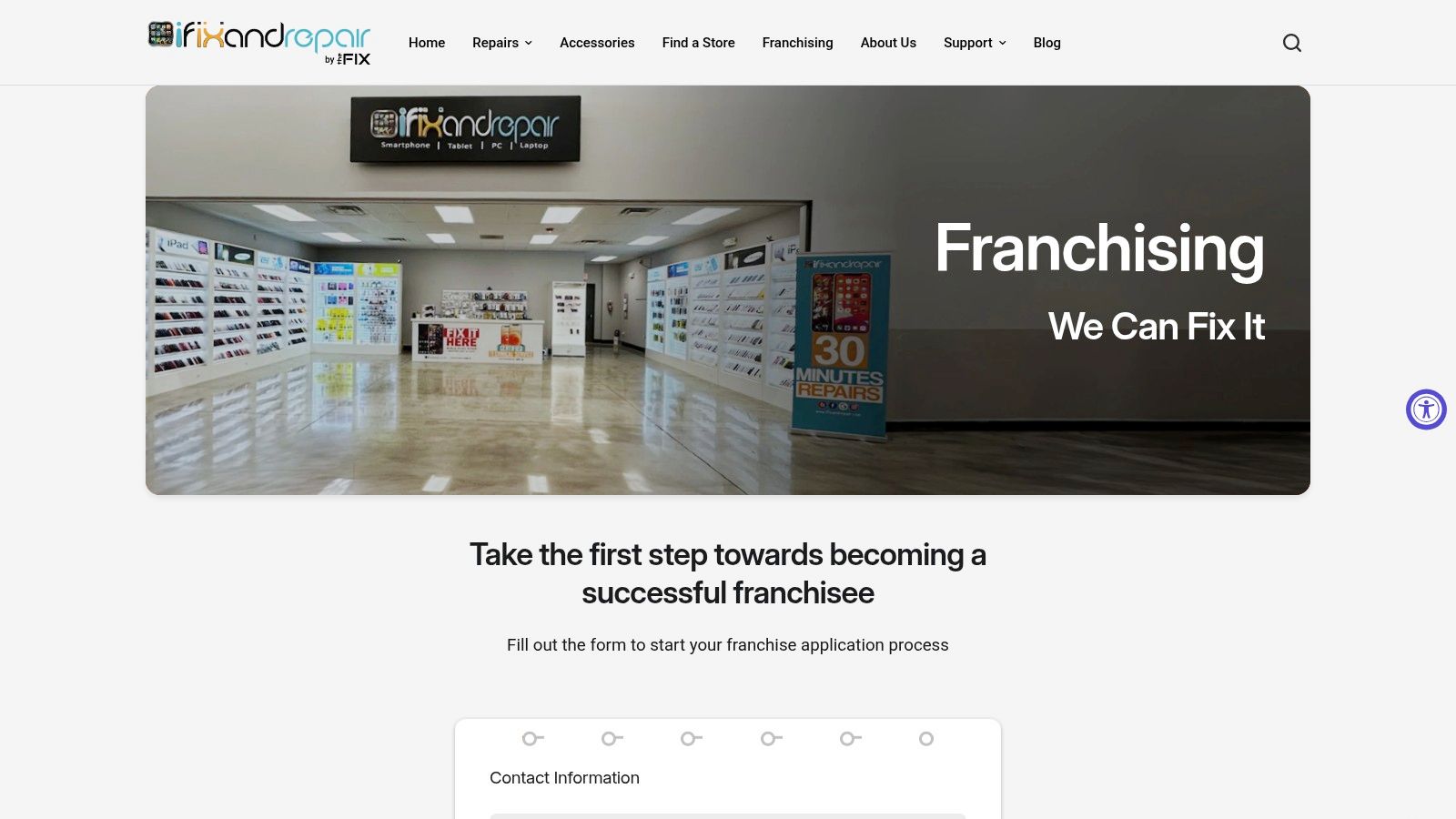
Third-party profiles report a lower starting investment range than some broader-format concepts, but that claim only matters after normalization. Kiosk versus inline-store economics, percentage rent, common-area charges, and required mall hours can erase a buildout advantage within the first lease term. Investment estimates therefore need checking against the latest FDD Item 7 and market-specific lease terms.
Repairability Limits the Menu
Regulatory and supply-chain readiness deserves more weight than mall placement in this model. Research reports smartphone replacement cycles reached approximately 3.5 years in 2025, while a 2025 comparative study found 18% of phones in the first five years of ownership required repair annually and about 30% were classified as unrepairable, according to Sector Data Insights coverage of smartphone repair market conditions.
That gap between theoretical repairability and field execution forces a strategic choice. A narrow, high-volume menu of screens and batteries protects speed and first-time-fix rates. A broader menu raises tickets but adds failure and warranty exposure. The brand markets multi-unit ownership and remote-ownership pathways after ramp-up, so validation should test whether absentee structures maintain repair quality when the owner isn't supervising diagnostics, parts grading, and data-privacy intake.
7. The FIX (The Fix Solutions)
The FIX combines phone and tablet repair with accessories, gadgets, and device sales in smaller mall or inline spaces. The hybrid design pairs fast-turn repair with retail purchases in high-footfall locations. Smaller footprints may allow faster openings than larger-format concepts, and centralized marketing supports a standardized service and accessory offering.
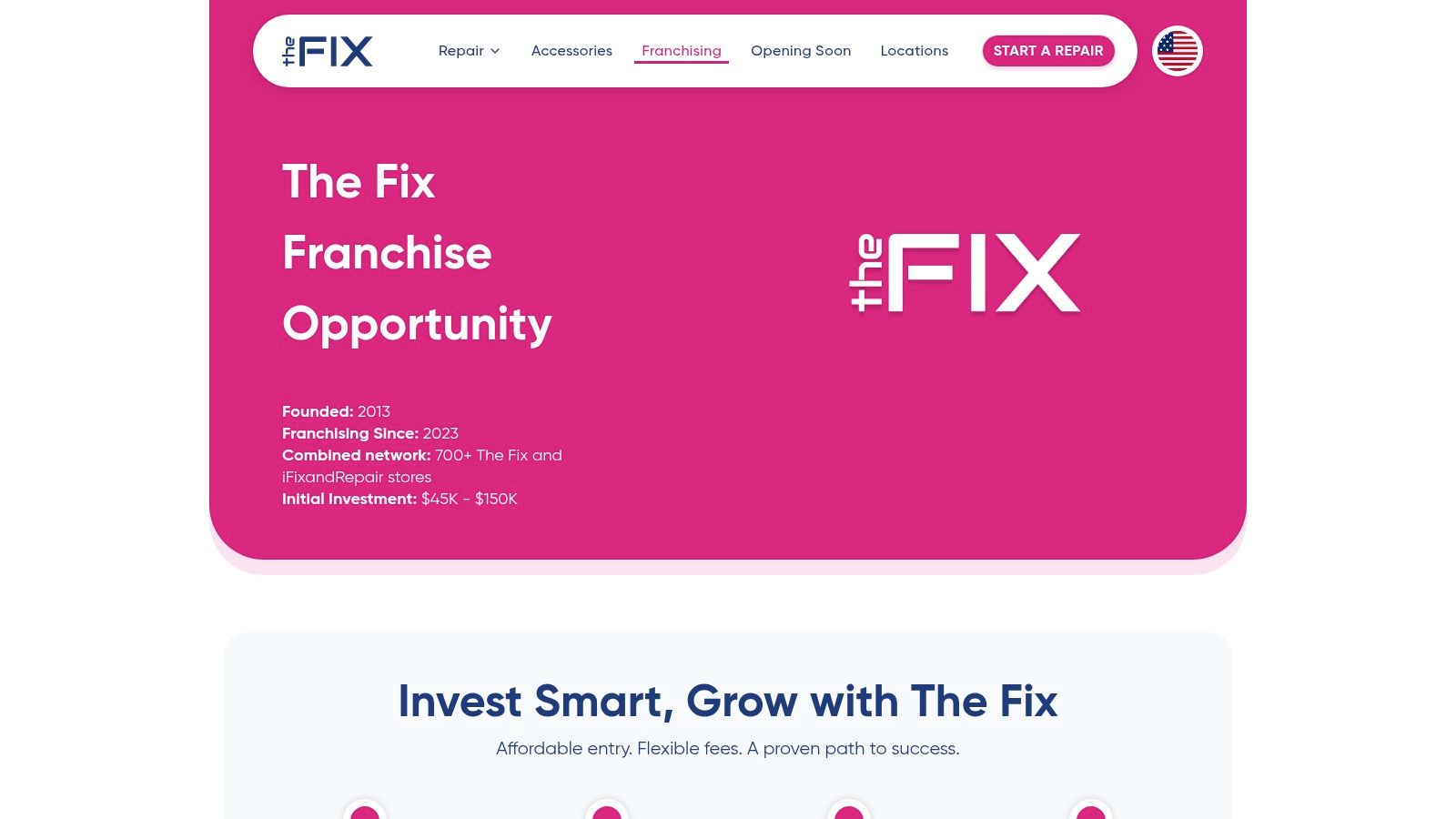
Speed of opening isn't the same as durability of the trade area. Mall lease costs, mandated operating hours, traffic seasonality, and anchor-tenant health can shift staffing economics quickly. Repair visits do create accessory add-on opportunities, yet gadget and device sales expose the operator to retail markdown risk that a service-only P&L doesn't carry.
Disclosure Discipline Before Any Ranking
Current franchise fees, investment requirements, and performance data for The FIX should be confirmed directly in the FDD, because federal rules control what can be claimed outside that document. The FTC states that if a franchisor represents sales, income, or profits, the claim must appear in Item 19 with a reasonable factual basis, and financial performance claims can't be made elsewhere in spoken or written franchise sales materials if they don't appear in Item 19, according to the FTC plain-language guide to buying a franchise and Item 19 rules.
- Item 7 normalization: Separate kiosk fixtures, initial accessory inventory, and mall deposits.
- Item 20 verification: Distinguish new openings from transfers or reacquisitions.
- Lease stress test: Model required mall hours against technician payroll at low-traffic periods.
That framework keeps a compact footprint from being mistaken for low operating risk.
Top 7 Mobile Repair Franchise Comparison
| Franchise | Operating Complexity | Resource Requirements | Expected Outcomes | Ideal Use Cases | Key Advantages |
|---|---|---|---|---|---|
| uBreakiFix by Asurion | Broad repair operations with established systems | Trained repair staff, parts access, franchise fees | Multiple repair categories; potential protection-plan referrals | Owners seeking a recognized, multi-device repair brand | National awareness, training, supply chain, and conversion options |
| CPR Cell Phone Repair | Repair services plus optional retail and device trading | Repair capability, accessories or device inventory, ongoing royalties | Revenue from repairs, accessories, and device sales | Owners seeking several revenue streams and multi-unit potential | Established brand, broad services, centralized marketing and training |
| Techy | Multi-service model spanning repair, retail, and smart-home work | Repair skills, retail products, smart-home service capability | Potential sales beyond device repairs | Owners seeking a wider electronics and smart-home offering | Broader service mix and flexible site-selection approach |
| Batteries Plus | Broad retail and service operations across multiple categories | Inventory across product lines and staff trained in varied services | Revenue from retail, repairs, key services, and commercial accounts | Owners seeking a diversified specialty retail business | Multiple product categories and potential B2B business |
| Experimax | Repair combined with pre-owned device retail and trade-ins | Repair capability, device and accessory inventory, working capital | Repair revenue plus sales and trade-in activity | Owners seeking an Apple-focused retail-and-service model | Specialized positioning and multiple sales channels |
| iFixandRepair | Repair and accessory sales in mall or retail-center settings | Repair staff, accessory inventory, suitable lease | Walk-in repair demand with accessory add-on opportunities | Owners targeting mall traffic or multi-unit ownership | Foot-traffic strategy and additional accessory sales |
| The FIX (The Fix Solutions) | Repair and retail in a compact mall-oriented format | Repair staff, accessories and gadgets, mall lease | Repair demand complemented by retail purchases | Owners seeking a smaller-footprint, high-traffic location | Compact format, mall visibility, and accessory upselling |
Rank Models by Economics Before Territory
A defensible ranking of these 7 systems starts with normalization, not brand familiarity. Development teams should rebuild Item 7 on a common basis that separates leasehold work, fixtures, initial parts and accessory inventory, pre-opening payroll, and working capital. Mall formats, retail-heavy models such as Batteries Plus and Experimax, and service-led stores such as uBreakiFix by Asurion do not carry the same inventory burden, so headline investment ranges mislead until those lines are aligned.
Recurring fee burden comes next. Royalty, brand fund, technology, and required vendor costs should be calculated as a percentage of realistic sales by repair category, since screens, batteries, charging ports, liquid damage, and board-level work carry different cycle times and warranty rates. Any Item 19 representation needs testing against comparable outlets by age, format, and market type, and claims heard on discovery calls that aren't in Item 19 should be discarded.
Item 20 then shows whether growth is real. The FTC describes Item 20 as providing charts on system growth and owner turnover, including outlet counts, transfers, projected openings, and contact information for current and former franchisees, in the FTC guide explaining Item 20 outlet and turnover tables. Former operator calls reveal whether vehicle costs, technician shortages, or territory economics are driving exits that net unit counts hide. Item 21 financial statements complete the screen by showing whether the franchisor can fund training, parts programs, and field support.
Score each brand across repair concentration, retail attachment, B2B potential, site costs, and multi-unit scalability. End-of-life handling belongs in that score too, since trade-in and pre-owned programs create device disposition obligations, a topic covered by Beyond Surplus on asset recovery. Franchise Fast Track supports that diligence with a registry of 7,000+ brands, a database of 68,000+ FDDs, a directory of 31,000+ multi-unit franchisees, and 3.5 million classified franchise industry contacts. Analysts and CDOs comparing automotive services, home services, QSR, fitness and wellness, and retail systems can start that work at franchisefasttrack.io/fdd-database or franchisefasttrack.io/franchises, where outbound to verified candidates can be measured against franchise portals, paid Meta and Google ads, and broker referrals on cost per qualified conversation.
Franchise Fast Track gives established franchisors a verified candidate pipeline and the FDD, brand, and multi-unit operator data needed to judge mobile repair franchise economics before committing territory. Development teams ready to replace unqualified portal and broker volume with screened, capital-verified conversations can review the platform at Franchise Fast Track.
Ready to see results like these for your franchise?
Stop wasting money on leads that never close. Start getting hundreds of replies from high-net-worth professionals daily.