40–50% Commissions: What Franchise Broker Fees Cost U.S. Buyers
Franchise brokers typically collect 40% to 50% of the initial franchise fee as commission, and the franchisor pays it, not the buyer, at least on paper. That cost still shapes what you end up paying because it's baked into the fee structure and the recommendations you get. Before you sign anything, get the broker's exact commission percentage in writing.
TL;DR:
- Franchise broker commissions typically range from 40% to 50% of the initial franchise fee, often pushing up the total upfront costs buyers face.
- Most broker agreements include a payment trigger once the franchise agreement is signed and initial fees are paid, sometimes with holdback clauses for early termination.
- Brokers prefer higher-fee brands and multi-unit deals because their commissions scale with the size and number of units, creating incentives that might not favor your best interest.
- Transparent, written disclosure of broker commission percentages and full cost breakdowns are rarely provided upfront, increasing the risk of overpaying or misaligned recommendations.
- Fee-based consultants offer an unbiased alternative by charging buyers directly, typically between $2,500 and $25,000, with no commission-driven incentives shaping their advice.
Table of Contents
- What Is a Franchise Broker Fee, Exactly?
- How Much Do Franchise Broker Fees Actually Cost?
- Who Really Pays, and Why 'Free' Advice Isn't Free
- What Fee-for-Service Franchise Consultants Charge Instead
- Why Multi-Unit Deals Change the Incentive Math
- Questions to Get in Writing Before You Sign Anything
- Pros and Cons of Working With a Franchise Broker
- How to Negotiate and Avoid Overpaying
- A Publisher's Take on Broker Transparency
- An Alternative Path for Franchisors Weighing Broker Costs
- Sources
What Is a Franchise Broker Fee, Exactly?
A franchise broker fee is the commission a franchisor pays to a broker (or the broker's network) for referring a buyer who signs a franchise agreement. It's not a fee you write a check for directly. It's baked into the deal on the franchisor's side, which is exactly why it deserves more scrutiny than most buyers give it.
Franchise brokers, sometimes called franchise consultants when they operate independently, work almost exclusively on referral agreements signed with franchisors, not buyers. The agreement typically specifies a commission percentage, the trigger event for payment (usually the signed franchise agreement and payment of the initial fee), and sometimes a holdback period tied to the franchisee opening and operating successfully.
Here's what that referral agreement usually spells out:
- Payment trigger: Commission is owed once the buyer signs the franchise agreement and pays the initial fee, not when they merely tour or express interest.
- First-year fees: This term often extends beyond the base initial franchise fee to include add-ons like training fees, technology or software fees, and sometimes a portion of the brand fund contribution collected in year one.
- Network versus individual split: If the broker belongs to a network or franchise brokerage firm, the network typically takes a cut (often 20% to 30%) before the individual broker sees their share.
- Holdback clauses: Some agreements delay part of the payment until the franchisee has been operating for 90 to 180 days, protecting the franchisor if the deal falls apart early.
The exact language varies by network, but the core mechanic is consistent: the franchisor signs a contract, the broker delivers a qualified lead, and money changes hands once that lead becomes a signed franchisee. Buyers never see this contract unless they ask for it, which is precisely the problem.
How Much Do Franchise Broker Fees Actually Cost?
The commission math is where the abstraction turns into real dollars. Franchise brokers commonly take home 40% to 50% of the initial franchise fee, and that percentage doesn't shrink much whether the brand is a modest home-services concept or a national retail name.
Run the numbers across a few common price points and the spread gets stark. A $15,000 initial fee, typical for lower-investment service brands, generates $6,000 to $7,500 in commission. A $40,000 fee, closer to the median for many retail and food concepts, produces $16,000 to $20,000. Push to $50,000, a common benchmark cited in industry reporting, and the broker's take lands at $20,000 to $25,000. At the high end, a $150,000 initial fee, seen in some larger-format or multi-brand systems, can throw off $60,000 to $75,000 in commission on a single placement.
| Initial Franchise Fee | Commission at 40% | Commission at 50% |
|---|---|---|
| $15,000 | $6,000 | $7,500 |
| $40,000 | $16,000 | $20,000 |
| $50,000 | $20,000 | $25,000 |
| $150,000 | $60,000 | $75,000 |
Some referral agreements widen the base further by folding in first-year royalty projections or a share of the brand fund contribution, which inflates the commission base beyond the sticker-price franchise fee. If you're trying to understand what actually makes up that base number, it helps to know what the franchise fee covers before you compare one brand's economics against another. A brand with a $50,000 fee and a broker-friendly commission structure can end up recommended over a $35,000 brand that's a better operational fit, purely because the math favors the broker.
Who Really Pays, and Why 'Free' Advice Isn't Free
Franchisors pay the commission, which is why brokers market their services as free to buyers. That framing is technically accurate and functionally misleading. The franchisor doesn't absorb that cost out of goodwill. It's a line item in the development budget, and development budgets get funded by franchisee fees, royalties, and the overall economics of growing the system. You don't write the check, but the incentive structure still bends toward what generates the biggest payout, not what fits you best.
That creates two predictable distortions:
- Higher-fee brands get more attention. A broker choosing between two comparable concepts has a financial reason to steer you toward the one with the larger initial fee, since the commission scales with it.
- Multi-unit deals get pushed harder. Signing you for three territories instead of one multiplies the commission on a single conversation, which changes what gets recommended and when.
- The brand roster is curated, not comprehensive. Most broker networks work with roughly 100 to 150 brands, a fraction of the roughly 4,000 franchise concepts operating in the U.S. You're choosing from a pre-filtered list, and that filter was built around who pays commission, not who fits you best.
Pro Tip: Ask every broker for the full list of brands in their network, then independently search for three or four concepts in your industry of interest that aren't on it. If none of those outside brands come up in conversation, you're seeing a curated shortlist, not the market.
What Fee-for-Service Franchise Consultants Charge Instead
A smaller but growing group of consultants skip the franchisor-paid commission model entirely and charge buyers directly. This removes the built-in incentive to steer you toward specific brands, since the consultant gets paid regardless of which concept you choose or whether you choose one at all.

Typical buyer-paid pricing falls into flat fees between $2,500 and $25,000, depending on the scope of work, or hourly billing in the $100 to $300 range for narrower engagements like FDD review or financial modeling. A franchise development consultant working on a flat-fee basis often provides deeper due diligence support than a commission-based broker has any financial reason to offer.
Here's the practical trade-off:
- You pay upfront, which stings compared to "free" broker advice, but the cost is transparent and fixed from the start.
- You get access to any brand, not a curated list of 100 to 150 concepts tied to a broker's referral agreements.
- The advice tends to be more candid about risks, since there's no commission riding on you signing anything specific.
This model tends to fit buyers evaluating a narrow set of brands they've already identified, or anyone who's been burned by vague answers from a commission-based broker and wants a second, financially neutral opinion.
Why Multi-Unit Deals Change the Incentive Math
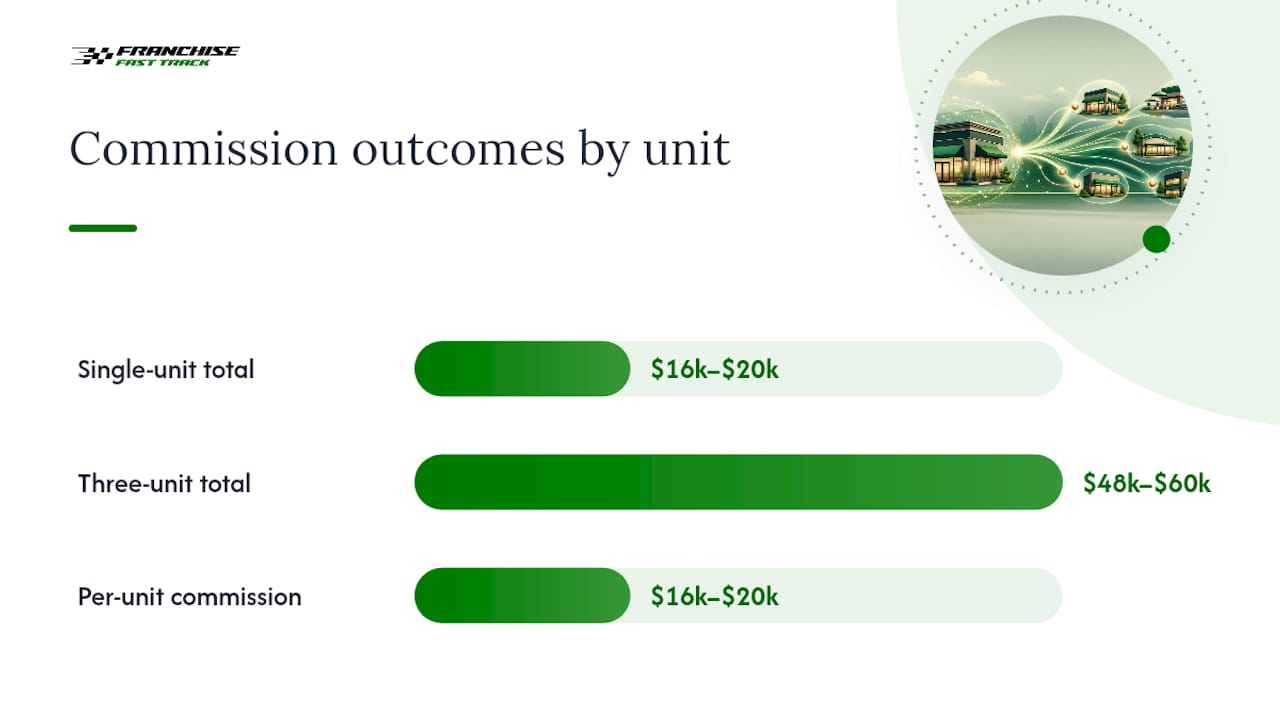
Commissions stack per unit in most multi-unit and area development agreements, which means a broker who talks you into three territories instead of one can see roughly triple the payout from a single conversation. On a $40,000 initial fee, a single-unit deal might generate $16,000 to $20,000 in commission. The same buyer signing for three units can push that figure toward $48,000 to $60,000, depending on how the referral agreement treats each additional unit.
That math creates real pressure to skip the pilot stage. A cautious buyer wants to open one location, prove the model works for them personally, then scale. A broker chasing a bigger commission has reason to push straight into a three-unit or five-unit commitment before you've run a single store.
Protect yourself with a few basic guardrails:
- Insist on a single-unit agreement first, with a documented option (not obligation) to expand later.
- Ask directly whether the broker's commission increases with additional units, and get the answer in writing.
- Talk to at least two current multi-unit operators in the system before committing beyond one location.
Questions to Get in Writing Before You Sign Anything
Verbal reassurances from a broker mean nothing once the ink is dry. Everything that matters should be documented before you move forward with any brand they've recommended.
- What percentage of the initial franchise fee do you receive, and does that number change by brand?
- Does your commission include first-year royalties, brand fund contributions, or other fees beyond the base franchise fee?
- Do you receive a bonus, accelerator, or higher rate for multi-unit or area development deals?
- How many brands are in your network, and can I see the full list?
- Can you provide a sample of the referral agreement you have with this franchisor?
Watch for these red flags while you're asking:
- Refusal to name an exact commission percentage, or vague answers like "it varies."
- Pressure to sign a franchise agreement within days, especially before you've spoken to existing franchisees.
- A network roster that's suspiciously small or heavily weighted toward one or two brands.
- Strong pushes toward multi-unit commitments before you've discussed a single-unit pilot.
Pro Tip: Call the franchisor's own development team directly and ask them to confirm the broker's commission structure. Franchisors are required to operate within FTC Franchise Rule disclosure standards, and most development staff will confirm basic commission terms if asked plainly, since discrepancies between what a broker tells you and what the franchisor confirms are themselves a warning sign.
Pros and Cons of Working With a Franchise Broker
Brokers earn their keep in a few specific ways: they speed up candidate matching, they explain industry jargon and FDD structure to first-time buyers, and they often manage logistics like scheduling a Discovery Day visit. For someone brand-new to franchising, that guidance has real value.
The downsides sit on the other side of the same ledger:
- The commission incentive can quietly steer recommendations toward higher-fee or multi-unit deals.
- You're working from a curated roster of 100 to 150 brands, not the full market.
- There's pressure, sometimes subtle, sometimes not, to move faster than your own diligence timeline.
A simple decision rule: use a broker if you're early in your search and need education and structure, go direct to franchisors if you already know which brand you want, and pay for a fee-for-service consultant if you want unbiased analysis across a specific shortlist. Understanding the broader risks of franchise investment matters regardless of which path you choose.
How to Negotiate and Avoid Overpaying
Commission structures aren't fixed in stone, and buyers who push back sometimes get better terms. Ask the franchisor directly whether any portion of the broker commission can translate into a fee credit, reduced initial payment, or improved pilot terms for you. Franchisors have already budgeted that commission dollar amount; some are willing to shift a small piece of it if it closes the deal.
Before comparing brands, calculate the full first-year cash outflow for each one: initial franchise fee, projected royalties, brand fund contribution, and estimated working capital. Then look at the broker's commission as a percentage of that full number, not just the base fee.
- Request written fee-credit or pilot-term options before signing.
- Build a first-year total-cost comparison across every brand you're seriously considering.
- Set a walk-away number in advance and document every verbal promise in an email follow-up.
| Action | Why It Matters |
|---|---|
| Get commission percentage in writing | Confirms the real financial incentive behind the recommendation |
| Calculate full first-year cost | Shows the true impact of commission relative to total investment |
| Talk to current franchisees directly | Verifies claims independently of broker or franchisor messaging |
| Insist on single-unit pilot first | Limits exposure before multi-unit commission incentives apply |
If a broker won't put numbers in writing or pressures you to skip these steps, that's your answer. Walk.
A Publisher's Take on Broker Transparency
The commission structure behind franchise brokers isn't a scandal. It's just poorly disclosed, and that's the part worth fixing. Buyers deserve a written commission number before they trust a recommendation, full stop. Working with franchisors and vetting buyer intent for a living has made one pattern obvious: the deals that go sideways are almost always the ones where nobody wrote anything down early. Ask for the number in writing before you ask anything else.
— Cody
An Alternative Path for Franchisors Weighing Broker Costs
If you're a franchisor reading this and doing the math on what 40% to 50% commissions cost per placement, especially across multi-unit deals, there's a different way to fill your pipeline. Franchise Fast Track connects franchisors directly with pre-qualified, high-income candidates earning $150,000 to $500,000 annually, through verified appointment setting rather than commission-based referrals.

It's a different cost structure entirely: appointment volume you control, rather than a percentage tied to every fee your brand collects. If commission math on your growth targets is starting to look uncomfortable, take a look at Franchise Fast Track's lead generation service and see how the numbers compare for your next development cycle.
Sources
Franchise buyers and franchisors alike can verify the claims in this article directly. The FTC's Franchise Rule sets the baseline disclosure standards every franchisor must follow, and the agency's $17 million settlement with Xponential Fitness shows that enforcement around disclosure practices is active, not theoretical.
For deeper reading on commission mechanics and buyer-paid alternatives, Franchise Business Review's breakdown of broker pros and cons offers a balanced industry perspective, while independent analyses of broker commission structures and consultant fee models fill in the pricing specifics.
On the Franchise Fast Track blog, Franchise Brokers: How They Work, What They Cost, and the Alternative expands on the compensation models covered here, and What Is the Franchise Fee? breaks down exactly what that base number includes before commission ever enters the picture.
- Franchise Broker Commission: Who Really Pays (2026)
- The Pros and Cons of Working With a Franchise Broker
- Franchise Consultant Costs: What to Expect and How They Get Paid
Recommended
Ready to see results like these for your franchise?
Stop wasting money on leads that never close. Start getting hundreds of replies from high-net-worth professionals daily.