7 Digital Marketing Franchise Partners for 2026
Roughly 3,000 active US franchise systems compete for a limited pool of verified operators, while about 800,000 franchised establishments generate close to $800 billion in annual output. The deciding comparison for a digital marketing franchise partner isn't impressions or raw lead volume. It's Item 7 capital fit, Item 19 claims discipline, Item 20 multi-unit operator movement, and cost per screened discovery call.
That distinction matters at scale. The International Franchise Association projected 851,000 franchise establishments in 2025, growth of more than 20,000 units, or 2.5%, and $936.4 billion in output. For systems with 50+ locations, recruitment spending has to map to territory economics, not channel activity.
The comparison below covers positioning, best-fit system size, qualification standard, pricing transparency, and pipeline ownership across seven providers. It also separates agency-reported metrics from verified economics, a discipline that applies equally to paid media and franchise group client acquisition.
Table of Contents
- 1. Franchise Performance Group (FPG)
- 2. Lead PPC
- 3. iluma Agency
- 4. Sparktank Franchise Marketing
- 5. StructureM
- 6. ClickTecs
- 7. CyberMark
- Top 7 Digital Marketing Franchise Providers Compared
- Choose by Qualified Conversations, Not Lead Count
1. Franchise Performance Group (FPG)
Franchise Performance Group positions franchise development marketing as a combined generation and conversion engagement. The firm says it's worked with more than 150 brands since 2002, a company-reported figure that should be weighted against recent, category-relevant references in QSR, home services, or fitness and wellness.
Where FPG Fits in the Funnel
FPG covers franchise lead generation and digital marketing, outsourced franchise sales and recruitment support, development website design, and sales-process consulting. That breadth suits a CDO whose bottleneck sits after the inquiry, in speed to contact, application completion, or discovery-call show rates, rather than in traffic alone.
The trade-off is scope. A full-service, consultant-led model can exceed what a brand with a functioning internal development team needs, particularly if the gap is only paid media execution. Pricing is proposal-based with no public rate card, so scope, fees, and qualification definitions require a formal proposal before cost per qualified conversation can be calculated.
Reporting discipline deserves the same scrutiny. CDOs should ask how FPG separates agency-reported activity from CRM-validated outcomes and whether reporting extends to a downstream SEO reporting tool view by source and territory.
Analyst note: A partner operating both marketing and sales owns more of the funnel, which makes attribution cleaner only if stage definitions are fixed before launch.
2. Lead PPC
Paid acquisition is the entire proposition at Lead PPC. As a franchise lead generation agency focused on Google Ads, Meta, and LinkedIn, it serves both franchise development campaigns and local marketing for individual locations.
Lead PPC publishes an agency-reported average cost per lead of about $32 alongside budget and cost-per-sale guidance. That's more transparency than most providers in this set offer, but the figure isn't a guarantee and shouldn't be underwritten against a specific brand or market without a test. A free PPC proposal lowers the cost of initial evaluation, while standard management fees aren't publicly listed.
The Benchmark Problem With Paid Search
Search captures active demand at scale. Search advertising reached $102.9 billion in 2024, equal to 39.8% of US digital ad revenue and up 15.9% year over year. Scale doesn't resolve qualification. A low cost per lead in automotive services or senior care means little if candidates can't meet Item 7 initial investment ranges.
The narrow focus is both strength and limit. Brands needing brand strategy, sales-process redesign, or candidate verification beyond the click will need a second provider or internal capacity. For a development team that already screens well, the paid-only scope can be an efficient fit.
3. iluma Agency
iluma Agency operates as a full-service franchise marketing company with a dedicated recruitment and development offering. Services span candidate targeting, digital advertising, recruitment collateral, development websites, CRM, and email automation, plus local marketing for franchise locations.
That integration suits systems that want recruitment coordinated with consumer marketing, a common requirement in health and beauty, retail, and education where local unit performance shapes candidate perception. Creative production sits inside the same engagement, which reduces vendor handoffs between campaign and collateral.
What Requires Verification
- Qualification depth: Public materials describe targeting, not financial verification standards against Item 7 thresholds
- Case evidence: Prospective clients should request franchise development case studies with downstream conversion data
- Pricing: Available by proposal only, with no public benchmarks for comparison
Breadth also complicates head-to-head comparison. An integrated retainer can't be priced against a paid-lead specialist without isolating which line items drive qualified discovery calls. CDOs should require source-level reporting that separates recruitment spend from local consumer spend by market.
4. Sparktank Franchise Marketing
Sparktank Franchise Marketing concentrates on franchise sales marketing and applicant generation, serving emerging and national brands through custom campaigns, web and creative services, and educational content on franchise sales and LinkedIn prospecting. For development teams evaluating franchise development partners, the recruitment-first positioning is the relevant signal.

The firm's site carries an A&W testimonial reporting doubled applicant volume. That's a client-published testimonial hosted by the provider, not independent verification, and applicant volume isn't a qualified-call metric. Custom campaign design may suit brands with distinct candidate profiles, including multi-unit operators in QSR or home services, but the testimonial can't substitute for stage-by-stage funnel data.
Due Diligence Questions for Sparktank
Public materials don't provide standard pricing or detailed lead qualification methods. Pricing is proposal-based, and service coverage and location should be confirmed for the proposed engagement. Brands should request recent results in their own vertical and define, in writing, what counts as a qualified lead before signing.
Volume claims without capital verification tell a CDO how busy the sales team will be, not how productive it will be.
5. StructureM
StructureM is the consumer-marketing entry in this set. The firm builds scalable programs across corporate and franchisee levels, covering SEO, paid advertising, websites, email, social media, reputation management, reporting, and CRM or marketing automation, including HubSpot implementation.
Turnkey support for franchise owners addresses a real governance problem for 50+ unit systems, where corporate messaging and local execution often diverge. Direct owner support can improve consistency across real estate brokerages, fitness and wellness, and home services locations without expanding internal headcount.
A Different Job Than Recruitment
Local demand infrastructure carries measurable weight. Google is reported as the most trusted platform for local-business research at 66%, and 76% of mobile local-search users visit a store within 24 hours. StructureM's model maps to that behavior, but consumer traffic doesn't equal franchisee recruitment.
Case results and testimonials are provider-hosted and should be checked against comparable systems. Pricing is proposal-based. A CDO hiring StructureM for network marketing still needs a separate answer for candidate sourcing, Item 19 compliant messaging, and discovery-call conversion.
6. ClickTecs
ClickTecs specializes in franchise and multi-location digital marketing for both franchisors and individual franchisees. The service list covers websites, local and national SEO, PPC across Google, Meta, and LinkedIn, social media, local listings, content, and managed WordPress hosting.
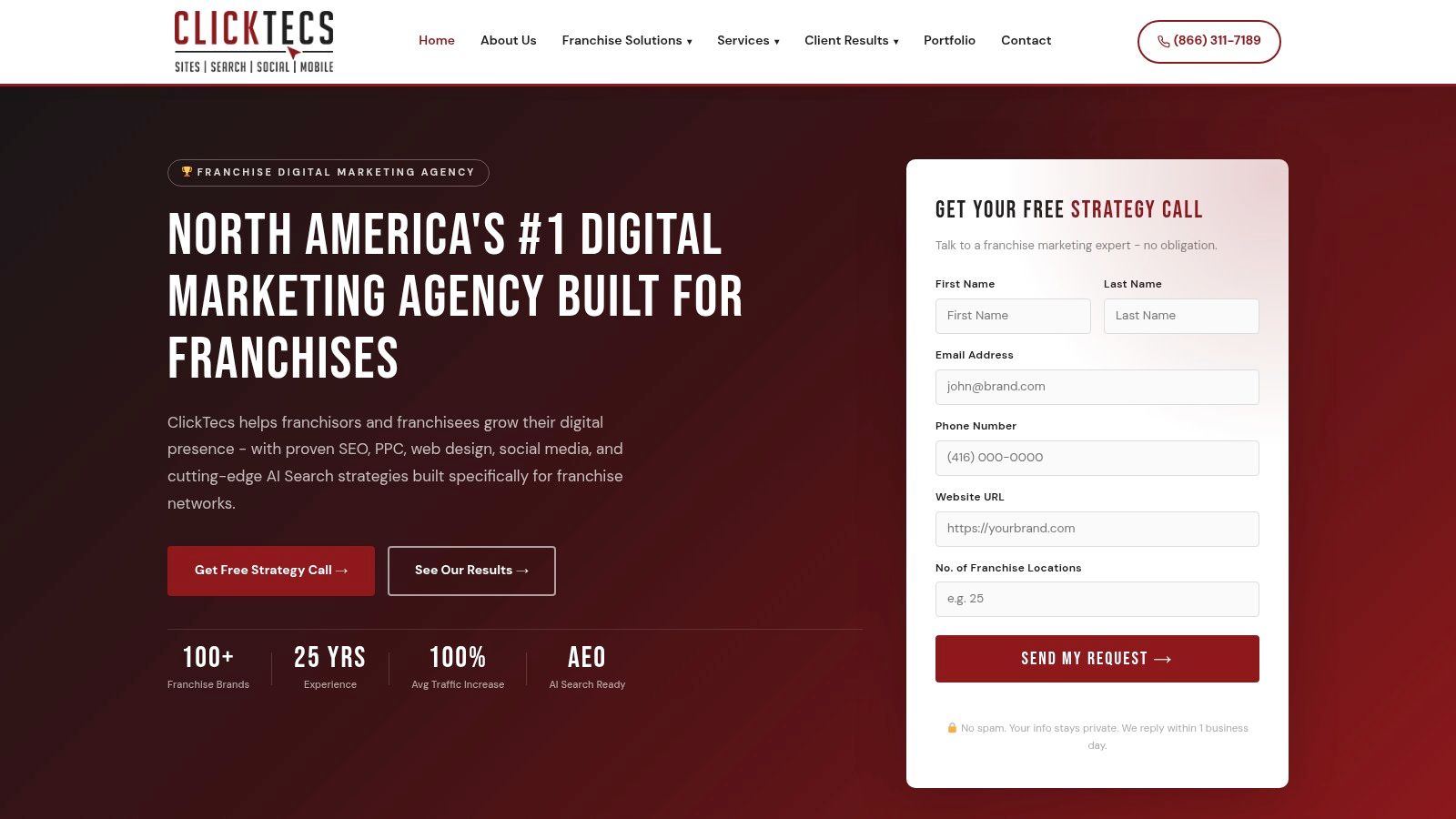
ClickTecs also lists AEO and GEO services aimed at visibility in AI-driven search experiences. That addition reflects shifting discovery behavior, though CDOs should ask how AI-search visibility is measured and reported separately from conventional search rankings.
Governance Questions on AI-Driven Targeting
AI adoption is outpacing governance frameworks. Survey findings indicate 60% of franchise brands use AI to improve customer experience and 75% plan additional investment. Coverage of those programs says little about validating AI-generated claims, documenting consent, or defining when a human specialist takes over.
Experience and client-retention claims from ClickTecs are company-reported. Pricing is available by consultation and proposal. Local-search strength supports existing locations, but it doesn't on its own cover recruitment strategy or sales qualification for new territories.
7. CyberMark
CyberMark positions its work explicitly around franchise development advertising, using full-funnel digital campaigns to connect opportunity messaging with candidate acquisition and nationwide market expansion. That clarity distinguishes it from consumer-traffic providers, and it frames the evaluation for teams comparing franchise recruitment with Franchise Fast Track against agency-led paid campaigns.
The public record is thinner than peers in this set. Pricing isn't listed, and lead qualification standards aren't published. Service details are less extensive, which shifts more diligence burden onto the franchisor during the proposal stage.
Claims Discipline as a Screening Criterion
Opportunity messaging carries regulatory constraints competitors rarely foreground. A franchisor may make financial performance representations only with a reasonable basis and written substantiation, and those representations must appear in Item 19 of the FDD. Any partner writing recruitment copy should demonstrate how campaigns stay inside that boundary.
Brands should clarify candidate verification, lead ownership, CRM integration, and conversion reporting before commitment. Without those terms, full-funnel language can't be translated into cost per qualified conversation.
Top 7 Digital Marketing Franchise Providers Compared
| Provider | Service Scope and Resources | Implementation Complexity | Expected Outcomes | Ideal Use Cases | Key Advantages |
|---|---|---|---|---|---|
| Franchise Performance Group (FPG) | Lead generation, digital marketing, sales consulting, recruitment support, and web development; proposal-based pricing | High; may involve marketing, sales-process, and team coordination | Franchisee leads plus support to improve recruitment and conversion | Brands needing help across both lead generation and franchise sales | Connects marketing with the sales process and offers outsourced development support |
| Lead PPC | Paid campaigns on Google, Meta, and LinkedIn; proposal available; fees not public | Low to moderate; focused on paid media and campaign setup | Paid franchise-development leads and local marketing traffic; published averages are not guarantees | Brands prioritizing paid acquisition and campaign benchmarks | Franchise-focused PPC specialist with public budget guidance |
| iluma Agency | Recruitment campaigns, advertising, creative, websites, CRM, automation, and local marketing; proposal-based pricing | High; broad services may require coordination across channels | Candidate recruitment support and coordinated local marketing | Brands seeking an integrated agency for recruitment and location marketing | Combines media, recruitment materials, CRM, and local marketing |
| Sparktank Franchise Marketing | Candidate campaigns, lead generation, websites, and creative services; proposal-based pricing | Moderate; custom campaigns require alignment on candidate profiles and lead criteria | Franchise applicant generation and supporting campaign assets | Emerging or national brands seeking tailored franchise recruitment campaigns | Recruitment-focused campaigns with creative and web support |
| StructureM | Corporate and location marketing, SEO, ads, websites, CRM, automation, and reporting; proposal-based pricing | High; network-wide rollout may require corporate and franchisee coordination | More consistent consumer marketing across franchise locations | Franchise systems seeking scalable local marketing and owner support | Combines marketing execution with CRM, automation, and reporting |
| ClickTecs | Multi-location SEO, PPC, websites, hosting, social, listings, content, and AEO/GEO; consultation-based pricing | Moderate to high; scope depends on the number of locations and services | Improved digital visibility and local marketing across locations | Franchisors and franchisees seeking multi-location digital marketing | Covers websites, search, paid ads, and local listings |
| CyberMark | Franchise-development advertising and full-funnel digital lead generation; pricing not public | Moderate; clarify qualification, CRM, and reporting requirements | Prospective franchisee leads and market-expansion support | Brands promoting franchise opportunities in new markets | Focuses campaigns on franchise recruitment and opportunity messaging |
Choose by Qualified Conversations, Not Lead Count
The decision rule for CDOs and VPs of Franchise Development is mechanical. Score every partner on verification depth, exclusivity by category and market, Item 7 capital alignment, Item 19 claims discipline, Item 20 multi-unit targeting, and cost per screened discovery call. Providers that can't report past the form fill fail that test regardless of lead price.
Lead volume is a weak success signal. Industry data shows 67% of surveyed franchise-marketing categories identified digital advertising as the leading driver of traffic and leads, while 80% of brands reported leads had increased or remained stable. Neither figure confirms financeable demand with adequate liquid capital or territory fit.
Benchmarks That Separate Activity From Economics
Outbound channels illustrate the metering standard. Available 2025 B2B benchmarks report roughly 27.7% open rates, 5.1% reply rates, 1% meeting-booked rates, and 0.22% overall conversion for cold email. Reply quality and CRM-validated outcomes are more reliable than opens, and the same logic applies to paid social and portal leads.
Compliance gates belong in the same scorecard. The FTC requires delivery of the FDD at least 14 calendar days before signing or payment, and claims outside Item 19 can't be made through other channels. Item 21 requires the franchisor's three most recent audited annual financial statements, a separate diligence lens from outlet-level performance.
Portals, Meta and Google ads, and broker referrals should all be benchmarked against verified outbound pipeline on signed-unit economics. Franchise Fast Track is one option built on that model, supported by a registry of 7,000+ franchise brands, a database of 68,000+ FDDs, a directory of 31,000+ multi-unit franchisees, and 3.5 million classified franchise industry contacts. Development teams can use franchisefasttrack.io/fdd-database for Item-level research and franchisefasttrack.io/franchisees for multi-unit operator mapping before committing spend.
Franchise Fast Track builds verified outbound pipeline for established franchisors, screening candidates against Item 7 capital requirements before booking discovery calls directly onto development team calendars. Its FDD database and multi-unit operator directory give CDOs the Item-level evidence needed to compare any digital marketing franchise partner on qualified conversations rather than lead count. Visit Franchise Fast Track to review the data infrastructure behind that model.
Ready to see results like these for your franchise?
Stop wasting money on leads that never close. Start getting hundreds of replies from high-net-worth professionals daily.